Episode Transcript
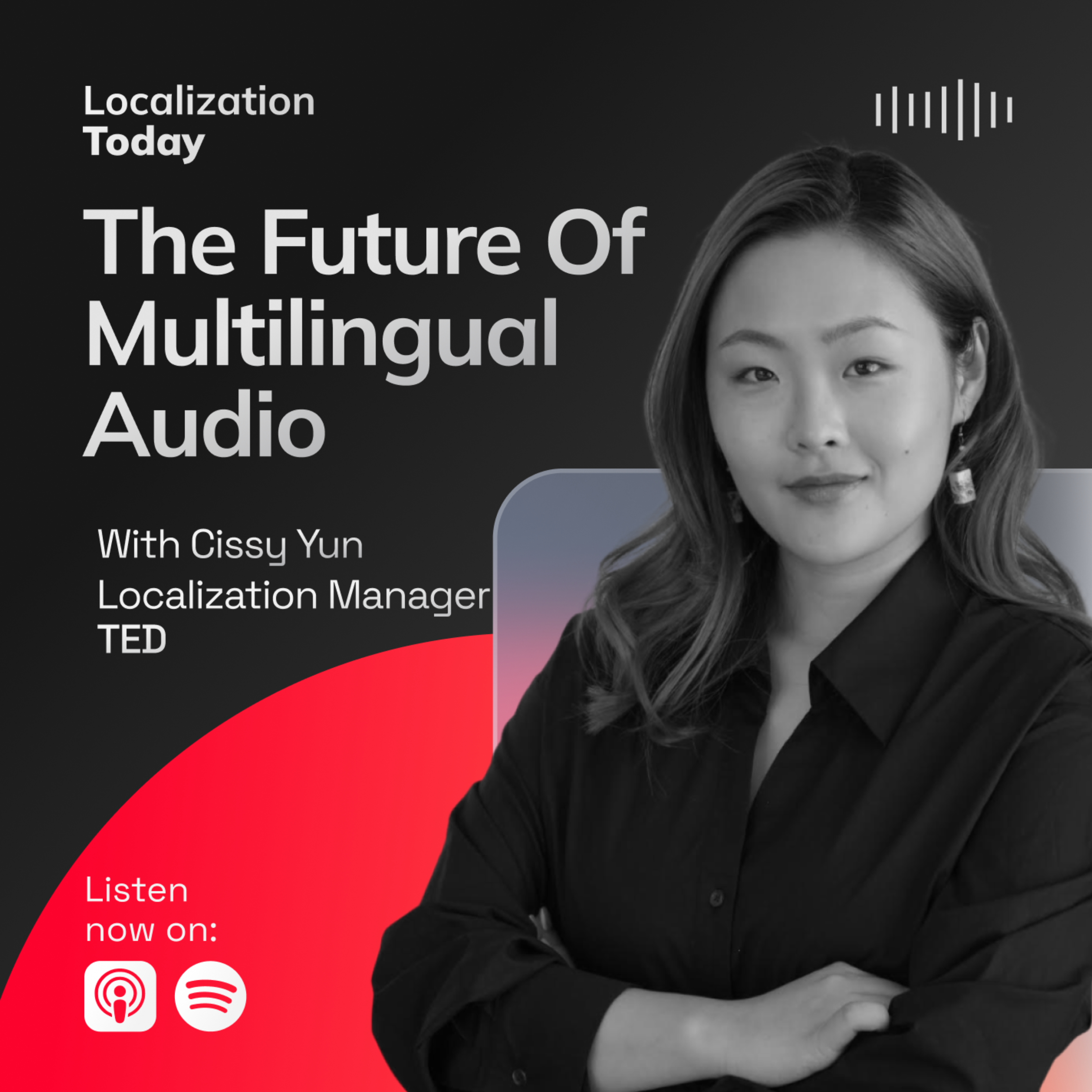
[00:00:02] Speaker A: Hello and welcome to Localization Today, the podcast where we explore how language, technology and community converge to unlock ideas for everyone everywhere. I'm Eddie Arrieta, CEO here at Multilingual Media, and today we're going to talk about aiw, which has become one of the most talked about developments in multilingual content. We hear about increasingly natural synthetic voices, improved LEAP synchronization, and the possibility of making video content accessible in dozens of languages at a fraction of the traditional cost. Generating a synthetic voice is only one part of the process. Organizations also need to think about speaker consent, linguistic quality, editorial standards, production workflows, and the people responsible for making sure the final result feels authentic. Our guest today has been working through through these challenges firsthand. Cece Yun is localization Manager at ted, where she has helped build TED Fluent, the organization's AI dubbing initiative designed to make TED talks accessible to more audiences through multilingual audio. Cici, welcome to Localization Today. How are you doing today?
[00:01:18] Speaker B: Thank you for having me, Eddie.
[00:01:19] Speaker A: And of course we're here to talk about AI dubbing and also about lip sync, which we found, I found very interesting as a concept and I didn't think about it until the interview we had last time with TED Antanyaya. So I'd love to hear what's been happening there, what the evolution looks like and hopefully we can also share some clips after we post edit this. But TED CC is bringing AI dubbing to content that reaches audiences around the world. What motivated TED to explore AI dubbing? What were the biggest challenges you encounter when turning the idea into an actual product workflow?
[00:01:59] Speaker B: Yeah, I feel like dubbing has always been on our mind. Big ten has been operating through the translator model. We have a global community of translators that help us translate TED talks in over 100 language. We've been doing that for the last 15 plus years and through working with the community and also just knowing that our global audience, we know like different audience, appreciate content or consume content differently. I personally like watching films with subtitles, but my friend does not. So like we have, we've been hearing from our translators and also just audience like they want dubbing but they want high quality dubbing. So like dubbing has been always on my mind, but we kind of run into this challenge of the human dubbing is super expensive and sometimes the lip sync, there's no lip sync going on and it just look awkward. And then we also tested before AI dubbing, we tested like different type of machine voices too and none of them just sounds quite there. Yet for us to really invest in.
So like the time kind of goes too late where we're approached by Panjaya and we got to see what their technology can do.
I remember I saw a demo in Mandarin and the language I spoke, I speak and then I remember just being blown away.
And this is the first time when I like watched a dubbed content where I feel like I'm not watching a dubbing because everything just so seamlessly put together. You're just thinking, oh, I'm just that person just speak Mandarin randomly like it, it, it's just recorded that way. So I think that's the moment where we just like okay, this is, there's something to explore here. Let's, let's continue working on this to see if this could kind of solution to this dubbing dream that we've been having for a long time.
So kind of we, that's like at the end of 2023 and we going to work, we trying to bring the, this excitement for oh my God, we can do dubbing in so many language to. So all of our TED talks into something kind of like oh, but now we have to actually build something. We have to actually have a product, we have to actually have some talk stubbed. So that challenge is like how do we do that without compromising the quality that we're chasing. And you know, you said that we are a AI dubbing program. We are not just trying to dub a few talks like one off thing and be like oh this is done. Put on the Internet like we're not going to touch it anymore. We want to build like a sustainable thing that's long term that we can engage our translator community in. So that's exactly kind of what we did. But we also know that we've been operating as a subtitling kind of workflow and community for years. We, there's talents there, there's like human talents, there are language resource there, there's. But we don't want to also let that workflow or system constrict us into building something new. So it's finding that balance of you're reimagining a new thing but also you're wanting to tap into the existing resources that we have.
So you know, that kind of become the solution where we build the AI dubbing program around our linguists, around the translator community that we've been working on working with for the past 15 years and working with the existing subtitling transcripts. So these subtitles have been translated by our translator. They're human Review, they're super accurate. Our translator know the TED talk, they know the speakers, they know the style. So we're able to kind of use those resources to first set of talks that we put on it. Internet.
[00:05:50] Speaker A: I love, I love this conversation because it's a full circle moment for us and I think for our audience as well. We've recently received some, you know, feedback from, from part of the audience that says, hey, maybe from the multilingual side. You've, you've all been focusing too much on what AI can do, but you're really not talking to us about the translators. You're not talking even to us, the translators about what it is the translators that are doing that is very different, perhaps from a full quality estimation job where your only job is to say this translation is good or it's not good. So I love how you put it when you say we work with our translators to do these things, and we work with our translators to figure all these other things out.
I'm wondering, as you are bringing AI dubbing into existence, to reaching other audiences, how do you work with your leaders? How is that work done? To go from no lip sync, how does that work?
[00:06:55] Speaker B: So, very good question. So as I mentioned before, we kind of build a program with the linguists, our translator at the center, because we know they're passionate, they know our content, and I think that's also the key.
We don't treat them as like just simply QA or dubbing. And this is good enough. They actually go into the transcript, they go into the translation, and they make edits. They make a lot of edits sometimes to help make the dubbing sound more accurate. I kind of think of them as like audio directors, and they're kind of working with this AI dubbing little actors who are really new to their jobs. And you are trying to use your creative ways to, you know, observe how the actor's doing and then be like, you know what? I'm going to put some change this part of the script to make it sound better. So it is a lot of human work. And I mean, we know, like audio visual translation is a new thing. It requires a lot of human judgment and creativity. And especially I see that in the beginning part of our production, where the technology is still growing, a lot rely on the tricks that human have to make something work. Like we sometimes I remember experimenting with spelling out like a word in English for it to sound like Chinese or Mandarin. So, like, these are the things that machine cannot do, right? It's human judgment and creativity. Come in and to make something from like just something like a machine output versus like something that you will watch like, oh, this sounds natural and authentic. So that's what our translators is really good at. But I will say that it takes time to build that skills. Right. You're, you're. They're. They've been working on, working with text for years and now they're kind of evaluating sound.
So that's a new skill. We kind of was figuring out how to guide them through this process because to be honest, we don't speak those language. We don't speak all the language. We support us. So like we, we really need to figure out some universal things we can tell our translator to follow when they're editing the AI dubbing, but also give them like creative control over the other stuff they can do to make it better. Yeah,
[00:09:10] Speaker A: this is super interesting because it totally talks about the future of work. And you know, I'm all in into that conversation. I know how difficult, difficult it can be to think about once changing the way in which you do things. And nobody should be able to go through that or has to go through that. But for some of us, we've had to do that in different locations.
And now Judy's trying, of course, now a shift from translating perhaps very traditionally, which is probably not the first time that this happens, to editing a performance, to basically watching someone translate himself or herself into your language. And you're listening and you're saying, actually we don't say in that way. This is how you should be able to say it.
How have you approached the training conversation with the linguists also with the translators, the evolution? Because I assume there is some resistance and not everyone might have want to do that either.
[00:10:06] Speaker B: Yeah, I think it's all about switching your brain around from just editing subtitles to editing a dubbing script. Like essentially you are editing a script that actor can read. Right. But working with AI just put a lot of uncertainty into that actor.
So I feel like we have a few challenges where it takes time to kind of get the translator understanding our vision or what their actual job here is. Because we have two type of group, two groups. One is like they went in and go ham on all of them subtitles. They change every single bit of it. And it's super kind time consuming and to be honest, not too necessary because sometimes it does sound natural. It's just like a personal preference, like it's the end product is amazing. But they translate after doing one talk because, you know, that's a lot of Work well, the other group kind of just went in and why. What do I need to change about it? It looks. It reads accurately. It looks correct. Why? Like the machine can just say out whatever out loud. So to kind of like we need to ask translator, like, hey, when you listen to this stuff, does this sound like something a person will actually say in front of you? Or does this sound like a person will actually say when they're on the TED stage talking to the people in the room, trying to spread their message? Like, I kind of like putting that thing that. Those questions into the translator mind before we even start editing.
And of course, there are universal things that I mentioned that we tell the translator. Like, no overlapping audios. You should maintain the speech should be the same line across every sections.
If there's background sound, please mute it. Stuff like that. Another thing that we don't talk about in idubbbing a lot is to match the gesture with the sound, right? You cannot be like the speaker will be clapped in front of the camera, but then in the audio, like they're still talking like that. That does not work. Like, if you listen to it, it works because it's the same. But like when you look at the video, that doesn't really match. So these are the things that. But those are kind of universal across all languages.
So we make sure to have those checklists ready for our translator, but also kind of just prime them on the possible little bugs that gonna appear here and there. Another thing we do is to put them in groups. We found, you know, groups work better. Like they're all great team teamwork. They're super good at teamworking and kind of like sharing those little tricks with each other. Like, oh, here, you know, try the spelling here. Like, you know, put a pause mark. Put a. Put a, you know, different punctuation than you will expect to do here. This will do the trick. So it's about teamwork and it's about like kind of giving them the creative control. And then the other thing is like, we realized that we are just in a supporting seat, right? Like we're. We're supporting them, we're listening. And then trust.
If they raise an issue like, hey, this is not working, you really like do believe them and like make sure that you will put your heart in to help them resolve that as like, you know, a manager of the production workflow. So that's, that's the. I think it's really just also showing the translator that they are in the driver's seat. There's like, AI is Not in the driver's seat. They have huge impact on the dubbing that's. We're going to publish Ted.com and to the, to the public.
So.
And just we're also like working together to make this work. We're just not like asking them to sign off or something.
Yeah.
[00:13:50] Speaker A: And this is, this is very interesting. Thank you so much for sharing that. Because we have a podcast called Lang Talent where we talk about, again, about the future of work and the future of talent. And this could be a really important conversation to have there, which is this evolution on the different roles and activities that translators, the different functions, also the translators are able to integrate themselves into. And if I'm to guess, if you were not to use technologies like these and translators like this, because many translators cannot do dubby, they are not voice actors. So while they could translate, they wouldn't be able to record it because they don't have that talent. So is it the case that with this infrastructure, human technology that you are working on, you are doing dubbing that otherwise would have been either too expensive to do into locales, into languages that you wouldn't have been able to get to because of, again, the complexity and costs that this would bring?
[00:14:52] Speaker B: Yeah, I absolutely agree.
That's why dubbing didn't happen for us for so long. Right. We just couldn't find a solution that's the best of both worlds. And now it has. And then I am also super proud to build that with my community, where this is something that we have a strong team of human loops to help us, making sure that everything we put on the Internet is good people is going to enjoy it. Yeah,
[00:15:16] Speaker A: yeah. And of course, you've also shared an interesting example about revisiting, you know, Mandarin dubs after a few different models.
And, you know, we were talking about it especially this morning at another podcast interview where we were saying, expectations are changing so quickly.
So how do you make sense of the new models and the new expectations that are coming and evolving, even previous dubs, and eventually in the future, you're going to have to dub into modern English language. I guess in a thousand years, the English of today won't make sense to a lot of people. But how do you compare with quality and the new models and what you are publishing?
[00:16:00] Speaker B: Yeah, in my article I did mention that, like, quality is a moving target. Language is languages. And it's absolutely so true, like working with high resource language versus working with lower resource language. The experience is very different.
So I will say we try our best to have the Universal guidelines across language to our linguist so they can kind of understand what our expectations are. So there's like a baseline of quality there. But we also trust our speakers, our linguists, that they are native speaker for these languages. Right. They can tell us if this is good enough or not to use. So I'll give you an example.
When we try to expand to Indonesian and Vietnamese, the first thing we do is we grab the subtitle, just srt file, we put it into the machine without any human intervention, and then we just download that and send it to our linguist that can potentially work on this project and ask them, hey, what do you think about this? And what we're trying to do is to see if the raw output without any human editing has reached maybe like 70% of accuracy. Or we want to make sure that sound does not sound robotic. It is nice to the ear. And it's like. And the issue that in the dub can be fixed by some human editing. So that's luckily both of them, those language come back from the linguist like, yes, that's actually really good, 95% there. We just need to go in and make edits to the dubbing to make it sound better.
But if the answer is not like that, we might just need to wait to release anything in those language. Right? That's kind of. It's the moving target for us. We need to be flexible around what is good enough to be put out.
And something I did not mention in my article that I also think about is like, quality also differs from talk to talk dubbing. Like, this is something we learned that just you don't think about the audio side more, you think about the visual side. When it comes to AI dubbing, it has a huge lip sync aspect to it where it can be interrupted by a lot of movement on the stage, a lot of movement around your mouth area, a lot of maybe interruption from the audience.
So we then kind of rely on our production team to tell us and also our technology partner together to tell us, hey, is this talk even dubbable? Can we even work on this talk? It's not just a language issue now. It's more like, oh, does that look good? Because you don't want the audience to watch something and see a hand here, but it's covered by a mouse on top of your hand. That's just like a gnarly look for anyone. So it's just like those quality standard where these things should not happen, the artifacts should be fixed. There is level of artifact that we can accept and a published dub, but there are some that we like, oh, if this happens, and the talk that we should not publish it. So these are the stuff kind of we follow when it comes to the final quality of the dub.
[00:19:09] Speaker A: And I appreciate these efforts because making sure that a lot of this content is in all these languages really gives people access to new thoughts and new ideas. And especially now that there is like an overproduction of like AI generated content and the human spoken seems to reach so much more of its value, which is a beautiful thing to have. Of course, one of your very interesting points also in your article is how linguists sometimes have to get creative, even deliberately misspelling words to achieve the right pronunciation. So what has this experience, experience taught you about the limitations of AI and the kind of human expertise that remains essential, remains essential to producing authentic multilingual content.
[00:19:59] Speaker B: So I think, you know, that's something like, that's a really big topic, right? Like, and then we're in the localization industry, we've been kind of sensing this. There's like a looming melancholy of like whether human is even needed with AI being so powerful with translation or with any content generation. And I also have been on the receiving end for a lot of these emails transliterating me like, hey, do we need us? Like, do you need us? Like, I love my work, but like, I am trying hard to find values in my work when some engine can just spit out whatever that they can produce in seconds. And kind of like working with AI dubbing and kind of like reignite my hope for human involvement in the localization industry.
Because so many part of this process still depends on human judgment, right? I mentioned about like the human linguists going in. I mentioned about the even like working, pulling different teams together to get legal consent to get production. These are all human effort, right? It's kind of hard to be just. You cannot just push a button and let a dubbing like sprung out.
And the other thing is I always feel like translation requires some level of interpretation and AI is really good at imitation.
But when it comes to dubbing, especially dubbing like content like TED Talks, where you have a speaker who's been working so many years to on this talk, to spread ideas, to talk about their achievement. You want to make sure that whoever's touching your content understand what the speakers are coming from. You want to make sure that the speaker, the translator kind of understand what the speaker trying to communicate and to be able to make that judgment. That is this dubbing script make sense when spoken out loud. Like, does the, the sound or the tone reflect what the speaker sounds like on stage. Because like these things are still not that easy to produce with AI alone.
You need human there to as like a guard be like, hey, this is. You need. We need to make sure that this part needs edits or this part can be better enhanced.
So I think working on this program, working on this initiative, kind of just show me the importance of just having that expertise, that human expertise in any projects. I relate like you working with AI and the level of culture, understanding and creativity, creative judgment the human has is going to trump AI anytime. Yeah.
[00:22:49] Speaker A: And I'm on the same campus you. I think the, the final agent is the human. And that conversation, it will forever, forever be the case.
The risks and all that conversation. I think I let our lawyer friends focus on that. They probably are going to love that. Lawyers will have more work than ever to set up some of those rules that can allow us that we would do. But on the creative side of things that I am, I love the opportunity for ted. You're spreading ideas across the globe, which is fantastic and it's really good.
Are you feeling. And just to get your own personal perspective, are you feeling this AI dubbing is helping you fulfill the overall mission of what you do at ted.
[00:23:37] Speaker B: A hundred percent.
I think I mentioned before, I don't personally consume content with dubbing. I prefer subtitles.
And I was working on a Chinese Mandarin dubbing for a talk, a TED Talk. And I watched the TED talk so many times before and this is the first time I watch it with Mandarin. And it brought me to tear for the first time. And that kind of the impact, that kind of convinced myself, hey, this is something important that I'm working on. Like carrying an idea in your own language is gonna. No matter if you speak multiple language or speak speak English, if you're fluent, if you can read or cannot read. Power, power of the hearing. The speaker talking to you directly in their own language is on another level.
And then the other thing is when we first released our first set of talks, one of our speaker, Angelica Das, her talk was dubbed into Italian. And then she received a schoolteacher email from Italy saying that they loved their talk and they're finally able to show who cannot even read.
Like it's harder for them to read subtitles. This important talk. So these are the moments that make my work made me feel like my work is super important. And I'm like so proud of our translator to be able to kind of bring this to life.
[00:25:05] Speaker A: This is great. And it's really inspiring to help others also find meaningful work hopefully within the language industry. Whereas what we have before, and I think that's the fear before we lose a lot of the linguistic talent that we have. But I'm very hopeful, very optimistic and I think that the most prominent linguistic talent and those that really love their trade, they are going to find ways to execute their abilities through it.
And of course you also emphasize that some of the most valuable improvements from the speech models does not come from the speech models themselves, but from the changes to the editing tool and the production experience. So. So this collaboration within linguists internal teams, your technology partner turning into impact, what can you tell us about that?
[00:26:01] Speaker B: I think it is a cross team function, right.
Our first layer of work is to bring everyone to speed on what we're trying to build.
We're able to do that pretty fast in our first round of production. And I think I also mentioned that in my article. The one thing that I think people don't talk about is how important the tool you're building these things with is.
You're not just like translators are doing amazing work on editing those dubbing script, but how do we make their editing experience more smooth?
So the end product better is kind of the problem we try to solve with our, our translators internal team and our technology partner. So like I also think like that's one of the biggest things we've been doing with this production is to consolidate feedback that we get from various angles. We get feedback from our translator about, oh, this tool needs this adjustment. There should be a button here to help me add a more faster pause or slower pause or from our internal team, production team be like, why is there artifact, like repeating artifacts on this when it's at this angle film on this side, like these are the things that we're consolidating into actual feature changes that we can work with our technology partner to realize. Because yes, translator is going to tell you if a dubbing, does it sound good? Does the language sound, does the voice sound natural?
That scene is kind of dependent on engines, right?
If this engine is good enough and if not, maybe two months later it'll get better. This is kind of out of our control. And I'm sure that technology partners, that's all they're focused on, right? That's great because they need to focus on the, to make the technology great. But another part is like can I use this tool, can I use this editing platform to make it better? And this is kind of things that a part of a big part of my work has become kind of figuring out what kind of feedback makes sense to realize right now. What should we prioritize, which should we deprioritize, which kind of change will have the biggest impact on the workflow and what kind of change can be put on the back burner for a little bit because, you know, we have to allocate resource on that. So I think we kind of need to. The one learning is like, we need to write the like, ask the right question. You cannot just simply be like, oh, how do you feel about this? What is your editing experience? You have to like ask some really specific things, like what are you experiencing now? And like versus what do you expect it to behave? And also like, if we change this part, do you think your editing is going to like, how much percentage of time is saved or how much more willing for you to work on another task? So these are the questions that we're able to ask them and gather really like quantifiable feedback from them, from our volunteers.
So those feedback allow us to kind of have a more productive conversation with a technology partner.
Instead of just like giving them pages of like, not just complain, but like also praises for their tool, we kind of just streamline everything to make their life easier too.
[00:29:28] Speaker A: And making their lives easier. That sounds really, really.
Before we go, what are you excited about when it comes to, you know, Ted, when it comes to AI dubbing, when it comes to working with linguists with translators, what are you looking forward to?
[00:29:45] Speaker B: I think one thing that the power AI has shown me is like the importance of crowdsourcing talent. I think that's the success of tech translators community.
We are a volunteer community with 70k volunteers around the world. Many of them are professional translators, but many of them aren't. But it's the pool of collective knowledge that makes something great like providing high quality subtitles and high quality AI dubbing to our audience possible.
So I think like tapping into the scalability of AI, but also tapping into the community wisdom. This is a model that I would love to work on for more in my current work and my future work. And we've seen this scene working and we see people also being super excited to be able to develop with ted. Right. Like some other translator could be like, oh, I never worked on this AI dubbing tool before and this is gonna.
I'm gonna add that to my resume. And that's something that's music to my ear. It's like we're just not. They're not just working on, they're also bettering themselves through kind of playing with this new technology.
So I'm kind of just super excited to continue that work and just to bring more content that's more authentic and more approachable to more people around the world.
[00:31:08] Speaker A: Thank you, cc, And I really appreciate you sharing with us your experience and TED and what you're doing. And I'm going to be looking for those AI dubbing kind of feel, you know, the satisfaction whenever you are surprised and you're like that is that speaking my language is so interesting because when it's not good enough, you want to switch to the original language if you speak that original language. So when you don't switch, that's the, that's the real test in there. So, ccc, thank you so much. I don't know if there's anything you want to add before we go.
[00:31:42] Speaker B: I think. I think I pretty much shared everything. Just want to thank you for this opportunity to share, you know, our journey building this tool and then. And looking forward to the future.
[00:31:55] Speaker A: Wonderful, Sissy. Thank you so much for joining us for sharing your experience building TED Fluid. For our listeners who want to learn more, you can read Sissy's article Operationalizing AI Dubbing at TED Building Talent, Workflows and Quality Standards on multilingual.com A big thank you to everyone who's listening to this episode of Localization Today. If you've enjoyed the conversation, make sure you subscribe on Spotify, Apple Podcasts or YouTube for all of them. And visit multilingual.com for more stories and insights from across the language industry. I'm Eddie Arrieta, CEO of Multilingual Media. Thanks for listening and we'll see you next time, cc. Goodbye, everyone. Goodbye.
[00:32:37] Speaker B: Thank you.