Episode Transcript
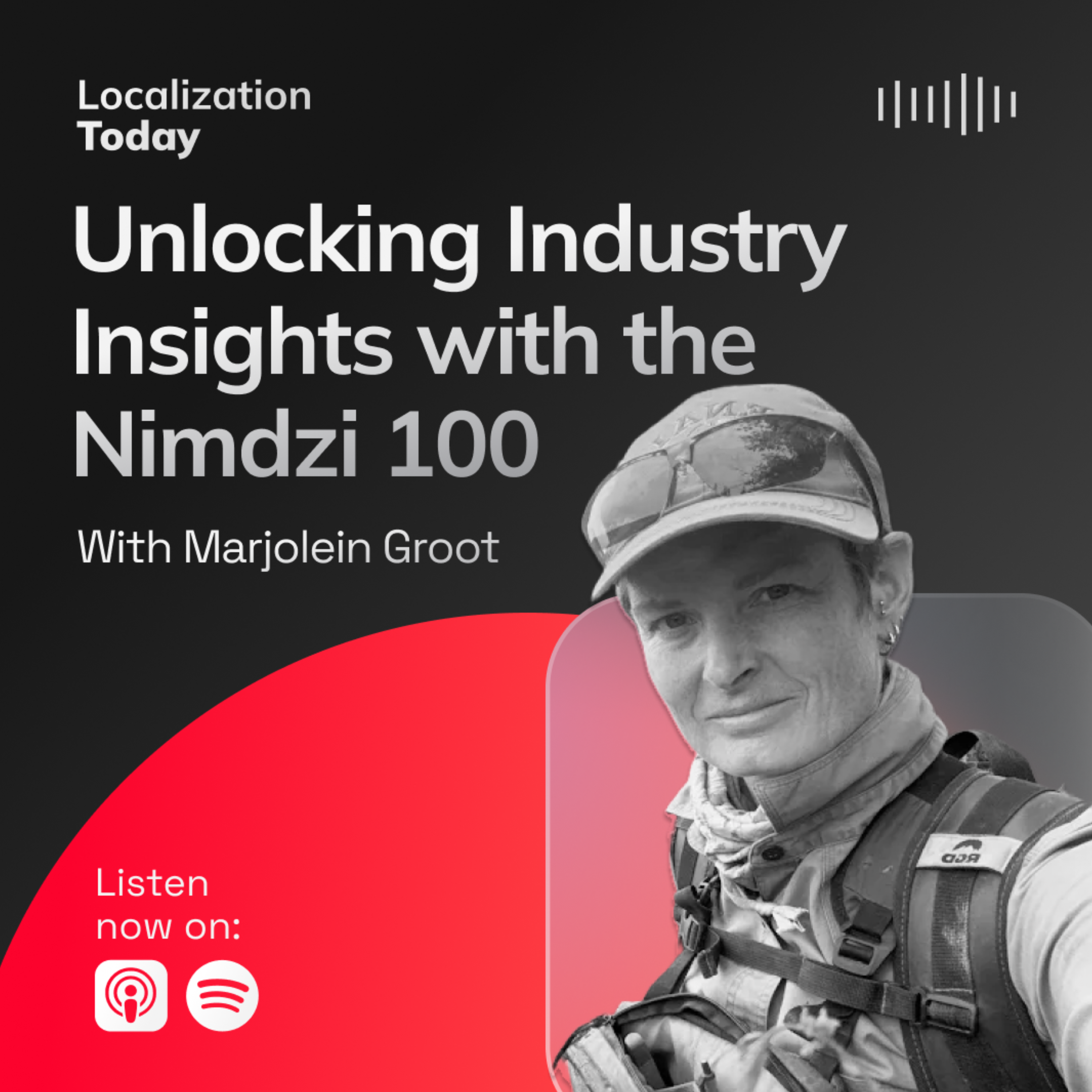
[00:00:03] Speaker A: Hello and welcome to Localization Today, where we explore how language, technology and communities converge to unlock ideas for everyone everywhere. I'm Eddie Arrieta, CEO at Multilingual Media. Today's episode focuses on one of the most widely referenced benchmarks in our industry, the NIMC100. Published annually, the report has become a shared point of orientation or language service providers, buyers, consultants and investors alike. We will also talk about stones, rocks. Tulsi. Our guest is Marjolaine Groot, former CEO of Multilingual Media and now leading the NIMC100 for a second year in a row. With deep experience in publishing, industry analysis and community building, Marjolaine brings continuity and a fresh perspective to a project that sits at the center of how the language industry understands itself. Marjalaine, welcome back. How are you doing today?
[00:01:06] Speaker B: Thank you so much for inviting me back into a studio that I'm very.
[00:01:10] Speaker A: Familiar with, and thank you. Because of that, we've, you know, been enjoying ourselves at the backstage of this conversation for some time today.
And Marjolaine, you've been away or you haven't been away, Tell us about your most recent geological.
Margieline. Marjolaine, so stones you've been looking at, stones you've been visiting, is it Alaska? Where is it? Tell us for those that know you and for those that don't know you as well.
[00:01:39] Speaker B: Sure.
Yes. We work in Alaska, and by we, I mean my husband and I work there. He is a master geologist and he decided that I was good enough at digging up stuff to work for him. So it's been a nice career change. We spend about four months out of the year in the field. And we do look for rocks. We look for rocks that contain certain minerals. The rocks themselves don't matter as much. It's the mineral composition of said rocks.
Do you want to see some?
[00:02:11] Speaker A: I want to see some and I want you to describe some in a way that those that are listening, of course, understand, please, please show. And you're going to have to promise me that you'll give me a rock. I like stones and I collect a few. So next time I'm in Sandpoint, I'll pick up some from you.
[00:02:27] Speaker B: Yeah, great. And some projects that we go on are soil sampling projects where we have a grid on a very remote landscape usually, and we dig these holes and then we get to where the bedrock is disintegrating up and is turning into soil.
So sometimes you need to dig a meter, usually up to a meter by hand, or you have a machine called an Auger that can go deeper.
And sometimes we look for rocks.
So the rocks are going to be on the surface, usually outcrop or float. Surface, float.
And that's where it gets really interesting because you can see things much better.
If you dig up soil, there will be rock and you have to look at them and check them out, but you don't usually take them with you. You use them to describe what the soil is made out of. Sometimes you get lucky and you're digging a large hole, or in this case, we're digging a trench that was a couple of hundred meters long, a meter wide and a meter deep. This we are digging in near freezing temperatures in Alaska, and it's always kind of raining.
And we found a beautiful pocket of quartz crystals.
And quartz crystals are very common crystal.
They don't have a great monetary value, but they are very pretty. And people consider them to have healing powers. These are clear. The crystals are about an inch long, an inch wide, thick. It's a big cluster of them, about the size of a small fist.
And they are clear and transparent, or translucent, actually, which means you can't quite see through, but you can see into them.
And so they are known as a rock crystal.
Sometimes they're purple, blue, whatever. They have very fancy names. But most of the crystals that you see for sale that are affordable are just quartz crystals, which is a very, very common.
It's a very common element. And the color is determined by what minerals were present when those crystals were formed. They can get huge.
But these are. These are still pretty nice. And they're sharp and really pretty.
[00:04:52] Speaker A: And you also have the. Oh, no, you're gonna keep it. Please, please, please. Keep showing, keep showing.
[00:04:57] Speaker B: Yeah, so I have a piece of stibnite. Stibnite is a rock. Stibnite is actually a mineral that is very interesting right now to mine. It's basically got a structure that's very foliated. Foliated means it's got layers. I'm going to have to lick this one so you can see the reflection better.
And this is what geologists are, rock lickers. That's what we do.
So they're all little layers, so when you turn them, you know, you can see the reflection change like that.
It's a blue gray, which is very telling of it. This rock is almost completely stibnite. And usually you just find minerals in a rock. Stibnite, minerals in a rock. But this is completely stibnite, basically. Stibnite is popular now, even though it used to be just tossed aside as a, as a byproduct that wasn't worth carrying out in other mining operations.
And stibnite is used in the military for arms, for munition manufacturing. It's used in lead based batteries and it is also used in creating the glass for your cell phone screens.
[00:06:11] Speaker A: And of course, the more fun part of this, I imagine is what you were mentioning to us regarding these fossilized.
What's the right term? Feces. That's correct, yes.
[00:06:27] Speaker B: Fossilized feces or petrified poop.
They're more accurately called coprolite.
And coprolite is just. So none of this is actual feces, just like any process of fossilization.
And by the way, I'm holding a kind of a flat patch of what looks like could be a giant rabbit poop or small deer poop. So little pellets.
So in fossilization the original material is, is replaced by another mineral and often it is a silica. And silica is, is the most common element that you find in the earth.
[00:07:10] Speaker A: Thank you so much.
It seems to me like it doesn't get more outside industry for someone to come from digging, digging the ground and then coming to work on the analysis industry. And of course the NIMC100 has been one of those things that for those of us that came to the industry is one of the first things that you, that you come across and then it's one of the first things that you start analyzing and it tells your story about where we are, about how many amazing profiles we have. Like Marjolaine, who is outside of the industry, inside of the industry, within the community, at the heart in the.
It's very interesting how there's so much diversity around this. So Marjolaine, why don't you tell us a little bit about your experience with the NIMC100, how you've experienced your relationship with the NIMSI100 and you know, why have you come back for a second year to help with it?
[00:08:06] Speaker B: Why have I come back for a second year? Well, they pay me and I would get bored if I didn't have anything to do in the winter. Digging rocks is something that you do in the summertime.
What I find interesting about it is exactly what you said. It's one of the first places that you go to get a grip, a grasp on the industry.
And that is exactly what sets it apart from other annual language industry assessment reports.
Because the Nimzi 100 is free, there's no paywall, it's accessible for anyone. You can share it however you like and it's therefore basically just a service from Nimzi to the industry so that everyone can benchmark and also share the data about the industry with potential investors. Because we see so much more venture capital interest, especially now that the industry is becoming more tech forward.
[00:09:04] Speaker A: And in that conversation about the future, the NIMC100 has stayed relevant over time and will continue to be relevant in the future. Why do you think that's that's the case if that's the case for you as well?
[00:09:18] Speaker B: Right. So the Nimz 8100 has been getting published since 2018, and since then it's been accessed more than 65,000 times.
Relevance just increases every year. So in the reporting, we look at all of our past data, we don't just look at what happened last year, we compare it to the previous years of data that we have.
That is what makes it more interesting over time.
So this year we are including more specific questions on AI. Last year we had a lot of open questions. People could kind of let us know what was top of mind for them. And now we were able to refine those answers into more specific questions and then we can start making comparisons and creating a real data set to see how to visualize the shift from traditional services to tech forward, or at least like AI dominant processes. So the relevance grows every time.
As long as we see this increase of engagement, which there has been, till last year, we had more engagement than ever before. This year I'm trying to get even more data, more data each year and more data going into the past.
Therefore every year it becomes more relevant.
[00:10:40] Speaker A: And of course there is a process to go by that you are already receiving responses, you're already having phone calls, and you don't have to tell us like, how does it usually work? But added to the changes that you referred to, you were mentioning there are some adaptations, more specific questions on artificial intelligence. Can you give us more on that, on what's changing? And that's going to translate into different insights at the end of the day?
[00:11:07] Speaker B: Hmm. Yeah. Because LSPs, or what we traditionally consider to be LSPs, are, let's say, inspired to add AI to their workflow. It's hard to identify for much longer as purely a language service provider. This is what we're seeing. And therefore we have expanded the survey to include companies that provide both.
And then we have distinguished questions for these divisions, the services division and the tech division.
And we also invite all ltps.
So Tech forward, tech dominant language providers.
So it's no longer going to be called the size and state of the language services industry. It's the language industry. So that is a really big shift. You might not notice it when you glean over the promotions that we put out there.
But we have three sections in the survey and they get triggered by what you answer on the first two pages. So what is the revenue spread in your company between language services? And then we specify interpreting and then technology.
So pure technology offerings.
And that is the first time we're doing that.
It's going to be the second time. We're doing a mid market report as well. That comes out after the Nimzi 100 and the Mid market ranking. It lists well, last year it listed another 150. So theoretically we can publish a Nimzi 250. But we feel like there's some gaps to fill on the mid market ranking and we really, really would like to invite companies of all sizes to add their information.
And aside from the ranking and the size of those companies, their insights are incredibly valuable as well. Because if you consider emerging markets where the value of language services is the same as in the western world, but their pricing is lower. Right. Simply because they are emerging markets. You might have top 10 companies that are based in, in Africa or say, you know, say Bolivia, name it country like say Bolivia and they are huge players in their market area but they wouldn't make it onto the Nimzi 100. But their experience of the market is just as valuable as those that are reporting in Euros or US dollars.
[00:13:49] Speaker A: And thank you for sharing that. And we are talking here about going beyond the largest LSPs which have historically been included.
Do you expect to see any variation in the types of companies that are in like the mid market, like the way in which they do things. Do you expect to see more technology and what are the questions? Rather the question would be what is in the survey that's going to help you get a pulse on those mid market companies that we will see in the result. Like what can we expect to see in the result of the NIMC 100 about those mid market companies?
[00:14:28] Speaker B: Yeah, yeah. Well the NIMC 100 is still going to be focused on the results from the top 100 companies.
So when we analyze our data we're going to separate those from the rest of the results.
However, when we start writing the content, you know, so most of the report is text.
So in the text we will specify when we are talking about the largest 100 and when we're talking about the industry as a Whole, and it might surprise you, but a whole lot of the Nimzi 100 report. So the actual state of the industry report, when we talk about market economics, pricing pressure, M and A, a lot of that is about the entire size of the industry.
[00:15:17] Speaker A: And that's of course what we are looking forward. We are part of the industry and it is something that we look forward to talk about. So we'll have you back to talk more about it.
Especially for those that have not heard of it. Who is this design for LSPs? Buyers, consultants, investors? All of the above.
Who should look into it?
[00:15:40] Speaker B: Yes, all of the above. So it's helpful for people who are providers in our industry to benchmark themselves to see their own experience reflected among that of others.
Because you only have a limited amount of touch points with your peers or you know, co workers and no one has the ability to get a full, full scope of the industry. That's what really what we're trying to provide. Because your opinion of the industry is going to be based only on what you're hearing reflected at the conferences that you're going to and the people that you talk to.
And it's never going to be as many as we are able to touch points with.
So it's benchmarking for providers.
And especially, you know, I have to point out something that I think is traditionally overlooked. And people look at, people think of the NIMZI 100 and the report as just a report on the previous year, not to use it as a tool in their strategy development for the upcoming year. We have very, very distinguished demand change graphs.
So you can see this year you're going to be able to see for both services, technology and interpreting which verticals do we see a demand decrease, where do we see demand increase, which markets are growing in these specific sectors using that going forward? You know, people look at their own name on the list or they see what their market is doing in terms of growth or what it did last year and then not really thinking as much to use the knowledge that we share to improve their competitive positioning in the next year.
[00:17:25] Speaker A: Many companies and leaders in the industry probably and outside of the industry probably need that change of mindset to be able to have the big picture view of it. Right.
And why would you think that having this big picture view of this industry will matter now more than ever? And then the NIMC100 provides the tools, I think you've expressed it really well, provides the tools to have the big picture view.
Why is that important? Outside of the obvious, of course Yeah.
[00:18:01] Speaker B: I think there's a lot of information siloing right now and I experienced that in working at Multilingual together with you.
And that is what I like to remind people of when we're creating a magazine and curating information.
People are living, whether they know it or not, in this very siloed information experience.
So whatever you've been interested in, you're going to get more of whether you know it or not. This is, this is the case for almost every place that you interact with information.
So getting a big picture view, getting an oversight, it's going to help you distinguish places where or parts of information where you haven't been paying enough attention to and then you can go and chase that and go down the rabbit hole. So I think there's a tremendous value in that.
[00:18:56] Speaker A: And of course the more information, the more data like you've been getting year over year, the better the results and the insights. And I presume that this is of course published to everyone like it' been in previous years. Why should lsps participate and you know, some of them are privately held, why should they do it and provide the information for this survey? And of course I wanted to ask, it's where, where do companies go to, to do that?
[00:19:28] Speaker B: Why to do it? Well, keep me in a, in a job, keep me having a job.
I'm just kidding. Well it's all the things that we've previously talked about, right? Like this helps everybody benchmark. But when I first started I was just amazed at how willing companies were to share their revenue data. And I can see the previous five years, five, eight sometimes.
Yeah, about eight years now I can see their development and you can tell that it's accurate because it reflects what you see publicly going on in that company.
It's amazing how willing companies are to share that data because most of the data comes from people self reporting. Although there are about 15 to 20% of the top 100 companies that are publicly traded. So we can just grab that information or get shareholder reports for example. And so I guess they know why they're sharing it. One is the benchmarking tool. Two, which you get ranked, which looks great if you're looking for an investor, especially in this mid market segment now too that we have, you can say look, we are the number 13, we are top 150. That is tremendously valuable because you can say that to anyone and they'll be like eh, who's gonna independently verify that? That's what we do.
[00:20:48] Speaker A: And of course many companies historically have used an MC100. As, you know, a sign of a pride. They'll put the badges the companies will still get. Right. You get different badges.
What did you get last year? Are you gonna continue giving companies the badges when they make the nimsy 100?
[00:21:06] Speaker B: Absolutely. There's badges simply like, I'm top 10 or I'm the number one.
Then there's women led. There's a technology, top technology company.
And just to be clear, we're gonna. We've expanded this survey, so we have to do fewer surveys in the year. And we're gonna have more than one ranking coming out of this. So the 100. We have the 150, the next 150, or, you know, maybe nimsy 250. Then we're going to. Also from this data, we're going to do another interpreting index, and we're going to do a technology index. So there's going to be all these different rankings with all these different badges. And, yeah, you can. You can just have. You can have, like, you can end up with three of them by April because the report's going to be out at the end of March, and then we're going to have rankings coming out throughout the spring, and each of them has a different badge.
[00:22:02] Speaker A: That is great to hear. I can't wait to look into the data. One of the things that I always like is the graphs. And I think last year there was an extra effort that was made to make sure that the graphs were visible.
Is this a huge part of the process of getting the insights, deciding, is this going to be a bar? Is this going to be a pie chart? Is this like it?
This is the hardest thing to do to be able to make that data visible to others. Do you envision adding more to it this year or similar to last year is going to be your approach as well?
[00:22:37] Speaker B: Of course we're going to have additional information this year, so we definitely want to have additional graphs. And yes, you're kind of honing in on a fun challenge each year, which is to create graphs that are visually distinguishable so they don't all look the same and you don't get confusion.
Last year I did spent more time on that and actually worked together with multilinguals graphic designer and layout artist. And I think it's hugely important.
But in the process, you got to consider, you get your data, then you analyze the data. It takes a good three, four days, and then from that, you're gonna start seeing a picture, you start seeing trends, you start seeing what. What jumps out at you. What is interesting enough and of which questions did you get enough data that you can actually create a graph that represents the industry?
Because some people don't answer every question. And if you only get 20 entries for a question, I'm not going to make a graph out of it, even though it would be super interesting. But you want to have something that reflects the industry, then you start making your graphs and then when you have those, that is going to be the foundation of the text part of the report. So you start with the data, then you have the graphic representation of set data and then you start formulating the storyline.
[00:24:16] Speaker A: Thank you for sharing again. And I really like the three pillars.
I like that approach. I'm looking forward to the different rankings.
That's really fun to help understand. And also the graphs. I know you're looking forward to the cash. What if anything, are you looking forward to in this work of the NIMC 100, this new one 2026 edition, what are you looking forward to?
[00:24:39] Speaker B: I just love the creation process. So once we get the data and the graphics and I get to have a little more hands on part, take a little more hands on approach to the creation this year. I love that creative process and that's what I always loved at multilingual. That's what I've always loved in my life.
So the creative process I love. And then the team is so inspiring. Everybody at Nimzi is so engaged with this.
Um, I get notes from left and right saying like, hey, I was talking to someone. They really want to know what to do, where to go for the survey. Um, and, and people are just engaged. People say, hey, I noticed this about M and A. Hey, I. Are you, are you talking about this, Are you talking about the reduction of education programs in the United States for translation localization, for example? Like people are contributing. People find it important to contribute to what is written in this report because they know that it is the most widely read and distributed industry report for the language industry.
[00:25:46] Speaker A: That is right, Marjolaine. And we didn't even talk about our co ceoing experiences. We might get a chance to do that in a different moment. Marjolaine, is there anything you like to add about our conversation on the NIMC 100, what's to come in 2026 about it and the companies that are thinking about, you know, finishing up the survey?
[00:26:09] Speaker B: I guess I could add that when, when people enter their data, the revenue of this year, the revenue of the past year is the only thing that we will publicly share. Right? It's the industries they work in, their sectors, their verticals, the revenue and everything else is treated with the utmost confidentiality.
So that's all that stays internal. We respect gdpr. There's going to be no way that your data is going to get traced back to whoever entered the data, for example, so it's confidential. If you have any concerns, reach out to me on LinkedIn or you write to nimsi100mimsy.com thank you for sharing that.
[00:26:53] Speaker A: I think that's very important and we'll make sure that our editing team sends that out so that everyone who is listening to this and those that are in social media have the opportunity to participate in the survey, the NIMC 100. I'm already looking forward to it. For those that are listening to this entire conversation, thank you for listening to Localization today. Marjalaine Once again, thank you for participating today.
[00:27:20] Speaker B: Absolutely. It was my pleasure to see you.
[00:27:25] Speaker A: All right, and thanks for sharing about the NIMC 100 and also about your rocks. Different types. Like I said, I expect not to leak any of those rocks myself, but if I can get one to bring to Colombia, that'd be great. Hoping not to break any loss. It'll be small stone for sure, but thank you so much for doing this. For those that are listening again, this was all about the NIMC100. Why it matters as a research project, as a benchmark, and as a community effort, the NIMC100 remains one of the few shared reference points our industry has, and its value grows with every company willing to contribute data, context and honesty. Catch new episodes of Localization today on Spotify, Apple Podcasts and YouTube.
Subscribe, rate and share so others can find these conversations. I'm Eddie Arrieta with Multilingual Media. Thanks for listening and we'll see you next time. Goodbye.