Episode Transcript
[00:00:00] An athlete building language operations for the world's biggest sporting events.
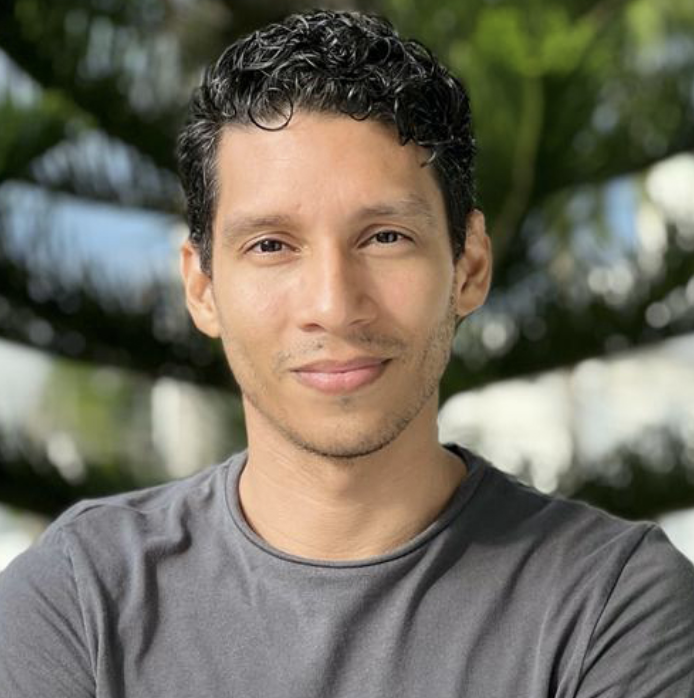
[00:00:04] I mean, Moore most of us have had a moment of panic when we're out of our element. Being in a foreign country where you don't speak the language is scary enough. When you're an athlete at one of the most important events of your whole year, it can be terrifying. Mariana Quintanilla thinks about what happened to her all the time. She was 15 years old, alone at a tennis competition in Russia, when something went wrong with her accreditation. Her English was basic, and the officials spoke only Russian. Then a volunteer who spoke Spanish appeared, and suddenly everything changed. Instantly, I felt relieved and supported, she recalls. Without realizing it, I was learning about the importance of language services.
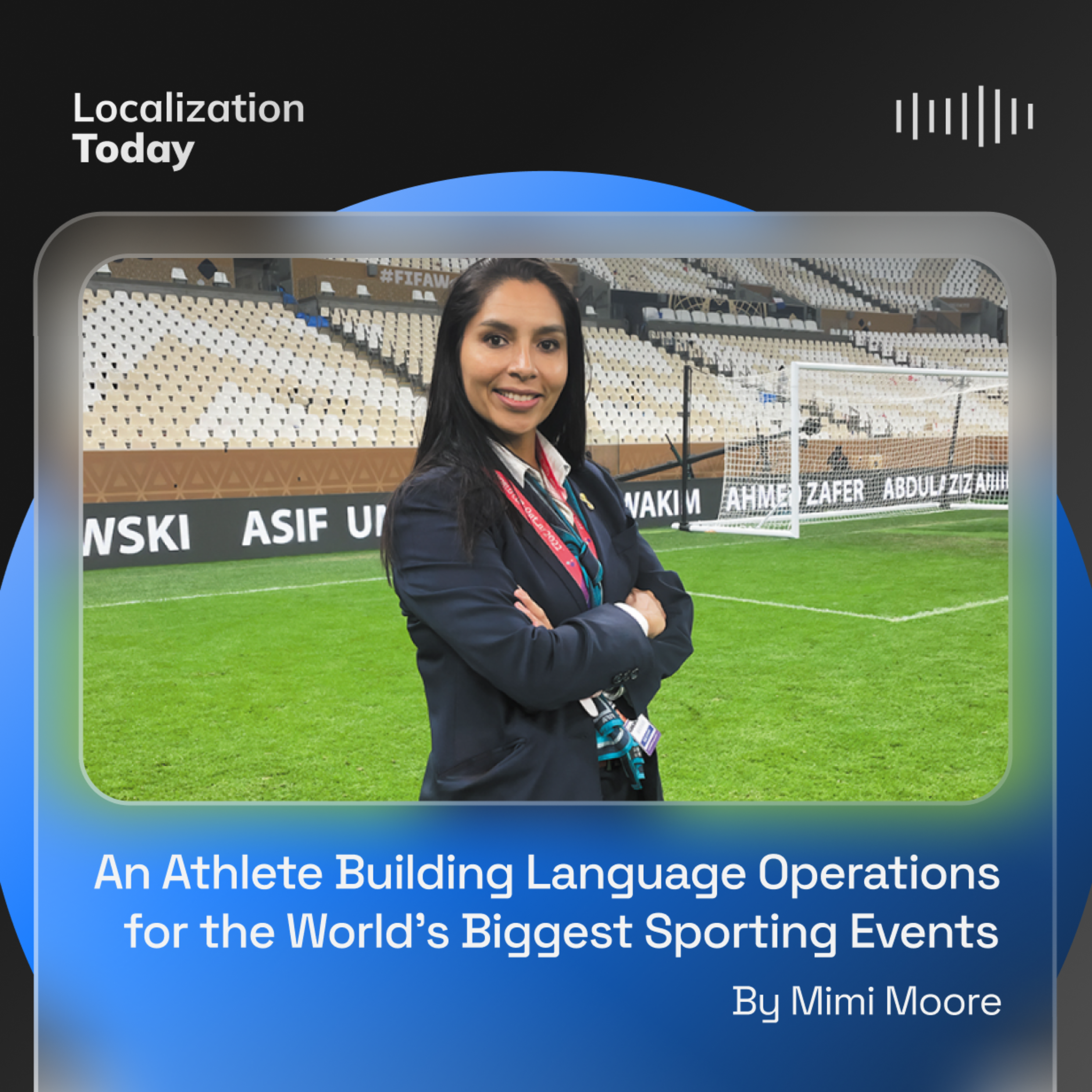
[00:00:44] Today, Mariana is head of language services for Saudi 2027, building the linguistic infrastructure for the Asian Football Confederation AFC Asian Cup. She has managed interpretation and translation at some of the world's biggest sporting events the Pan American Games, the FIFA World cup, The Milano Curtina 2026 Winter Olympics and a string of other global events. In tennis, when a racket meets the ball at exactly the right point, players call it the sweet spot. Maximum power, minimum effort, and a perfect result. For Mariana Quintanilla, it's where language and sport join to not only bring people together but help us understand each other a little better, too, on the court and in the classroom.
[00:01:28] Mariana grew up in Puno, Peru, a city 3,800 meters above sea level on the shores of Lake Titicaca. Her family was bilingual. Both her grandmother and her mother spoke Spanish and Amara, the indigenous language spoken primarily in the Andes. Her parents enrolled her in taekwondo and tennis at an early age because they believed sport brings opportunities, among its many other benefits.
[00:01:51] When she was 8, the family moved to Paraguay, the only country in Latin America with two official languages, Spanish and Guarani, which she began studying at 16.
[00:02:02] She went to Barcelona to train in tennis and came back speaking Catalan. She next learned English and then French, partly because she had read in a school booklet that French was one of the official languages of the Olympics. I was always excited and curious to learn new languages, she explains.
[00:02:18] Like sport, it opens doors in hearts. When you speak in another person's language, there is a higher level of connection. Mariana went on to study international relations at university, earning a scholarship to compete in varsity tennis in the United States and Mexico. She won four national championships and two Most Valuable Player awards.
[00:02:38] International relations is a broad field, and now more than ever, it is closely connected to sport, she says.
[00:02:44] I truly believe in the power of sports diplomacy and the strong message that sport can carry to the world. After graduating, she was ready to retire from tennis, but not from training and competing. She took up pistol shooting and discovered a new passion. Shooting is a very mental sport, she says. Your biggest rival is yourself and your emotions. It is also a sport that allows you to start at a later age and still be competitive. It has given me a path to continue growing as an athlete and as a person.
[00:03:14] Mariana represents Peru internationally in pistol competitions, working on her ambition to qualify for the Olympic Games. An executive with an athlete's edge in 2017, Mariana became head of international relations and protocol for the Lima 2019 Pan American and Parapan American Games. She felt the language services available were nowhere near enough and pushed for something more professional. Leadership not only agreed, but asked her to create staff and also lead the new department. I am glad I accepted the challenge, she says. I learned so many things along the way. Mariana created a completely new language services department staff by an in house team of translators, interpreters, revisers, desktop publishing specialists and project managers.
[00:04:00] Her efforts applied best practices in a way that she says had rarely been done before at a major sporting event and later served as a model for other events.
[00:04:09] Mariana was also a competitor at the Pan American Games.
[00:04:13] Mariana trained every morning, then shifted into her organizer role for the rest of the day. My dual role was unique, she says. Because I am both an athlete and an executive. I have a different perspective when organizing an event. I can step back, understand what our clients need and adapt our services accordingly. When FIFA found its Arabic Voice In March 2020, Mariana moved to Doha to take up the role of language services manager for the FIFA World Cup Qatar 2022. She stayed for nearly three years, overseeing one of the most ambitious language operations ever attempted at a football tournament. For the first time in FIFA World cup history, Arabic was introduced as an official language. That decision reverberated through all aspects of the language services operation, starting with terminology.
[00:05:03] There were so many football words and concepts that were new, mariana says.
[00:05:07] So we formed a terminology working group with linguists and operational staff who could explain the concepts. We worked through football's vocabulary, identifying terms, testing them, and then submitting them for multiple approvals before anything was published or printed. The glossary became a permanent reference for managing football in Arabic. Every translated sign across the stadiums and the surrounding city required a strict quality control process. Even a single sign sending fans the wrong way can cause real chaos on match day.
[00:05:38] Language is more effective when it's consistent, so every stadium sign needed to agree with the spectator guide, the app, a patron's ticket, and the training materials for volunteers, just to name a few. It's a lot. Mariana's responsibilities at FIFA extended beyond terminology and signage. She planned and implemented the remote interpretation center, handled the integration with broadcast services, and developed the staffing plan for both paid staff and volunteers. It was the most complex language operation she had taken on, but that would soon change. The Remote center at the heart of the 2026 Winter Olympics the Milano Cortina 2026 Winter Olympics distributed competition sites across multiple locations in northern Italy. Getting interpreters to each site in time for every metal press conference, then moving them on to the next, presented a huge logistics challenge. The ric, operating from Milan, changed everything.
[00:06:36] Rather than dispatching interpreters to each venue, a centralized hub connected every competition site via the game's own network. A team of on site and remote interpreters covered press conferences across the entire Games in eight languages in real time. Mariana remembers that everything had to be in place months before competition began, including securing the interpretation platform, coordinating the infrastructure at each venue, and making sure the connectivity was stable enough for live simultaneous interpretation.
[00:07:06] The system had to integrate with live streaming and broadcasting services because press conferences from the Games are not only watched live by journalists in the room, they are also replayed and redistributed long after an athlete has left the podium. The relay system is the backbone of Olympic interpretation, but how it works is complex. With eight official languages, direct pairing between every language combination just isn't practical. Instead, English functions as the core language, and every interpretation flows through it first. Any error or imprecision in the English appears in all other ADA official languages instantly.
[00:07:42] Some of these press conferences are watched by thousands of people and replayed on different platforms. Mariana says accuracy is important. A mistake or something taken out of context can become viral instantly at the Games. Document translation requires speed and agility. You can't wait for a final approved version. When the schedule changes every hour, we translate the draft document, knowing that final changes rarely amount to more than 10 to 20%.
[00:08:09] Mariana says the translation memory takes care of those updates quickly and allows multiple versions to be delivered at once. Internal clients at first say they can't share a draft because it's not yet approved, but once we explain our process, they are more open to collaboration. Saudi 2027 an interpreting first for the AFC as head of language Services for Saudi 2027, Mariana is now preparing the AFC Asian cup, which takes place in January 2027. In fact, she's already introduced something new to AFC tournaments remote simultaneous interpretation RSI had never been used at an AFC event before she brought it in for the U23 AFC Asian cup in Saudi Arabia in 2026. For me, it's always exciting trying new technologies, she says.
[00:08:59] RSI provides more flexibility and wider possibilities of reach, and it integrates better with broadcasting and live streaming services.
[00:09:07] Usually, innovating elevates the level of service at an optimized cost. However, she is cautious about artificial intelligence assisted interpretation.
[00:09:18] While there have been some improvements, Mariana says press conferences are difficult for AI interpreting systems. For example, athletes speaking in their second or third language, emotional exchanges, sports specific vocabulary and rapid context shifts create a level of complexity that current AI tools struggle to handle in a live setting. However, she says she will be watching how the technology develops, Helping Athletes become Professionals Mariana volunteers with The International Olympic Committee's Athlete365 mentoring program, working with athletes, making the transition from competition into professional careers.
[00:09:57] As athletes, we spend years working hard in our sport. We often believe that we lack experience to transition to the professional world, she explains.
[00:10:06] I see it differently. We have many years of a different kind of experience that only sport can develop at such a high level. She says that experience shows in how athletes approach their work. Through years of competition and training, they learn how to manage competing priorities while staying focused, bouncing back after a setback and performing under pressure. All skills that transfer well to the business world. The Global Language of Sport Ask Mariana what excites her about her work and her answer may surprise you. From an operations perspective, she talks about developing new glossaries and researching how a new technology might work for a given event. But from a sporting perspective, she believes in the power of sport to support the development of society.
[00:10:50] By making sport more accessible to different cultures through language, she says, we can all learn to collaborate and connect better. The stories from the athletes are really inspiring, mariana says. Creating the possibility that more people can be inspired by them is rewarding. For those considering a path that combines language and sport, she says there are many possibilities.
[00:11:11] Sporting events happen at every level and in every region, from single sport regional competitions to global multi sport games.
[00:11:19] And there will always be a need for people who understand both language and sport. Speaking more than one language is a privilege that allows you to become a bridge between cultures, mariana says.
[00:11:29] We do more than translate. We help spread understanding, inspire people and create connections.
[00:11:35] Sport, like any other field, has the opportunity to break boundaries with the support of language services.
[00:11:42] This article was written by Mimi Moore. She is owner of Netherlands based Wolfsenhaus Writing, a content Marketing Agency for LSPs language technology companies and B2B technology companies.
[00:11:54] She has 25 years of experience in the localization industry and is Program Manager, Content and Social Media for Women in Localization.
[00:12:03] Originally published in Multilingual Magazine, Issue 254, August 2026.