Episode Transcript
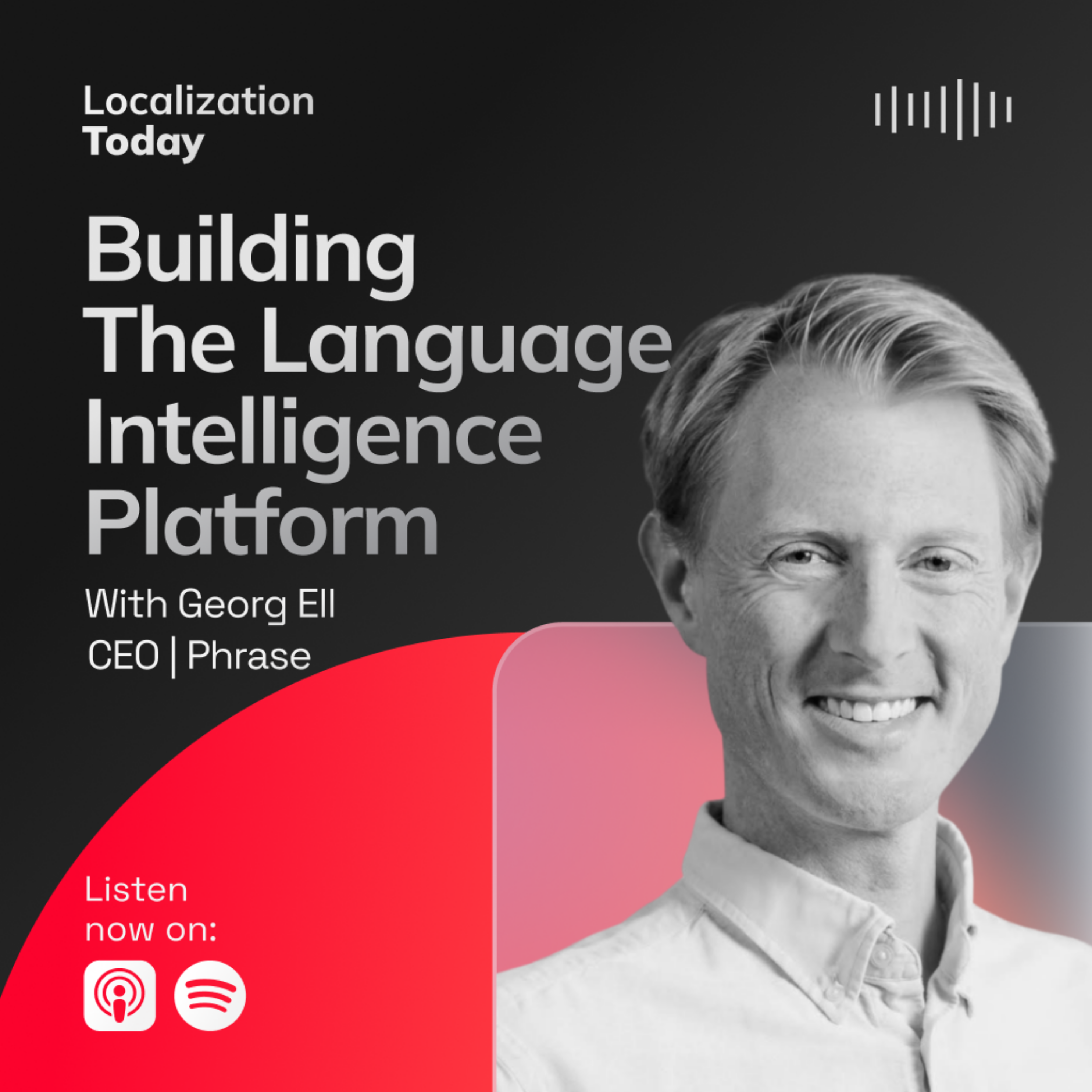
[00:00:03] Speaker A: Hello and welcome to Localization Today where we explore how language, technology and community converge to unlock ideas for everyone everywhere. I'm Eddie Arrieta, CEO at Multilingual Media. Today we are going to talk about something bigger than a product launch or a rebrand. It's about how the language technology industry might be redefining itself in the age of AI. Phrase recently announced its repositioning from a localization platform to a language intelligence platform. Now, the idea is that the value in multilingual content is no longer found primarily in moving content through translation workflows, but in the intelligence layer that enables humans and AI systems to create consistent, high quality experiences across languages, markets and channels. To unpack what that means and whether we are witnessing a genuine category shift, we're joined by Georg El, CEO of Frase Giorg. Welcome to Localization Today.
[00:01:11] Speaker B: Hello. Thank you for having me back. Appreciate it.
[00:01:13] Speaker A: That is great. And I'm really glad you are taking some time from Lock World to talk to us. You are already there. What is the reception of the new conversations that you are having around the new positioning for freights? Just to kick off with that.
[00:01:30] Speaker B: Yeah, firstly it's been a great Lockwell. So we're doing this from a hotel room at the end of two busy days and evenings and meeting lots of customers, meeting lots of partners and prospective new customers, which is lovely and it's always good to be back at lockworld. And it's been, I think, quite a. I keep saying to people, I feel like the conversations have been deep, they've been sort of really meaning meaningful. I think there's been such an acceleration in the world generally around AI adoption and certainly here at Frazen we'll talk about that. But I think everywhere people's understanding, awareness and the practical use is really starting to accelerate. So that's just enabled some really fun conversations and with the positioning that will, you know, hopefully I'm back today.
I think it's been incredibly well received. I feel like it is what people need and want in order to see how the future of localization can be bright and optimistic. So yeah, it's been a good reception.
[00:02:30] Speaker A: That's great to hear. And of course with the repositioning as a language intelligence platform, what stands out is not just the positioning but the depth that comes with it. You publish internal operating changes, customer outcomes, strategic priorities, even pricing philosophy. Why did you choose to, to go that deep? Why now?
[00:02:56] Speaker B: Yeah, so for those listeners that don't know, I published a long blog, sort of self awarely long blog just before lockworld and covered a bunch of ground in there. And it felt to me like sort of coming out of our shell phrase, you know, we have been working incredibly hard in the last few months, as it says in the blog, I think learning the midnight oil, learning a tremendous amount and really committing ourselves to some fundamental root and branch changes which are incredibly exciting. And I felt like it was just time and sort of merited explaining at a bit of length like a whole bunch of different things that we're doing. So the language intelligence platform concept itself has a bunch of meaning to it. But then we also talked about four different areas of product focus, talked about the release of not so much the release, but the development of our forward deployed engine engineering offering and new pricing concepts and then totally new ways of working. One of the things that we did in the blog was to try to say, look, we didn't want to write about things that we were going to do.
Obviously some of the vision isn't that camp, but the majority of what we wrote about in that blog is stuff that we've already done and a journey that we're already on. And we could evidence and there are. That blog is kind of full of examples of things that are happening today and have been happening in the last few weeks and months at phrase and that just felt like the right way to do it.
Yeah. And what's been wonderful is how many people at lockworld have read the blog and found themselves in it somewhere and said that really spoke to me, that really resonated, that was exciting, that made my spine tingle. Nice things. It's been great.
[00:04:48] Speaker A: That's really great to hear. And of course there's a huge component to this that moves slightly away or moves away from localization.
And localization as a word has defined the industry for such a long time. I personally feel that being in the industry for three years, I'm not yet really clear on what it was. Now I'm kind of forgetting what it was and moving on onto all these new frontiers. How do you perceive the concept of localization and this evolution that you're going through?
[00:05:19] Speaker B: Yeah, so I talked on a panel here and at lockworld and on the floor with a lot of people around this. I think that as an industry we do need to start to evolve our language. And so on our stand, it said beyond translation and our website says the same beyond translation. Like we see a lot of the industry talking about translation and localization. Now the problem with this language is that whether you're, whatever audience you're talking to Internally, as soon as you use those words, translation and localization, it's generally perceived as either a solved problem or that you're sort of finicketing at the edges of stuff, because people have such a good experience with basic machine translation these days. So what we want to do is to say, instead, this is about content that moves, content that sells, content that educates, content that warns you, whatever the purpose of that content, and this is one of our four pillars, is this concept of being close to the intention of the business. The business isn't buying a translation. They are buying content that achieves a goal. They have an intention when they do that. So intent, proximity. We talk about understanding that original intention at the outset of a pipeline of work, using the knowledge of that intention to inform the work that you do, and then using that knowledge of the intention as well to measure at the end whether or not it's successful, and then to close the learning loop. So I think translation and localization actually undersells what we do as an industry. Now, I'm not talking about phrase. I think as an industry, we can take an example I love to use is a hotel room, right? We can take a hotel room and we can help sell that to an elderly couple or a business traveler. Same room, sell it two totally different ways in one language. And now I can do that in all the variants of the language. And then I can do that with 50 different languages and cultures on top. And then I can do that with all the demographic intersectionality that you want to put on top of it in terms of age, gender, ethnicity, interests, background, previous purchase history, whatever you want to. You can do so much in one language and then layer the rest on top.
So I just think translation and localization becomes actually a kind of subset of the potential of our industry to drive, you know, positive value in our companies.
[00:07:32] Speaker A: So I believe you are right. And we've seen this shift starting last year, more timidly would say, and we're seeing signals across the market. Analysts are publishing dedicated evaluations for language technology platforms. Industry observers are adopting new terminology. We've seen new terms starting even last year. We're seeing that.
Do you think this is a genuine category transformation or are some vendors just repositioning themselves around, around AI?
[00:08:03] Speaker B: Well, it was interesting with Forrester.
We tried hard to convince them not to call it a TMS wave.
And to be fair to them, they did listen and they went and did a bunch of research on a bunch of different websites. And what they said is, look, two thirds of the websites of the companies here are positioning themselves as a tms, and you're not, but it's the language that people are using. So now, interestingly, that was in sort of May, June time, and then by September, I spoke to Kathleen, the analyst, and she said, I actually regret. I actually wish we'd called it, you know, language technology or something different because things had moved on.
And I think that, you know, there's the tired debate of whether or not TMS is dead and so on is actually not even happening at the show. I think maybe my first lockboard where people aren't talking about is the TMS dead? Because everyone has actually moved on quite substantially. And I think what people are seeing is that there's a. There's a sort of just a merging in so many different ways, emerging of roles and emerging of who does what. There's a merging of kind of technology and AI and the static technology and AI that needs feeding and watering and a degree of kind of like services that goes along with deploying AI successfully. So just think that the. The terminology is changing. I think people do understand that, and they do want to understand what's different. And that's the thing. We. We recognize ourselves as being in that LTP camp. We are in that camp. We're trying to describe an approach and a mindset that is different, that talks about language broader than localization. It talks about intelligence more than technology.
The word platform stays there because platform is something you build on. So we build on it with an ecosystem of partners, and we provide an environment for customers to build onto.
[00:09:41] Speaker A: Of course, this entire conversation about technology has to touch upon AI and it has to touch upon models. And there is a growing assumption that increasingly powerful AI models will eventually solve the language problem on their own. You've argued that the orchestration layer around the model matters more than the model itself. What does orchestration do even the best model cannot do?
[00:10:07] Speaker B: Yeah, I think you've got layers that you build around a model, and people use the term orchestration.
I think also the word harness is often used, and what that is is what information is stored, what context and information is stored, shared with the model, and used to inform the work of the model. Right. A model on its own, we know is powerful, but is rogue. And so what you need to do is you need to build a really sophisticated harness around that model that gives it context, that gives it guidelines, that does quality control.
And actually the underlying model can change.
And that's actually one of the powerful kind of realizations. The underlying models will change. We're going to move into a multimodal world very quickly. We're all spending far too much money on anthropic. That creates a tremendous incentive for people to find alternatives.
Jensen Huang just announced new chips that can be put in laptop and run a 20 billion parameter model. A year from now it'll probably be 100 billion parameter model running on laptops. Right. So suddenly, whereas today people around the world are using Opus and Fable to write blogs. Sledgehammer, crack nut. In the future there'll be, I'm sure, a proliferation of lots of different models. The value is actually going to be in the layer that controls and around that, that provides that consistency, the context, model selection and so many things. And sort of to back this up a little bit, there was a study from Stanford MIT published in March that actually said that even with the best frontier models, the harness around that could improve their performance against benchmarks by up to six times.
So that's incredibly powerful.
And it's good news because actually it then means you can change it out for another even better model underneath and continue to benefit from this kind of compounding improvement of running a harness over time.
[00:12:08] Speaker A: Very exciting times, that is for sure. And of course you've spoken publicly about a significant performance gap between raw AI output and orchestrated language workflows. What should enterprises learn from that? And what does it say about organizations trying to build language infrastructure entirely in house?
[00:12:29] Speaker B: Well, there's lots that can be said about that for sure. I think the.
So if we start at one end, I think what we do need to recognize is that it's very easy to build a prototype and the prototypes often look good.
Fine.
However, when you do anything with AI, it drifts. Hence the important need for a harness. I was talking to the global head of AI research at one of the big Indian consultancies and he told me about a model they built for insurance. And it worked brilliantly doing kind of evaluating whether or not to grant insurance to someone. The first thousand runs from 1,000 to 10,000. It started to oscillate violently. And after 10,000 runs, the exact same model with the exact same data became a 50, 50 coin toss.
And that's the point. Unless you have the harnesses around these things, then the models themselves drift.
So that's the first thing people need to just know about how these models actually work.
So the second thing is when people are making kind of build versus buy decisions, they also have to think about the economics. There's a tremendous amount of tokens getting spent in the economy at the moment. And I think in the second half of this year, the CFOs of the world are going to come knocking and say, what have we got to show for it? We spend all these tokens and we've rebuilt things that we already had.
It's just the wrong approach. It's economically pretty not sensible, whatever that word is, to do things that have already been built and have already been proven. The real opportunity with these things is like the Heineken effect, to go to the places the existing software doesn't go to build that extra thing on top that is really bespoke to you, that's going to help you make a difference in your business. So build on the foundations of what's before.
Rebuilding pipelines, rebuilding email, rebuilding Slack, rebuilding CRM.
These are in general things that are not just, just economically very sensible. Then people need to think about total cost and maintenance. And you know what, if you build something that's good, people ask you for features and then you get bugs and before you know it, you're a software company.
Is that what you want to be doing on every last thing?
It just really doesn't make a ton of sense.
But I think that the phenomenon of people building things, I'm massively in favor of.
I am the highest token spender at our company, partly because I'm inefficient, but I massively believe in builders and building things. And I'm building things all the time. And I have agents on my phone that go into my repos and fix issues and I can set them off literally via telegram. We live in amazing times. I'm all for building, just build sensible things that are adding value, not rebuild, not reinventing the wheel.
[00:15:11] Speaker A: And I believe that's where language intelligence platform, and rather a language intelligence platform approach or language intelligence approach comes into place. It adds this layer, like you're saying, that helps you avoid this drifting.
How do you see it with your enterprise clients? How is this layer that you're starting to implement and moving with the enterprise solutions providing the impact that you were expecting and that allows you to talk about it with such confidence.
[00:15:44] Speaker B: Yeah.
So everyone does these things differently. Everyone has different objectives with language and content.
So one of the important things for us is to be able to have a platform that can adapt and be used in an infinite number of ways, many of which we simply cannot forecast. And it sort of takes us neatly into at least the first couple of our four big product priorities. And there are really two pairs that kind of reinforce one another in a loop. Which is interesting. So I'll talk about the first two, which is what we call headless and guided. Now headless people generally know what that means as APIs. That's MCPS.
But also what it is is distribution. And that's the exciting thing. It means that a localization team that previously used to run around a company holding its hand up saying, please don't forget about us, please don't do your own rogue thing.
Here's the process. You just have to submit a form here and we'll get back to you and we'll make it better. It's sort of a compliance function, right? And the problem was that business people are pragmatists. They'll take the shortest path to what they want done and they won't always care about the same things.
So headless is actually more than sort of technology, it's a distribution model. Because now any business person in any business app can use an MCP to call into a system like ours. And so they can actually be a consumer of the value that the localization team brings without even knowing it.
So they're just using Jasper or Harvey or Claude or whatever they're using and they're getting the benefit of the central control and governance and terminology and so on and so forth of the localization team's implementation, but they're getting it via an MCP call. So they're not actively having to do anything or be retrained or go out of their flow or even remember to do it. So headless is very interesting for the industry.
Then what we call guided is, and we're building this already, we already have some customers testing it, but it is early days. But it's a sort of chat with dynamic visualization interface. The idea is you can talk to Frase and the system will do what you ask it to do. But it also bring dynamically into the interface artifacts from our design library and build a table or a workflow or a diagram or a graph or whatever is needed to get that particular job done.
But the even more interesting thing is actually how we can then use that interface to start to a learn what it is that customers really want. Because when they're not constrained by drop down menus and tick boxes, then they start typing all sorts of things in. So the product becomes the roadmap, which is very cool. We've found that in our own experience of building it is that as we're building it we're finding there are all these APIs that we wish we had and we don't have. So we're now. And there's the learning loop. Right now we're building tons more APIs and like really investing in making them amazing and well documented and so on. And all of that is then available for customers and partners to build on as well. So there's a good loop.
And then what we can do with guided is be proactive. So customer comes in, maybe they're an expert in phrase, but they know what they know. They don't know the bits, they don't. Or reinvented something new and they haven't seen it yet. Or maybe they really aren't an expert in phrase. And the system can then say, look, you asked me to do X, I can actually deliver that for you. But I can also give you these three other options of how you might do it differently or better, or how I can inject content, or how others in your company did it before. So the system can proactively make these suggestions to the user. So those are the first two of our four big new product priorities. And you can see how they reinforce one another. But also they're very exciting, I think, for how localization is perceived as it moves upstream, as it provides value to the business, as it deals with shadow localization by essentially making it easy for business people to work in the right way so they don't even have to think about it. It's fabulous.
[00:19:36] Speaker A: That is great. Thank you for sharing. And of course, I'm now curious about your other two product priorities, if you can spend some words for us.
[00:19:44] Speaker B: Sure, sure. So we call them compounding intelligence and intent proximity. So intent proximity is, and I talked about it briefly earlier, but it's this idea that if you understand the intention behind the work that you're doing, then you can actually include that intention in the custom prompting, you can include it in the workflow, and then if you can measure it on the other side, of course you can create a learning loop to make sure that the work you're doing is improving because you can see that it did or it didn't quite meet that intention. The compounding intelligence bit is interesting. So we have like a whole series of different layers of transformation that we can do on content today. So we can have quality evaluation profiles and style guides, and you can have multiple ones of those. You can have them at the sort of company level, product geography, demographics, graphic, so you can layer on different copies of that. And then we can do adaptation. We can really build in some very finely defined intersectionalities around age, gender, interests and so on. So there's all these layers of transformation that we can put on content what we haven't built yet. But I think this is the vision of it, this is exciting, is to say, well, if we're linking with intent, can we then get some intelligence that says we applied these three layers and this weighting between those layers and that made it better or that made it slightly worse. And then if we tweak it slightly, we change the weighting, we add another pass, we remove something, we change the language in the custom prompt a little bit.
How does that link back to the intention? So it's the metadata between the transformation layers which itself then becomes a model which is intelligent and another learning loop. So that's the second loop, which I think is. And an interesting thing there again is you've got these two user types, you've got the user that don't know, don't care and then you've got the expert user who wants to tweak, right? So the sort of don't know, don't care just says, well make it better and it will apply a bunch of defaults, but from the intelligence of all the usage across the platform over time. And then you've got the sort of person who likes to lift the hood up and tweak things themselves and everything's possible. So you sort of think about a platform like a planet with a core of a lot of capability and then the sort of crust around the edge which is the user interface, the drop down menus and the tick boxes and essentially what we're doing is reaching down into that core and pulling the whole thing inside out, making all of that capability available and distributable through headless and guided. And then that business outcome and that intelligence on the second half of things. And the UX that we have today doesn't disappear, it's still there, but it's probably not the primary interface anymore. It's for the true power users. So it's really interesting reinvention and I
[00:22:27] Speaker A: really love both concepts that you mentioned, the compounded intelligence and of course the intent, proximity. It seems like it brings you back into what's important for the companies, especially in a time where we started hearing about shifting left and now you are going to be able to do more translation than we used to do before. And I think many companies and users of language and buyers of language have defaulted into the good enough, it's good enough, the system seems to be working and then as you're mentioning, it's probably slowly drifting unconsciously by the companies and then it takes us to this concept of intelligence.
It seems like, of course, the system that you are mentioning has a lot to do with adaptation, has a lot to do with proactivity. And it gets me thinking about how do you understand intelligence within phrase, how do you conceptualize it? What is it for you and for your team?
[00:23:28] Speaker B: That's a really interesting question.
So in the context of the language intelligence platform, I think the intelligence is aimed to speak to naturally the use of artificial intelligence, AI, but also to the safe application of AI. And that's very important. I think we can very much position ourselves as the safe way that you deploy large language models. Right? That's very important. This industry knows how to do that safely.
When we think about intelligence in the context of language intelligence platform, we also talk about taking action, right? So the intelligence leads to insight site allows you to take action and then finally the measurable business outcomes. So it's sort of all of those things combined. So we wanted to step. Technology is almost like.
Technology is almost too limited. Right? It's just the how.
Intelligence is really the why and the what. And there's more interesting kind of higher order questions. So that's what we mean by intelligence in the concept of the platform. But then if I extend your question slightly, thinking about intelligence inside the product and how we work at Frase, it's really about, and this is part of the internal transformation that we've been making here is like a very deep, very serious commitment to using AI and agents as colleagues, as almost on a peer level with humans. And we are all on this learning journey very, very strongly here at Fraser.
And this concept of loops, all of these things like learning loops.
It's interesting when I look on Twitter at the very latest things that are coming out of Y Combinator and some of these fantastic American startups, there's really nothing that I'm seeing them doing that we're not already doing at Frase. And it's that which I try to get across in the blog, that sort of confidence to say, you know what, there's a European company that really is on the cutting edge of so much of the agentic revolution in how you work.
[00:25:29] Speaker A: And this is the time to kind of like take on that value. We have so much more than we used to three years ago. It's incredible how things have changed so significantly in such a short period of time. And of course, AI in language touches culture, context, regulation, brand, voice and constantly changing content. What makes language intelligence different from AI deployments in other enterprise categories? And what should companies be thinking about differently?
[00:26:00] Speaker B: Do you know what I think sometimes it's, yeah, let's talk about the differences. But I think there's also things in common. I made a comment on the panel today that we were there talking about shadow localization and how AI now made it possible for every team and department just to click a button and get a translation.
And I said, you know what, I bet there's a bunch of lawyers in a conference somewhere talking about shadow legal, because everyone getting legal advice on Claude, and for sure, there's a whole bunch of engineers somewhere saying, oh, my God, the whole business is now building stuff in Claud code, right? So I think actually what the language industry has in common with all the other industries is the distance between being able to imagine something and build it has gotten shorter, if you know how. And so more people are going to start doing it. So that I think we all have in common.
One of the things I think has historically been different but maybe changing a little bit is if you imagine until, certainly until relatively recently, language people would be very reluctant to put any content out unless it was perfect or near as. Damn it.
Engineers have no such compunction. They release software with lists of bugs and backlogs and, you know, and we'll get to it. And it's quite interesting, that difference actually, particularly when people talk about languages being programming with words.
Why is it that we've had, you know, sort of language is held to this high standard now, some of that may be just visibility and that a lot of people don't see broken code except they do when they hit a bug. But, you know, they sort of don't maybe see it in the same way. But I do think it's changing, right? So now I think we. I do see a shift where, you know, more people are happy to use good enough and get everything out there and then fix it at the back end. And actually the emphasis is moving more towards speed over quality. So one of the other things I've said here is I think we need to stop talking about quality. I think as soon as you talk about quality, you lose the room.
The business people don't care.
What they care about is, is the content achieving the objective according to the rules of the game that we're playing. So if we're playing sales, I want to sell. If we're in government, I want to, you know, communicate. If we're medical, you know, I want to issue a warning or whatever it might be, be.
And so when you have, it's a bit like an engineer talking about beautiful code to a CEO, the CEO doesn't care.
Only engineers care about beautiful code. And if you have a linguist talking about quality to CEO, they don't care. It's just like ship it.
So I think when we talk about quality in our industry, we lose the room. And that's important. I really think it's important. So if we shift our language from localization and translation and quality to intent proximity, content adaptation, what are we trying to do for the business?
We get in the room that we've always wanted to be in instead of being this sort of downstream thing.
So, yeah, I think I probably drifted from your question. Actually, I need a.
[00:29:04] Speaker A: It is great to hear your thoughts. It's great to hear your thoughts.
And of course, you know, this concept of intent proximity I love. I have to be open to everyone. I haven't hear it. I hear other versions of something similar. But intent proximity really brings you back to, you know, you have to be close to it. How do you measure it? If I'm an enterprise and, you know, I'm using phrase, how do I perceive? How do I receive some of this intelligence that's going to allow me to make business decisions?
[00:29:36] Speaker B: Yeah. So I think today there's.
On the input side, you know, probably custom prompting is the easiest way to do that. And today, on the other end of the process, at one level it's market feedback. So it's just that kind of subjective market feedback that comes in. But one could start to wire these things up to HubSpot and Google Analytics and Mixpanel and all these other systems that people have for sort of measuring whatever it is they want to measure. So if it's daily active usage or it's sales data, all that data does exist. So you can wire these things up.
I think our goal is to make that easier to do and to show a faster kind of correlation between a change and an impact, and then also to wire the reverse loop back in an automated way rather than a manual way. So today it's still quite manual, but like so much of this is about, you know, automating these things, having the agents continually running. We need to move from a world where the humans decide it's time to call the agent and one where the agents decide that it's time to call the human. And that's quite a mental shift, but I think we're getting there.
[00:30:44] Speaker A: That is going to be a significant shift and I'm really glad. Greg, we are having this conversation with you. Congratulations for the continued success and the changes, conceptual, very important changes within the company. Before we go, any message that you want to share to the industry, to the partners, to those around that perhaps have not read the blog yet and we will put it in the description of this podcast for those that have not read it yet so that they can read more in depth about this conversation.
[00:31:13] Speaker B: I think I'm not sure who this message is targeted at, but I'll tell you. I would just like to share our excitement at figuring out how to be the most agentic company we can be and what we mean by that. Some of it is like what I've already said, you know, agents calling the humans rather than the other way around.
We have recently reduced the size of the company, which we didn't need to do. It wasn't cost driven, but it was about speed, it was about moving faster.
And we did that about a month ago.
You know, lots of respect and empathy for colleagues that we parted ways with. But also the next day a different tone, excitement about the future and how we're going to massively accelerate and ramp up our and like ramp is one of the words because this is an American company called Ramp who we modeled a lot of what we're doing on. And so for example, we built a system internally called Launchpad where anybody at the company can deploy an app onto the same production infrastructure that we use for our product product. So anyone can build a production grade app with security, with safety, with privacy built in. Now these are apps for internal usage, but we're also starting to get to the point where people are going to start to build apps that customers can use with that same capability. Now if you think about how much investment we're putting into headless and APIs, we should be able to build almost anything for customers on top of that, right? So that's pretty exciting.
We talk in there about like.
Up like things like for deployed engineering, which is again something we've started to deploy out to customers since about January now is about the first time we're talking about it publicly. I think it's very, very interesting to explore how when you roll out AI based services, because we know they drift, how you roll out some kind of human support around that as well. And companies are either going to need to do that themselves or of course outsource that to someone else. And we're up for either model.
But I think we are going to start to get into that world with our four deployed engineering team where we're actually taking responsibility, where Fraser is building a pipeline, standing behind the outcome and then maintaining the quality of that over time, which obviously takes some work. So that's interesting. Right? So I think there's just new business models and we also talk about pricing in the blog and here and I've had a lot of conversations, a lot about this. I think the world is still figuring out how to buy AI, how to sell AI, how to price it.
There's a lot of moving parts. We're trying to be very innovative in this with our credit based pricing model and talk to customers and learn from every one of those engagements.
So lots of conversations about this going on at the moment. And I think it's another area where you need to be evolving, cannot be staying still.
Um, and so I guess the last thing I'd say is just I think at Freys we're trying to move very, very fast. And like if you said to me right now you have to take a holiday, you can't work at Frase for a while or ever, right? If I had like in some gap, I would feel bereft. I was like, I. My, my tools, my company, my data. Like, working at Frase at the moment feels like a playground. It's just so much fun to be building new things and inventing new things and like as soon as you have an idea, you can start building it. It's incredible. And there's not a lot of companies that will actually let you do that, actually set you free.
So we're having fun doing it.
[00:34:37] Speaker A: That is fantastic to hear. I'm probably going to invite someone from Frase to talk to us about what's going on with culture, what's happening with the changes, and how is it feeling to be part of such a dynamic group of professionals. Joerg, thank you so much for your time once again and hopefully in a couple of months, because things are moving so fast, in a couple of months we can have another catch up to see how things are going.
[00:35:00] Speaker B: Yeah, for sure. Okay, thank you.
[00:35:05] Speaker A: All right, Georg, thank you so much. And of course, thank you all of you for listening to Localization today. Once again, a big thank you to our guest CEO of Phrase, Georg Ell for joining us and sharing his perspective, his perspective on why the language technology industry might be entering a new channel.
One where the conversation moves beyond translation workflows and toward language intelligence as a strategic business capability. Catch new episodes of Localization today on Spotify, Apple Podcasts and YouTube. Subscribe, rate and share so others can find the show. I'm Eddie Arrieta with Multilingual Media. Thanks for listening and we'll see you next time. Goodbye.