Episode Transcript
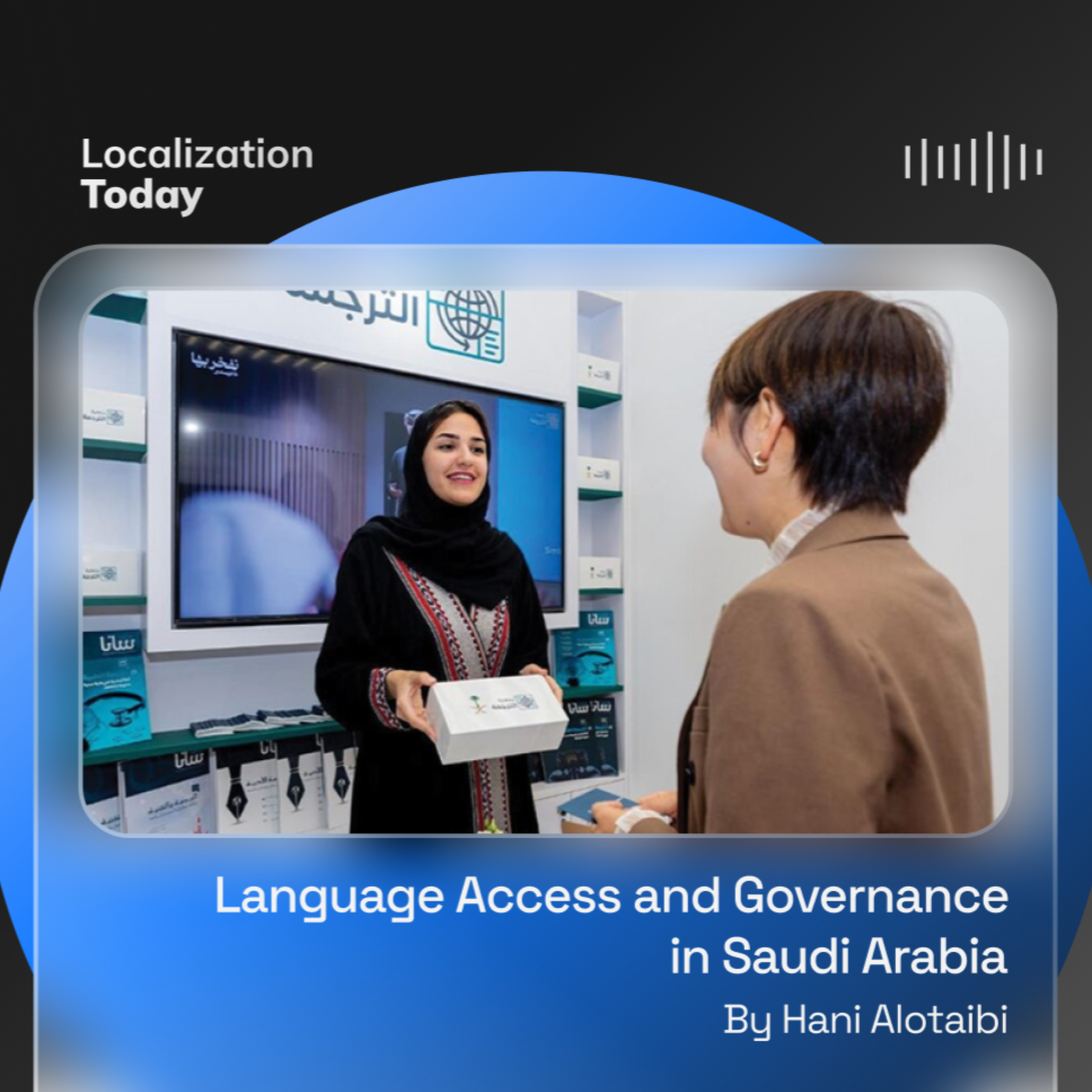
[00:00:00] Language Access and Governance in Saudi Arabia by Hani Alatabi In Saudi Arabia, language policy has increasingly been shaped by questions of access, service delivery, and institutional clarity. As the Kingdom advances its Vision 2030 programs, language is no longer viewed solely through a cultural lens, but as a practical instrument that determines how public services are understood and used by a diverse population.
[00:00:31] This shift reflects a demographic reality as much as a policy choice. By mid-2024, Saudi Arabia's population exceeded 35 million, with non Saudi residents accounting for approximately 44% of the total population.
[00:00:49] Non Saudis also represent most of the working age population.
[00:00:53] In this context, language access is not a marginal concern but a structural feature of governance. As Saudi Arabia's engagement with global markets, international institutions, and large scale visitor flows has expanded, so too has the range of languages encountered across regulatory, judicial, and service environments. Foreign investors, expatriate workers, residents, and millions of annual visitors must navigate legal systems, administrative procedures, and public services that were historically designed for Arabic speaking users.
[00:01:31] Ensuring that non Arabic speakers can understand and access these systems has therefore become a policy concern tied directly to transparency, service quality, and accessibility.
[00:01:43] Translation and interpretation have emerged as central tools in addressing this challenge.
[00:01:49] Rather than relying on informal mediation or ad hoc solutions, Saudi Arabia has moved towards structured language governance, positioning language access as part of public infrastructure.
[00:02:01] Formalizing Language Access this shift became formalized in 2024 with the issuance of Council of Ministers resolution number 483.
[00:02:13] These binding laws introduced for the first time a comprehensive framework governing the translation and publication of legal and regulatory texts issued by government entities.
[00:02:25] The resolution means that translation is no longer treated as an auxiliary task, but as a governed process with defined authority, accountability, and standards.
[00:02:36] Under the resolution, regulatory instruments issued by ministries and agencies and draft laws published for public consultation are subject to translation and public availability requirements.
[00:02:49] The framework provides for document specific timelines with transitional periods for legacy texts and shorter publication cycles anticipated for newly issued laws, regulations, and draft projects.
[00:03:03] English is designated as the primary access language, reflecting its role in international business and law. While other United nations official languages can be translated into where necessary, responsibility for implementation was assigned to the Official Translation Division within the Bureau of Experts at the Council of Ministers.
[00:03:24] The Division oversees translation workflows, review, and final approval supported by a joint committee that includes the Ministry of Investment and the National Competitiveness center.
[00:03:36] Translation work may be carried out by the Division itself or, where capacity or specialization requires, by qualified agencies. In all cases, translations are subject to standardized review procedures and unified terminology guidelines developed in coordination with the country's Literature, Publishing and Translation Commission Workforce Policy and Sotization Language governance does not stop at texts it also reshapes who produces them.
[00:04:10] Workforce policy has played a defining role in shaping Saudi Arabia's translation sector through the application of Saudization, which requires companies to hire certain percentages of Saudi nationals.
[00:04:23] Led by the Ministry of Human Resources and Social Development, this initiative forms part of the Kingdom's broader effort to expand employment opportunities for Saudi nationals across the private sector and to reduce structural unemployment. In line with Vision 2030 Human capital development Goals. In the translation sector, Saudization was formalized in which designated translation among the profession subjects to full localization.
[00:04:53] The decision applies across all private sector establishments operating in Saudi Arabia, not solely government contractors, and requires that translation roles be filled exclusively by Saudi nationals.
[00:05:07] At first glance, this may appear to be a conventional labor market intervention.
[00:05:12] However, the scope of application signals a policy choice to integrate language services into the Kingdom's long term workforce planning rather than treating them as peripheral or temporary occupations.
[00:05:25] At the policy level, Saudization serves several objectives.
[00:05:29] Nationally, it supports Vision 2030's target of increasing Saudi participation in skilled professional fields.
[00:05:37] At the sectoral level, it encourages the development of a more stable labor structure and translation, reducing reliance on short term staffing models, and reinforcing continuity within the profession.
[00:05:50] By extending the requirement across both public and private sector activity, the policy embeds translation into the Kingdom's broader employment framework. The implementation of sodization is governed by a detailed procedural framework issued by MHRSD.
[00:06:07] The framework defines targeted professions, sets a 100% localization requirement for translation roles, and specifies how compliance is calculated within establishments.
[00:06:18] Compliance is enforced through administrative measures rather than discretionary oversight.
[00:06:24] Establishments that fail to meet localization requirements may face restrictions on access to selected ministry services, including work permit renewals and occupational changes related to the targeted professions.
[00:06:38] These measures are designed to ensure uniform application of the policy across regions and sectors, reinforcing predictability for employers and service providers. Within the context of language governance, Saudization reinforces the treatment of translation as a regulated professional activity.
[00:06:56] With Saudi nationals forming the core workforce, greater emphasis has been placed on professionalization, standardization, and alignment with institutional requirements.
[00:07:08] By linking workforce composition to formal classification, licensing, and compliance mechanisms, the policy aligns labor regulation with broader language access objectives. In this framework, translation is positioned not merely as a commercial service but but as part of the institutional infrastructure that supports public communication and access.
[00:07:32] Workforce policy thus functions as an extension of Saudi Arabia's language governance model, connecting employment regulation with the organization of language services and ensuring that the expansion of institutional language access is supported by a locally anchored and regulated professional base.
[00:07:51] Language Access in Mecca the operational implications of this governance model are most visible in Mecca.
[00:08:00] Each year, millions of pilgrims from more than 180 countries arrive during Hajj and Umrah seasons, speaking hundreds of languages and converging in a confined geographic area over a limited period of time.
[00:08:13] Managing this linguistic diversity is essential for safety, ritual performance, crowd movement, and access to services.
[00:08:22] In this setting, language access is inseparable from risk management and public order.
[00:08:28] Over the past decade, and with increasing Momentum Under Vision 2030, Saudi authorities have transformed language support in the holy sites into a coordinated, multi agency system.
[00:08:41] At the institutional level, translation efforts are led by the Presidency of Religious affairs of the Grand Mosque and the Prophet's Mosque, the Ministry of Hajj and Umrah, and the General Authority for the Care of the Two Holy Mosques. These efforts are organized through initiatives such as the Custodian of the Two Holy Mosques Translation Project at the Two Holy Mosques, which provides a unified framework for multilingual religious communication.
[00:09:09] Weekly Friday sermons at the Grand Mosque in Mecca and the Prophet's Mosque in Medina are translated into 10 global languages. The Arafat sermon delivered during the Hajj is translated live into more than 35 languages and broadcast through television and digital platforms.
[00:09:28] Services for deaf and hard of hearing pilgrims, including live sermon interpretation in sign language, have also been introduced, reflecting a broader approach to inclusion. Translation extends beyond sermons.
[00:09:42] Multilingual signage across the holy sites provides guidance in major pilgrimage languages.
[00:09:48] Field interpreters are deployed in high density areas to assist pilgrims directly.
[00:09:54] Digital platforms, including the Nusuk app, offer multilingual guidance, permits, navigation tools, and official instructions.
[00:10:04] Artificial intelligence supports instant translation of text and speech into more than 20 languages.
[00:10:13] Language access in the Justice System A similar logic applies in the justice system, though in a different institutional register. As Saudi courts increasingly serve defendants, litigants, witnesses, and beneficiaries from diverse linguistic backgrounds, language access has become a procedural necessity rather than an administrative accommodation.
[00:10:37] Arabic remains the language of law and judicial authority, but effective participation in legal proceedings require structured mechanisms to address language barriers. To meet this need, the Ministry of Justice established the Unified Translation Center, a centralized service that provides real time remote interpretation for court proceedings across the kingdom.
[00:11:00] Integrated into the Ministry's digital litigation infrastructure, the center allows judges and legal professionals to access qualified interpreters through secure video conferencing, ensuring consistency and availability regardless of location. In this model, interpretation functions as an integral component of access to justice embedded within the judicial system rather than left to local discretion. The service has expanded steadily in scale and scope. It currently supports more than 47 languages and is staffed by a centrally managed pool of over 100 trained in house interpreters.
[00:11:40] Since its launch, the center has facilitated hundreds of thousands of interpreted hearings across criminal, civil, commercial, and and personal status courts, reducing delays and standardizing language access across judicial institutions.
[00:11:56] Language Access beyond the Courts the same approach to language access is increasingly visible across other areas of public administration.
[00:12:06] In recent developments, the General Organization for Social Insurance expanded language support within its mobile application to include Urdu, Bengali, and Filipino, extending access to core social insurance services for large expatriate communities from Pakistan, Bangladesh, and the Philippines. Through this expansion, users are able to access information related to contributions, entitlements, and services directly, reducing reliance on intermediaries and informal assistance.
[00:12:40] Language support is embedded into the service interface rather than offered as a separate or discretionary layer. While distinct from judicial interpretation, this initiative follows the same institutional language access is addressed at the system level, embedded into service delivery mechanisms rather than handled on a case by case basis.
[00:13:03] Together, these developments in the justice system and other public services illustrate how multilingual access is being incorporated into everyday administrative functions as a standard component of governance industry. Implications to support this expansion of institutional language access, Saudi Arabia has also formalized the regulation of language service providers through the Ministry of Culture and the lptc.
[00:13:34] Market participation requires obtaining a license to practice the translation profession through the Ministry of Cultures Abdiya platform, which serves as the official registry of authorized LSPs.
[00:13:47] Licensing applies to owners of translation offices and is issued following verification of commercial registration, declared activities, and professional eligibility.
[00:13:58] Licenses are issued for a one year term and must be renewed annually, reinforcing continuous compliance rather than one time authorization.
[00:14:07] The framework requires licensed providers to declare their operational scope requirements in detail.
[00:14:13] This includes the languages offered, areas of specialization, and types of services provided, such as written translation, interpretation, or audio visual. Translation offices are also classified by size based on the number of employed translators, ranging from micro offices with a single translator to large offices employing 10 or more translators.
[00:14:38] This classification introduces visibility into market capacity and aligns institutional demand with provider capability.
[00:14:46] Quality assurance is addressed through a combination of regulatory expectations and institutional practice for government and regulatory translation. Standardized review procedures, unified terminology resources, and multi stage validation processes are already in place through the Official Translation Division and its coordination with the lptc.
[00:15:10] While quality frameworks are not uniformly prescriptive across all market segments, the direction of travel is toward greater standardization in high risk domains.
[00:15:21] Overall, these developments point to a gradual reorganization of how the translation market operates.
[00:15:28] Language service provision is increasingly situated within defined regulatory and institutional frameworks, replacing earlier reliance on informal or fragmented arrangements.
[00:15:40] Regulation in this context provides a structure for consistency and accountability, linking market participation to declared capacity and compliance rather than ad hoc engagement.
[00:15:53] Conclusion Language access in Saudi Arabia has evolved through a sequence of policy interventions rather than a single overarching reform.
[00:16:04] Regulatory translation frameworks, workforce localization measures, professional licensing, and centralized service models have each addressed specific aspects of access, capacity, and delivery. This progression reflects an approach to language governance that emphasizes structure and institutional clarity.
[00:16:25] Language access is no longer managed as a standalone requirement but through policies that connect service delivery, professional practice, and administrative oversight. As these reforms continue to develop, their significance lies not in any single policy but in the ecosystem they create.
[00:16:45] By integrating language access into governance structures and public service design, Saudi Arabia has positioned language as a functional pillar of its broader institutional transformation.
[00:16:58] This article was written by Hani Alatabi. He is a localization project manager and PhD candidate focused on advancing language industry research.
[00:17:08] He works as an advisor and consultant supporting organizations entering and operating in the Saudi market.
[00:17:14] Originally published in Multilingual Magazine, Issue 248, January 2026.