Episode Transcript
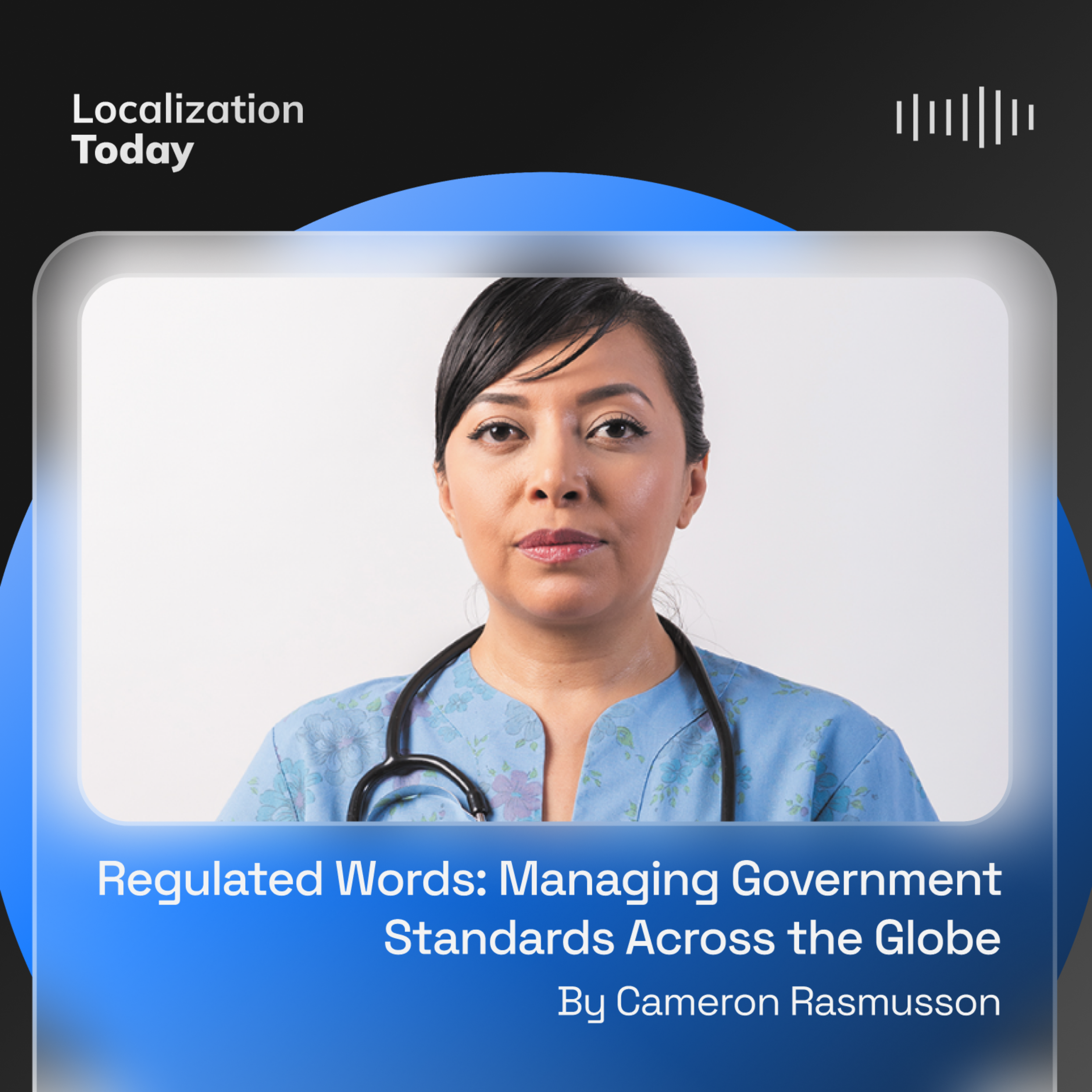
[00:00:00] Regulated Managing Government Standards across the Globe by Cameron Rasmussen Think of all the moments when clear communication is indispensable.
[00:00:10] The most intimate conversations with loved ones, the life milestones celebrated with friends and family.
[00:00:17] Those are the moments where the people you're with matter more than the moments themselves. Where language matters most. Or are they?
[00:00:25] Certainly, they're the moments that live best in memory. But then there are the more mundane beats of life that can carry equal weight and impact when mishandled. Doctor's appointments, lawyer consultations, immigration meetings, medical offices might be less memorable than wedding chapels. But miscommunication in these sterile environments can be far more consequential. If a person misunderstands treatment instructions or critical filing deadlines, the resulting mistakes can domino into much bigger problems. Given those realities, these regulated industries maintain strident standards that extend to language services, with the goal of minimizing the possibility of errors. For companies and linguists working within the regulated space, they face a complicated field that shifts in nature depending on the industry and global region in question.
[00:01:15] Linguava is one such company focusing its operations on healthcare in the United States.
[00:01:21] Language Line Solutions is similarly keyed into regulated industries, working in multiple global regions and industries. As personnel for both companies gauge the present and future of language service within regulated industries, they see the work as a matter of staying the course.
[00:01:38] Regulations change with the times, but the fundamentals of quality, translation and interpretation remain the same.
[00:01:45] The United Healthcare interpreted if there's one word that describes US Healthcare, it's complicated. In fairness, it's unlikely that healthcare is a simple affair anywhere in the world. But the number of laws and actors at multiple levels of American society and government can be overwhelming, particularly for the patients lacking the professional expertise to navigate the bureaucratic labyrinth. Laws at the federal, state, state and local level create, in the words of Carlota Ribas Lopez, Linguava director of translation and localization, a mosaic of regulatory standards for full compliance. While delivery of healthcare services for limited English proficiency individuals involves the coordination of patients, linguists, healthcare providers, insurance agents, pharmacists, and more, the regulatory requirements in the US have not changed much with the current administration, even after they made some important federal language access policy changes, such as designating English as the official language of the US section 1557 still requires that healthcare organizations take the necessary steps to provide meaningful access to LEP individuals, said Ribos Lopez. The major regulations for language service providers stem from Title VI of the Civil Rights act, which requires that healthcare providers accommodate lep individuals.
[00:03:12] Section 1557 of the Affordable Care act determines language access requirements for healthcare organizations, including the use of qualified medical interpreters and translators, and informing patients of their availability in the state's 15 most spoken languages.
[00:03:27] These standards were updated in 2024 to allow for machine translation with human review as required.
[00:03:34] The Health Insurance Portability and Accountability act governs the handling of protected patient information.
[00:03:42] The Centers for Medicare and Medicaid also include health plan regulations for language access, while the Joint Commission establishes standards for communication and patient safety. It's a sprawling tapestry of requirements. To be sure and to comply with them all, Linguava orchestrates a series of procedures to deliver sufficient services.
[00:04:04] They follow established standards to protect patient information, with dedicated training for staff, interpreters and linguists on HIPAA and fraud, waste and abuse regulations. When onboarding new linguists, rigorous vetting practices guarantee they possess the necessary experience, certifications, accreditations and subject matter expertise. Interpreters receive additional training and certification through the Linguava Interpreter Academy.
[00:04:31] Finally, their internal compliance team works with clients to audit their services and ensure compliance. Lenguava's choice to focus on healthcare was a deliberate one and not one necessarily motivated by commercial interests. Equitable access to healthcare for all Americans, regardless of their language proficiency, is central to their guiding mission, reiboz Lopez said. Central to this mission is our belief that every LEP individual deserves more than simply being heard and understood, rebuzz, lopez continued. They deserve a voice, a seat at the table, and an equal opportunity to participate in decisions that affect their health and well being. Playing the Global Field for companies like Language Line Solutions that offer services in multiple regulated industries around the world, the central task is to onboard linguists with the right qualifications for every particularity. And while there's plenty of overlap between various regulatory standards, each global region has its own unique qualities to consider.
[00:05:33] Take Europe as an example. The European Union's General Data Protection Regulation governs data protection policies throughout much of the continent, defining who owns accountability for compliance and governing safeguards for transfers outside the European Economic Area.
[00:05:51] These standards contrast with the United Kingdom's unique data policies and frameworks.
[00:05:56] And when companies like Languageline work all around the world, it creates interesting logistical challenges to ensure compliance. Who can access the content?
[00:06:06] Where will it be processed? What transfer safeguards are needed? What qualifications or certification will the receiving institution accept?
[00:06:15] These are all considerations that need well considered answers when working across national borders.
[00:06:21] But according to Language Line personnel, that complexity also creates an opportunity to build quality, security and accountability mechanisms that can adapt to fit each region's needs. We need consistent quality and security, but the workflow has to reflect local requirements from the language of a device's instructions to who can access patient information, said Tom Shaw, client solutions director for LanguageLI. For a global organization, consistency means being able to deliver the same confidence in every market while accounting for the requirements that make each market different. The differences among industries according to Language Line personnel who offer services for multiple regulated industries. While the specifics of regulations can vary, they typically break along three key data protection, access to essential services, and information accuracy.
[00:07:16] And some industries carry more requirements than others. The life sciences and medical device industries have regulations governing labeling, instructions for use and regulatory submissions with the U.S. food and Drug Administration governing oversight in the U.S.
[00:07:32] the EU Medical Devices Regulation, meanwhile, which oversees a broader range of linguistic diversity, requires that devices meet national standards in each country the company supplies.
[00:07:44] In other industries, data security is balanced with disclosure requirements.
[00:07:49] That's particularly true for the financial services industry, where the Gramm Leach Bliley act in the US Draws lines to protect the sensitive information of customers versus the disclosure obligations financial institutions have to the government or the public.
[00:08:04] Protecting legally secured data while distinguishing it from disclosure requirements, all while presenting the totality in clear, accurate language, is a balancing act on every project.
[00:08:16] Work within the legal and government sectors, meanwhile, packs yet another layer of specification, as regulations can also cover individual institutions under the broader umbrella. Title VI of the U.S. civil Rights act extends to education, where maintaining an even playing field for students means translating educational materials into the languages of students and their parents.
[00:08:39] Likewise, U.S. customs and Immigration Services mandate translations of all foreign language documents into English.
[00:08:46] The same sentence can carry very different consequences depending on where it appears in regulated content.
[00:08:53] Understanding those consequences helps us determine the expertise, review, and safeguards the translation requires, said Quarry Marker, vice president of sales for Language Line.
[00:09:04] To assign the right linguists to the right work. LanguageLine maintains a consistent process of checks and vetting. As always, the first step is understanding the assignment, and an initial review determines the intended use, destination, audience and sensitivity, as well as the appropriate regulations for all associated categories. Translation quality frameworks align with ISO 17100, while the company also maintains an ISO 9001 certified quality management system and Hitrus i1 certification for its translation division. Once those essential factors are established, administrators can assign a linguist to the project, and linguists are vetted and onboarded through a variety of metrics, including credential reviews, subject specific test translations, client specific onboarding, and ongoing quality evaluation.
[00:09:59] Assignments requiring specific credentials or certifications are matched appropriately and in compliance with security regulations. All data throughout the process is encrypted with role based access and multi factor authentication. Trust comes from being able to explain how the work was done, why the people and technology were appropriate and what controls supported. The result?
[00:10:22] That accountability has to be built into the service, markert said. Foreseeing the future between technological disruption and political turmoil around the world, it's a complicated time to work in any language field, but regulated industries are particularly impacted. But the more things change, the more they stay the same, according to Reiboz Lopez. Despite widely publicized moves by the Trump administration to declare English the country's official language, linguava's mission to provide quality language service for US Healthcare remained mostly unchanged over the past two years.
[00:10:57] And that's because regulated industries are still governed by codified law in the US section 1557 still requires that healthcare organizations take the necessary steps to provide meaningful access to LEP individuals, she said. But the rapid adoption of AI throughout language services puts the future of regulation into blurry focus.
[00:11:19] In 2024, a modified section 1557 opened the door for machine translation use in healthcare with review by a qualified human.
[00:11:28] But even with that change, Reibos Lopez said adoption has been relatively slow in the industry.
[00:11:34] This highlights the industry's continued focus on accuracy, quality and patient safety. Rybas Lopez said Language line personnel believe that as the world continues to adapt to the AI era, regulatory organizations will adopt more strident oversight over language service providers adherence to safety and accuracy expectations.
[00:11:55] That's not to say AI regulation is non existent. Service providers must meet an industry's requirements whether or not the technology contributes to a final product.
[00:12:06] But new regulation taking shape under the EU AI act may set the tone for technology specific standards to come. According to LanguageLine, the best approach is to build effective processes now and adapt. As governments establish universal standards, a fluent AI translation can still contain a consequential error. We need to evaluate whether it preserves the intended meaning in that specific context, then apply the level of human review the content requires, shah said. But as technology evolves and governments adapt to that evolution, the central function of regulated work hasn't changed.
[00:12:42] Amid the dizzying array of regulatory bodies, certifications, credentials and procedures, it's easy to lose focus on their raison dietray the human at the end point of service industries are regulated precisely so that humans can enjoy the precious moments of their lives, the milestones and the memories without being derailed by an unnecessary medical error or legal complication. That's why Rybas Lopez chose this line of work and why healthcare is her field of specialization.
[00:13:12] To make a real positive difference in lives every day.
[00:13:16] We believe that true language access should be measured not only by the availability of language services, but also by their impact on patient experiences, participation, and health outcomes, she said. Shifting the focus toward measurable health outcomes for LEP individuals would help ensure that language access translates into meaningful, equitable care. This article was written by Cameron Rasmussen, senior writer and editor for Multilingual Media.
[00:13:44] Originally published in Multilingual Magazine, Issue 257 November 2026.