Episode Transcript
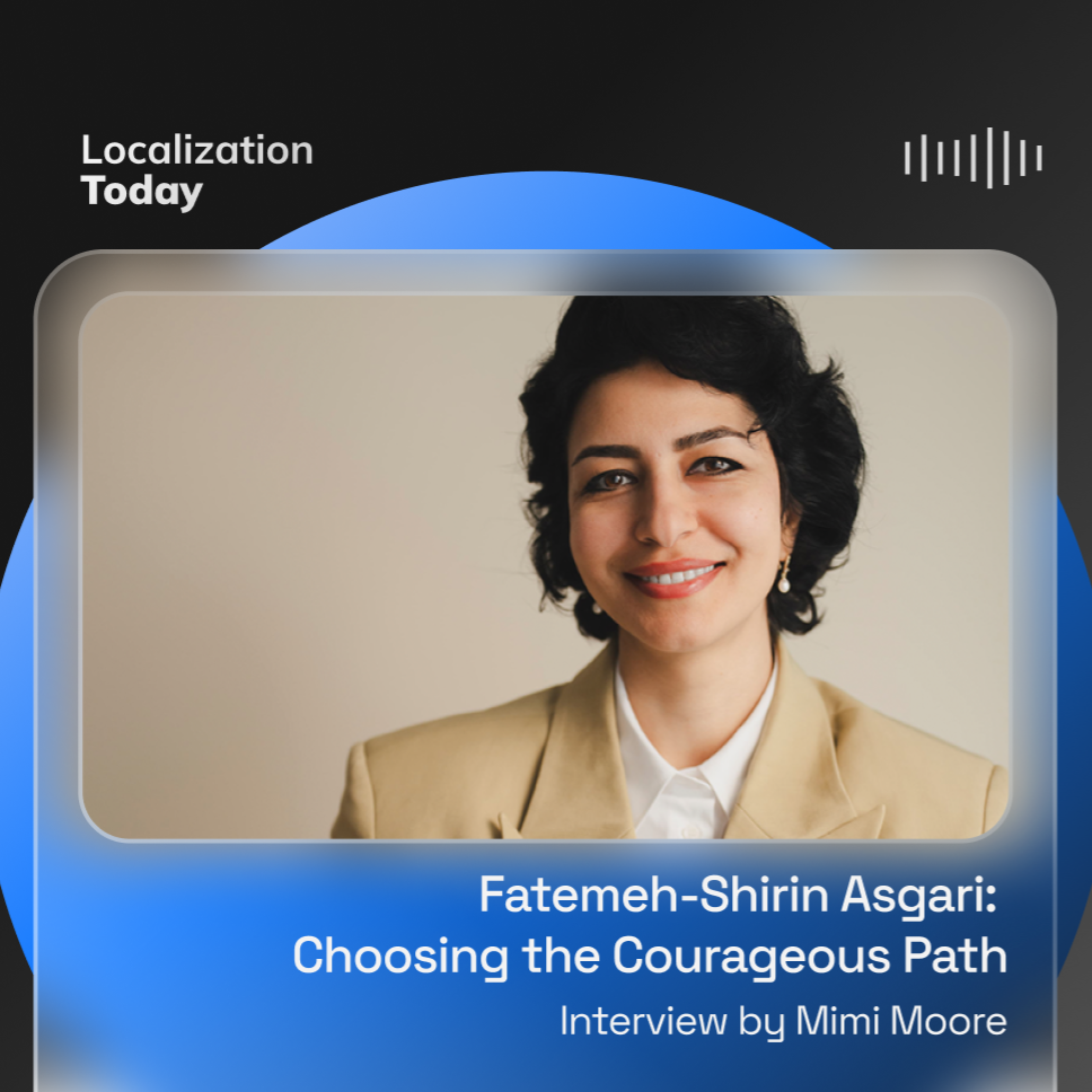
[00:00:00] Speaker A: Fatima Shirin Choosing the Courageous Path Interview by Mimi Moore A fulfilling career is a series of courageous decisions.
For Fatmashirin Asghari, this idea took shape through a lifetime of choosing unfamiliar routes. Growing up in Tehran, Asghari learned that progress often depends on persistence.
Educational opportunities were competitive and expectations for women were clearly defined.
Choosing to study away from home and later moving to Austria meant stepping outside those boundaries without knowing what would come next. When she arrived in Vienna, she had to learn German and rebuild her professional experience.
Asghari placed herself in situations where learning was unavoidable, volunteering, enrolling in a master's degree program and working within an entirely new system.
Asghari now works on artificial intelligence AI driven language initiatives for Osterreichi Bundesbahnen, Austria's rail system, where clear communication is as critical as infrastructure.
Her career has spanned international business, translation and technology, each adding to how she approaches communication and systems today. But it's language that makes her story possible.
What started as a way to connect to the wider world has led to a dynamic career, facilitating communication and making the journey easier for others.
In this interview, Asghari discusses how openness and adaptability enabled her to pursue an unconventional path and achieve remarkable personal and professional growth along the way.
What does courage mean to you and how did it take shape as you were growing up in Iran?
[00:01:44] Speaker B: For me, courage means doing new things even when you don't know how it will turn out. It may be good or not, but you do it anyway, out of curiosity or interest in the desired output because you want to achieve something.
It can be something small, like cooking a new recipe, or something bigger, like moving to a new country.
My first courageous decision was when I was 18 and I told my family that I was going to university in a city outside Tehran. For girls like me, it meant breaking unwritten rules.
Because of the intense competition, I spent a year preparing for the national university entrance exam and ended up ranking 510 out of around 300,000.
With that result, I became the first girl in my family to attend a national university and move far from my family to study. Growing up in Iran taught me how to deal with resistance and how to pursue my goals despite it.
Resistance started in the family and extended to the university, workplace and society, but it was important to not stop and to find a way to continue.
Just as training strengthens muscles, navigating difficult conditions taught me discipline, resilience and how to achieve my goals. These skills have shaped both my life and my career.
[00:02:57] Speaker A: Did you study languages when you were In Iran?
If so, why?
[00:03:02] Speaker B: Yes, my interest in languages grew from my desire to understand what was happening in the world.
In an isolated country like Iran, the only way to remain hopeful that there was a freer world out there was to learn English.
Some people asked me why I was learning English and if I was going to move abroad.
Somehow. The idea of moving to another country was always part of my future vision. But even if I didn't move, I wanted to learn English because it was a door to a bigger world.
[00:03:31] Speaker A: Before moving into AI, you worked in supply chain, in project management, and as a book translator.
What connected these seemingly different roles? And when did you sense your career might evolve in a completely new direction?
[00:03:46] Speaker B: I always did things that I found interesting and that allowed me to learn and grow.
What matters to me is staying curious, being open to learning new skills, and not being afraid of changes.
Of course, uncertainty is unavoidable, but I've learned that it is part of the journey and that it is important to continue despite it.
A career is like an adventure trip. You should be mentally prepared for change, but you can decide when and what the change will be based on your path, your skills, and the possibilities around you.
You can use recent experiences to develop new abilities and then see what you can do next.
I learned this when I moved to Vienna. I realized I couldn't do the same job that I did in Tehran because the economic system was completely different. As a newcomer, I had to learn the culture and language better.
So I started working as a translator with the language knowledge I already had in German and English. This allowed me to enter the economic system and learn it later. I decided to take a full time job to expand my capabilities.
I was open to starting in a different field because I was ready to learn. I was hired by OBB as a strategic procurement specialist and I stayed there for a few years before changing my field to AI.
[00:05:00] Speaker A: Beyond the practical challenges of language and culture, how did moving from Iran to Austria shape your sense of identity?
[00:05:07] Speaker B: Moving to Austria was undoubtedly challenging and at the same time, one of the most beautiful experiences of my life. It felt like stepping into a parallel world, almost into a different time.
That contrast triggered the deepest personal growth I have ever experienced. One of my earliest realizations was that a country is far more than its language.
Communication is about not only vocabulary and grammar, but also how people think before they speak. I grew up in a fundamentally different system, was taught a different version of history, and as a woman, was shaped by very different values.
Austrian and European cultures were a shock at first.
Bridging that gap required a great deal of openness, self awareness, and willingness to question my own assumptions as much as those of others.
My response was deliberate exposure. I consciously placed myself in unfamiliar situations as often as possible.
I worked long hours, attended cultural and sporting events, and met people from a wide range of backgrounds.
Through this, I began to understand the social fabric around me and, importantly, to decide where I wanted to belong. There is something profoundly liberating about entering a society where no one knows your past.
It gives you the freedom to position yourself intentionally and design your life with clarity and choice.
In Austria, I was able to redefine myself to a certain extent and consciously decide who I wanted to be in this new context. That process reshaped not only my identity but also my sense of agency, belonging, and purpose.
[00:06:43] Speaker A: Adaptability is clearly one of your strengths.
How does that mindset influence how you approach challenges?
[00:06:51] Speaker B: I believe adaptability requires courage.
After arriving in Austria, I began volunteering as a translator for social organizations supporting refugees from Afghanistan and Iran.
My German was far from perfect, but it was stronger than that of many of the people I was helping. It was not the role I had originally envisioned for myself in Austria, but it was the most meaningful contribution I could make at that moment.
Adapting meant doing what was possible, not waiting for perfect conditions.
A similar mindset guided me during the pandemic. I started reflecting on market dynamics and the future of my profession, and I realized it was time to expand my horizons.
I was deeply curious about emerging technologies and wanted to understand them beyond being just a user. I also wanted to work in a field that is constantly evolving.
That is why studying information technology, it felt like the right choice.
The intersection of technology and business particularly fascinated me, and adapting my skill set became a conscious strategy to respond to a changing job market. For me, adaptability means staying open to alternative paths that may lead to the same destination in unexpected ways. In Persian we say, stagnant water will rotate. Keep moving.
That philosophy continues to guide how I approach challenges today.
[00:08:13] Speaker A: Working as a volunteer translator helped you integrate into Austrian society while also supporting other migrants. Why did you want to volunteer, and how did this experience shape who you are now?
[00:08:25] Speaker B: I have volunteered in one form or another throughout most of my life. For me, volunteering has never been about achievements or recognition.
It offers something deeper, a sense of meaning and purpose beyond performance. While quietly supporting personal growth and shaping one's identity, you become someone who acts on values, and from that grows a confidence that is calm, steady, and lasting.
At that time, volunteering as a translator was a win win Win situation.
I supported people who could not speak German or English and needed help finding their way. In Austria, I helped social organizations reach those they were meant to serve. And at the same time, I gained a deeper understanding of Austrian society.
Looking back, I would do it again, even without receiving anything in return.
The fulfillment that comes from giving, especially when it helps others find their footing in a new country, is something no monetary reward can replace.
[00:09:23] Speaker A: You're also active with Women in AI Austria and other initiatives supporting women in tech.
Why are these communities important to you?
[00:09:32] Speaker B: I was the first girl in my family to go to university and the only one who moved to another country. I never had female role models to inspire me to be independent and self sufficient.
I tried to look up to men who were living my dream life or had my dream job, but it was not what I needed as a young girl. Because men go through different challenges than women do, I believe it's crucially important to be visible as a woman in technology, a career changer and a migrant to inspire girls who may have a background like Women in AI. Austria is a perfect organization for me because women from different industries and AI come together to share experiences and empower one another.
These networks help me by sharing information and experiences.
Having a dialogue with other women and hearing their stories inspires me and expands my horizons.
The most valuable thing is the inspiration and positive collective energy I get from people who are not working directly with me, but who have more or less the same challenges in their daily work. Before Women in AI, I joined the Women in ICT network in Vienna, which also empowered me to change my career direction. Women with different jobs in IT meet regularly to talk about their challenges, progress and experiences.
As a young woman in a new environment, it was very helpful for me to know other women in this field who I could look up to.
Now I am part of these networks primarily to support others and to create visibility.
This visibility benefits us as members, but it is even more powerful in reaching younger women who may be looking for role models, inspiration and encouragement.
There are so many outstanding women doing remarkable work. Making them visible matters because it shows girls and boys that greatness is not defined by gender, but by courage, talent and opportunity.
[00:11:20] Speaker A: Many migrants describe a moment when they finally feel at home in a new culture or language.
When did you experience that moment in Austria?
[00:11:28] Speaker B: For many people, feeling at home in a new country begins with learning the language and being able to make friends, join communities and share one's story. That was certainly part of my journey as well. But the moment I truly felt at home came when I stood on a stage in Vienna and delivered my first keynote speech in German.
After nine years of learning, changing and growing, that moment marked my arrival.
Speaking about AI in German, my third language, was when I deeply felt that I belonged not only socially, but also within Austria's business and professional world. A second moment followed later when I began volunteering as an integration ambassador.
In this role, I visit schools with colleagues from the Austrian Integration Fund to speak with teenagers about migration, integration, shared values, and living together in a diverse society.
Every time I do this, I feel that I am giving something back to a society I now call my own.
[00:12:27] Speaker A: You're currently working on a real time bilingual communication system for rail operations at OBB. What problem is the project designed to solve?
[00:12:36] Speaker B: BATE, or bilingual EisenbaumTribe AI technology for Xcitebersetzung is an automated translation tool designed to facilitate smooth cross border communication between dispatchers, train drivers, transport shunting personnel and emergency organizations.
With a large language model and a retrieval augmented generation framework in the background, it helps our personnel with real time translations to ensure safe, efficient and integrated rail operations.
The aim is to reduce communication barriers between Austria and neighboring countries and to support colleagues in critical situations.
The application supports various communication modes including text to text, text to speech and speech to speech and it can be adapted to local requirements of every border station.
[00:13:26] Speaker A: Where do you see language intelligence heading from here?
[00:13:29] Speaker B: The future of language intelligence and mobility lies in its ability to turn complex safety critical transport systems into understandable, trustworthy and coordinated ecosystems.
Language becomes the connective tissue between data machines, operators, passengers and regulators. Translating real time signals into explanations, supporting human in the loop decisions and making trade offs around safety, efficiency and fairness explicit. In the future, language intelligence is not going to be just a translator or summarizer, but a shared reasoning surface that can connect abstract concepts like law, tech and strategy.
I am really excited about how powerful it's going to be because language has always been the power that frames the problem and controls the narrative. In the future it will help us design better decision environments.
[00:14:23] Speaker A: Looking ahead what's next for you?
[00:14:26] Speaker B: What excites me most about my future is the freedom not to define it too precisely. I rarely plan far ahead.
Instead, I invest in learning across roles, industries and cultures while paying close attention to how my own interests and strengths evolve over time. I believe that starting over in a new field is not a weakness, but a sign of growth. People change, perspectives shift, ambitions mature, and when they do, our career should be allowed to evolve with them.
Staying curious, adaptable and and true to who I am becoming matters more to me than following a predetermined path. This mindset is how I shape my professional future.
[00:15:08] Speaker A: This article was written by Mimi Moore. She is owner of Netherlands based Wolfson Haus, writing a content marketing agency for LSPs, language technology companies and B2B technology companies.
She has 25 years of experience in the localization industry and is Program Manager, Content and Social Media for Women in Localization.
Originally published in Multilingual Magazine, Issue 249, January 2026.