Episode Transcript
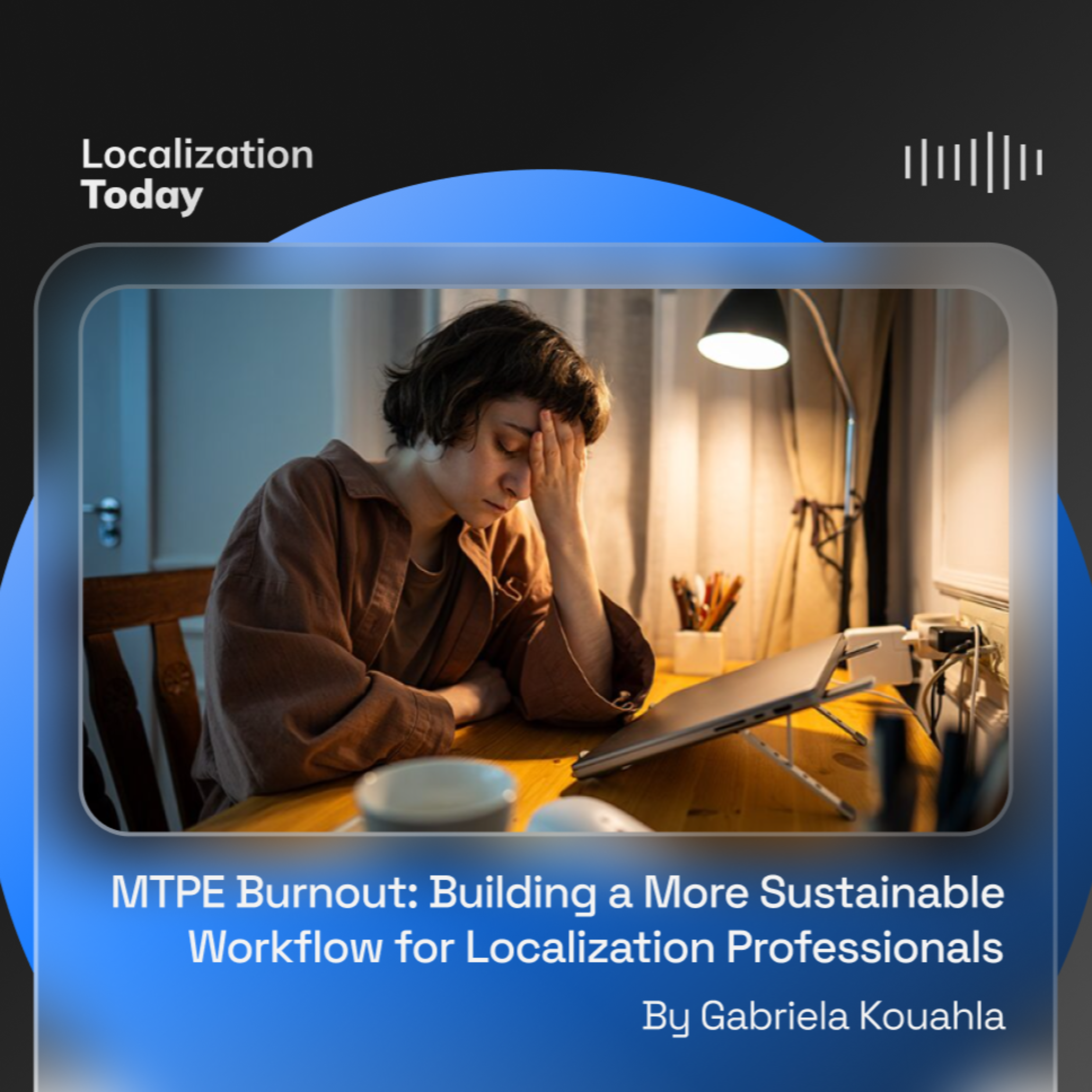
[00:00:00] MTPE Building a More Sustainable Workflow for Localization Professionals By Gabriela Kuala Professional well being is the foundation of a productive and fulfilling work life in the language industry. Reflections on how we care for ourselves and others in our daily lives are particularly urgent.
[00:00:21] The relentless acceleration of tools, processes, and expectations has reshaped not only how we work but but also how we think about our place within the system. It is therefore the right moment to pause and talk about something that quietly erodes motivation and trust across our field. Machine Translation Post Editing Burnout the emotional and mental exhaustion that emerges when people are asked to perform at the crossroads of impossible speed, invisible labor, and undervalued expertise, MTPE has become a defining element of the modern localization workflow.
[00:00:57] On the surface, it represents progress, faster turnaround times, reduced costs, and greater consistency. But underneath, it often feels like walking a narrow path between productivity and exhaustion. Linguists spend hours polishing almost right sentences expected to achieve human quality with machine speed.
[00:01:18] Project managers balance shrinking budgets with expanding expectations, often absorbing client pressure that goes unseen. Buyers, in their search for efficiency, sometimes overlook the invisible human toll behind the automation. The result is a paradox, a process that appears perfectly optimized yet quietly drains the people at its core. This article is not an argument against technology, nor a nostalgic longing for a world before artificial intelligence.
[00:01:49] It is a call for balance to make MTPE work for us, not against us, and to integrate technology with ethics, sustainability, and humanity.
[00:01:59] Because if we choose to use these tools, we must also choose to protect the people who use them. The human cost of MTPE burnout rarely appears suddenly. It builds quietly in the background of productivity charts and deadlines. It starts with one more late night, one more unacknowledged correction, one more light post editing task that turns out to require full retranslation.
[00:02:25] Over time, it becomes a chronic state of exhaustion and emotional detachment. For linguists, this often manifests as a sense of invisibility.
[00:02:34] They work tirelessly to fix machine generated content that looks coherent but misses meaning only to be told that the machine has done most of the work.
[00:02:44] The pay is lower, the recognition scarce, and the responsibility immense. MTPE demands unwavering attention, critical thinking, and cultural sensitivity. Yet it is often perceived as mechanical work, stripped of creativity and nuance. PM's face another form of strain position between business objectives on one side and human realities on the other. PMs often carry expectations from both directions.
[00:03:11] They are expected to deliver more with less time to defend freelancers while meeting business metrics and to ensure quality while racing against algorithms.
[00:03:22] Many describe the emotional fatigue of trying to protect people while keeping projects afloat, a form of quiet pressure that seldom appears in productivity reports but defines the real human experience of the job. Buyers, too, carry a role in this cycle.
[00:03:38] Most act with good intentions, aiming to modernize processes and improve outcomes. Yet without understanding the nuances of mtpe, the difference between light and full post editing, or the real time and focus involved, their decisions can unintentionally deepen burnout. What seems like efficiency in theory often translates to exhaustion in practice. The spreadsheets balance, but the people behind them struggle.
[00:04:05] Why MTPE leads to Burnout Ultimately, MTPE burnout is about disconnection. When professionals lose sight of purpose, the fatigue becomes existential. There are four primary reasons for burnout from one. The rate trap Compensation that feels unfair is often the first symptom of imbalance.
[00:04:28] Translation productivity has long been measured per word, a model that rewards output but ignores cognitive effort. When MTPE arrived, many assumed that because linguists were technically producing fewer words, they deserved lower pay.
[00:04:44] Discounts of 30%, 50%, or more became the norm and were often applied automatically, without accounting for quality or context.
[00:04:52] Yet MTPE is not mechanical repetition.
[00:04:56] It is intellectual labor reading, evaluating, rewriting, and maintaining meaning under time pressure. When compensation drops while cognitive effort remains constant, exhaustion follows.
[00:05:08] 2. The identity shift Many linguists chose this career not for speed but for substance, to carry ideas across cultures and to shape thought through language.
[00:05:20] NTPE alters that relationship. Instead of creating, you correct. Instead of authoring, you supervise. The result can be a painful loss of pride and purpose. When linguists are told that the machine did most of the work, they begin to question their value.
[00:05:36] 3. The hidden cognitive Load MTPE looks easy from the outside. The text already exists, the process seems streamlined, and the tools promise speed, but the real strain is invisible.
[00:05:50] Post editors must read faster, think deeper, and stay constantly alert to subtle errors in tone, logic, and coherence. The better the MT output, the more deceptive those errors become and the harder the mental work. Fatigue sets in quietly, amplified by unrealistic productivity. Metrics that ignore content complexity or language pair for the silence and the stigma.
[00:06:15] Many professionals perform MTPE but avoid mentioning it publicly, fearing judgment from peers or a perception of devaluation.
[00:06:23] This silence isolates, prevents collaboration, and makes it harder to advocate for fair treatment. By refraining from talking about mtpe, we allow unrealistic expectations to dominate.
[00:06:36] I've been there too.
[00:06:38] I know this exhaustion intimately.
[00:06:40] There was a time when clients expected what I now call MTPE miracles. Same day delivery, perfect quality and a 50% rate cut. I remember opening files that had passed through multiple engines filled with errors that no automation could fix.
[00:06:56] It felt as though my years of experience, sense of linguistic rhythm, and cultural intuition suddenly counted for less than a machine subscription. The frustration was real, the sense of being reduced to an invisible fixer even more so. At one point I realized I had two choices. I could hate mtp, complain endlessly, and blame AI for everything that was changing around me. Or I could learn how to master the tools, how to analyze the output critically, and most importantly, how to speak up. I chose learning. I started measuring my real productivity not in words per hour, but in focus, decision making, and mental load.
[00:07:38] I began explaining to clients why poor MT quality increases effort, why not every text suits automation, and why fare rates depend on measurable complexity. Over time, I learned to negotiate based on data, not emotion, and to define my boundaries. Clearly, that experience changed how I saw the work. I was no longer reacting to technology I was mastering it. I stopped viewing MTPE as the end of translation and started seeing it as an opportunity to use my skills in new ways. This mindset shift didn't eliminate the challenges, but it gave me back ownership. It also taught me an important lesson. When we approach technology with fear or resentment, we lose control. When we approach it with awareness and boundaries, it becomes a tool for growth and collaboration.
[00:08:28] A New Understanding of MTPE it's time we recognize MTPE for what it is, a specialized, evolving form of linguistic work that deserves respect, not shame. MTPE requires analytical skill, ethical reasoning, and domain expertise. MTPE does not erase the translator's voice, it reframes it.
[00:08:50] Rather than just fixing AI, linguists are translating through it, turning machine output into human understanding. Authorship in MTPE doesn't disappear, it evolves. The post editor's craft lies not in invention but in precision, ensuring that meaning survives translation through technology.
[00:09:10] Recognizing this shift restores dignity. As the one who ensures clarity, tone, and trust, the linguist becomes a decision maker, not a data processor. Finally, MTPE is not a magic shortcut that replaces human expertise. It is a partnership between technology and translators who ensure that meaning, tone, and inclusivity remain intact. While machines generate sentences, humans measure resonance, sensitivity, and context, building a shared MTPE culture.
[00:09:43] Ethics in MTPE is about fairness, consent, and transparency.
[00:09:47] Avoiding MTPE burnout is not about one grand reform, but rather about consistent mindful habits across every role. Sustainable MTPE workflows grow from shared literacy, a collective understanding of what post editing involves, what fairness means, and how human effort should be valued.
[00:10:07] The foundations of a Healthy MTPE culture are clarity before speed, the right tool for the content, fair rates tied to effort, open feedback channels and recognition that attention and focus are finite resources. When applied sincerely, they turn MTPE into a model of collaboration where technology enhances, not replaces, human intelligence. The path from shame to leadership begins with visibility.
[00:10:34] Linguists who share their experiences, data and challenges help shape the standards of the future. Each explanation of what ethical MTPE involves, from fair pricing to realistic productivity, raises the industry's collective awareness. The more we teach clients and PMs what sustainable MTPE looks like, the more influence we gain over its direction. The transformation to sustainable MTPE will require changing how we measure value.
[00:11:03] Instead of counting words, we must calculate time, real measurable time that includes reading, reviewing and quality assurance.
[00:11:12] When linguists present data based calculations rather than emotional arguments, negotiations become professional and fair and transparency replaces tension.
[00:11:23] Practical Paths Forward Whether you are a linguistic PM or buyer, the path forward begins with awareness and continues with courage. The courage to speak up, define your standards and demand balance.
[00:11:38] For linguists and vendors for linguists, sustainable MTPE starts with ownership. Define what post editing means to you and communicate it clearly. Explain the difference between light and full post editing and the time, expertise and focus each requires.
[00:11:55] The clearer you are about your process, the more respected your work becomes.
[00:12:01] Understanding your productivity in terms of hours rather than words empowers you to negotiate fairly. Data turns intuition into strategy. Continuous learning is also a form of self care.
[00:12:13] Understanding your tools, language pairs and MT engine's behavior transforms anxiety into confidence. The more you know, the more control you have. Beyond all the technical mastery. Protect your mental energy.
[00:12:27] Alternate MTPE with creative projects. Take deliberate breaks and seek connection with peers.
[00:12:34] For project managers, true leadership in MTPE begins with discernment. Recognizing which content is suitable for post editing and which requires full translation.
[00:12:46] Not all text belongs in an MT workflow and acknowledging that is a sign of competence, not resistance.
[00:12:53] Running pilot projects, collecting feedback from linguists and evaluating MT quality prevent long term strain. Clarity is the next cornerstone. Vague instructions like light or full post editing mean little unless defined. PMs who establish measurable standards, tone, accuracy and consistency create trust and save time.
[00:13:16] When clients push for unrealistic targets or discounts. PMs have the data and experience to push back diplomatically.
[00:13:24] Advocacy is part of qa. Protecting teams from impossible demands ensures both morale and long term performance.
[00:13:32] Finally, PMs thrive when they view linguists as collaborators rather than suppliers. Recognition, transparency and respect build loyalty far faster than any automation metric. A team that feels heard will always deliver better quality than one that feels invisible for buyers and localization leaders.
[00:13:52] Buyers and localization leaders have more influence than anyone else in shaping the ethical landscape of mtp. The choices they make determine whether the system rewards speed or sustainability.
[00:14:04] Responsible buyers ask the right how is MT quality assessed?
[00:14:09] How are linguists trained and compensated? When is MTPE appropriate and when is it not?
[00:14:16] Reward honesty from your partners. If a language service provider or PM says that MTPE is not suitable for a specific project, trust that judgment. It is not resistance, it is professionalism.
[00:14:30] The best localization leaders understand that the real measure of success is not cost reduction, but ethical efficiency, the ability to achieve quality outcomes without eroding human trust.
[00:14:43] Seeing beyond the four letters when communication is clear, expectations realistic and respect mutual, MTPE based workflows can transform from a source of burnout to a meaningful craft. I now see MTPE as a mirror that reflects how we manage change, communicate expectations, and treat one another.
[00:15:04] Technology will continue to evolve. The real question is whether we evolve with it ethically, consciously, and together.
[00:15:12] If we approach MTPE with transparency, empathy, and curiosity, it can become an opportunity to rethink what collaboration means. Linguists can lead that change by mastering their tools and using their voices. PMs can sustain it by designing fair workflows that respect human pace.
[00:15:30] Buyers can reinforce it by valuing integrity over speed. We cannot erase the four letters mtp, but we can redefine what they stand for. Meaning, trust, purpose, and empathy. Meaning because every refined sentence carries a story worth telling Trust because collaboration depends on it purpose because language remains our bridge to understanding and empathy because it keeps us human in an increasingly automated world.
[00:15:59] If we hold on to these four pillars, MTPE stops being a source of exhaustion and becomes a shared practice of progress. The future of translation will never belong to machines alone. It will belong to people courageous enough to learn, adapt, and speak up.
[00:16:15] This article was written by Gabriela Kuala. She is a certified bilingual translator, localization vendor, and founder of Beyond Words Linguistic Services, the first Algeria based localization agency dedicated to research content.
[00:16:31] She writes regularly on ethics and accessibility in the language industry and she co hosts the podcast PM vs Team Play for Success, originally published on multilingual magazine issue 249 January 2026.