Episode Transcript
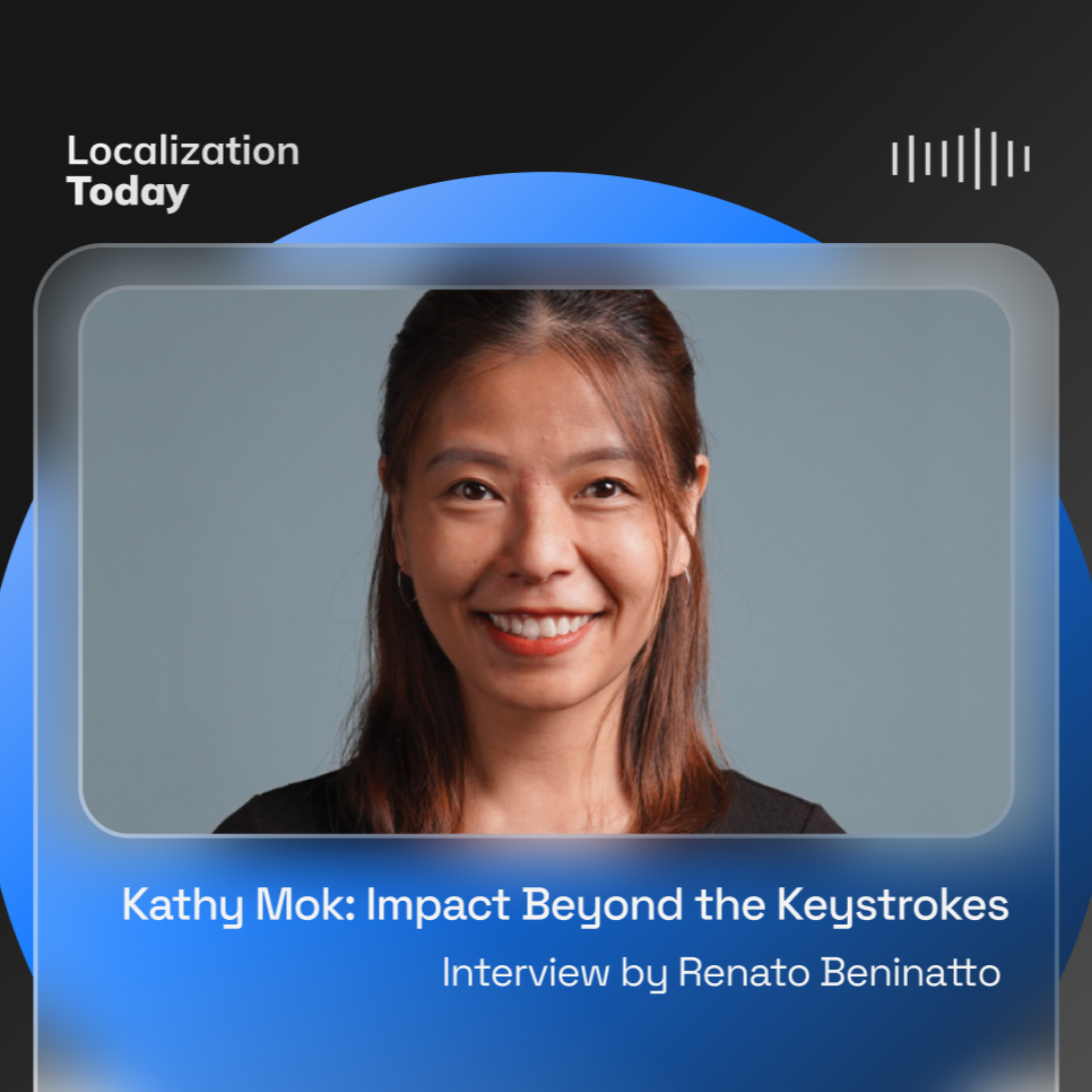
[00:00:00] Speaker A: Kathy Impact beyond the Keystrokes Interview by Renato Benignado Kathy Mach didn't set out looking for a career in localization. It found her drawn to translation within the publishing business. She eventually found her way to Silicon Valley and now stands at the epicenter of an industrial OpenAI overseeing internationalization and localization at the American Artificial Intelligence.
AI Mach's experience and position lend her a unique vantage point to understand an ecosystem that seemingly reinvents itself every month. As linguists continue to debate how AI technology will reshape language work, Mach believes an equilibrium will emerge that balances automated systems with human judgment, experience, and creativity.
Her ultimate goal is a world that connects and communicates on an unprecedented scale.
But part of that process is cultivating understanding and empathy in equal measure with speed and efficiency. And that dynamic is key to her work as she aims to ensure OpenAI services resonate across cultures.
No matter how words are generated, they still require ownership and responsibility.
For ma, the present challenge and excitement centers on not just what AI technology can accomplish, but but how humans will shepherd it into a tool that enables genuine communication and trust building.
You have built a localization career across some of the most influential global brands, including Apple, Disney, Uber, and Coinbase. Looking back, what common lessons did those environments teach you about what good localization leadership really looks like?
[00:01:51] Speaker B: I learned that localization leadership is leadership with the same fundamentals and the same accountability.
Be upstream and protect the brand are table stakes.
The real work is in the execution. It's speaking the language of product, legal, and engineering and translating your team's impact into business terms. It's building a team of thought partners you can debate hard, disagree openly, and still grab a beer after.
That only happens when leadership is grounded in trust and respect.
[00:02:24] Speaker A: Many people still enter localization accidentally. Was your own path intentional, or did it evolve organically as you moved across industries and roles?
[00:02:35] Speaker B: I didn't set out to build a career in localization.
I was on a different path early on, but a love of languages and storytelling pulled me into translation and publishing, and that became my gateway into tech.
Localization in Silicon Valley felt like the same craft at a larger scale, making meaning land for real people in different contexts.
I didn't come up through a traditional pipeline, so I learned by staying relentlessly curious. I read, I ask questions, and I learn on the job every single day.
[00:03:06] Speaker A: Having worked in consumer technology, entertainment, mobility, and financial services, how did those different content types and risk profiles shape the way you think about quality, speed, and accountability in localization?
[00:03:21] Speaker B: Different industries taught me one core quality is contextual and culture decides what good looks like in entertainment. Speed and voice matter in mobility. Clarity can affect safety in financial services. Accuracy and compliance are non negotiable.
But beyond industry, each market carries its own expectations of tone, precision and risk tolerance. If you're not genuinely curious about how real users interact with a product in their own context, language enablement only gets you halfway. Quality isn't just linguistic correctness, it's trust defined locally.
[00:04:01] Speaker A: You previously chaired women at Uber and have been active in advocacy and internal community building efforts.
What initially motivated you to take on that responsibility? And what did you learn from leading a global employee network?
[00:04:15] Speaker B: At the time, there was a lot of public conversation about culture and accountability across the industry.
At the time, there was a lot of public conversation about culture and accountability across the industry.
Inside the company, many of us were reflecting on the kind of workplace we wanted to help shape.
For me, it wasn't enough to observe. I wanted to contribute. I learned a great deal about advocacy and community building through my work on a non profit board in San Francisco, and I brought that same mindset into the role. Co chairing alongside two remarkable leaders was both energizing and humbling.
Together, we organized what became the largest female and non binary student hackathon in the Bay Area.
Operational complexity was real, but the lasting lesson was empathy. When you step into discomfort and genuinely try to understand someone else's experience, your leadership changes. Efficiency builds programs, and empathy builds trust.
[00:05:14] Speaker A: What role do internal advocacy groups play inside large organizations, especially in functions like localization that are often small, distributed, and easy to overlook?
[00:05:26] Speaker B: Internal advocacy groups create visibility and belonging in organizations that can otherwise feel very complex.
They give people a space to connect, share experiences, and build confidence across levels and regions. For smaller or distributed functions like localization, that model is instructive. Influence rarely correlates with headcount. It grows from clarity of impact and the ability to articulate that impact in a shared language the business understands.
Whether you're advocating for people or for a function, the principle is the do the work, understand what matters to stakeholders, and communicate it in terms they care about.
[00:06:07] Speaker A: For women building careers in localization and language technology today, what kinds of sponsorship or advocacy have you personally found most impactful, both as a recipient and as a leader?
[00:06:19] Speaker B: The kind of sponsorship that has mattered most to me is specific and visible.
It could be someone putting my name forward for a stretch role, trusting me with ambiguity, or advocating for my work when I wasn't in the room. That kind of belief changes how you see yourself over time. I've tried to pay that forward in a simple way by letting talented people do meaningful work, then naming their impact clearly and publicly. Opportunity grows when recognition is specific and advocacy sticks when it's spoken out loud.
[00:06:51] Speaker A: OpenAI is often discussed as a force that could either disrupt or redefine the language industry from the inside. How do you describe OpenAI's philosophy toward localization and multilingual access?
[00:07:05] Speaker B: From where I sit, multilingual access is fundamentally about enablement. Communication unlocks empathy and learning. If this technology is meant to serve billions of people, localization and language can't be an afterthought.
You simply don't reach global users without it. Without localized access, there is no growth, no inclusion, and no meaningful participation.
The goal is to expand that access responsibly, balancing speed with safety and scale with trust.
[00:07:37] Speaker A: I recently spoke with Lukash Kaiser at the TAWS conference and he mentioned that in the early days, engineers were sometimes asked to review translations themselves, such as Polish content.
As OpenAI scaled rapidly, professional localization clearly became necessary.
How did that transition take shape?
[00:07:57] Speaker B: In the early days, like many fast moving companies, there was strong internal interest in helping review and improve multilingual output. That's a healthy sign. Good products benefit from internal dogfooding, and language is no exception.
Different users experience language differently and that perspective is valuable. In the early days, like many fast moving companies, there was strong internal interest in helping review and improve multilingual output.
That's a healthy sign. Good products benefit from internal dogfooding, and language is no exception. Different users experience language differently and that perspective is valuable.
It's important to clarify roles, though. Research teams focus on advancing models and technical capabilities.
Localization, on the other hand, is about operationalizing language at scale, quality frameworks, workflow governance, market context, and accountability.
As the company grew, it became clear that informal review wasn't enough to ensure consistency and manage risk across global surfaces.
Today we still have a culture of open feedback, whether it's about product features, bugs, model behavior or language.
But alongside that openness, we formalize partnerships and processes to ensure multilingual quality scales responsibly at a high level.
[00:09:22] Speaker A: How is localization organized at OpenAI today?
For example, how do you think about centralization versus embedded support across product research, policy and communications teams?
[00:09:36] Speaker B: As we've grown, localization has evolved with the company.
Some elements are centralized to maintain consistency and quality standards, while collaboration with cross functional teams remains close and ongoing.
The balance adjusts as needs change.
We're a lean team and wear multiple hats, made possible in part by our own technology stack with which supports many aspects of our workflow. That flexibility allows us to stay agile while maintaining accountability as we scale.
[00:10:07] Speaker A: Without getting into confidential detail, can you share how OpenAI approaches localization from an operational standpoint? For instance, do you rely on a translation management system, external language, service providers, internal tooling or a hybrid model?
[00:10:26] Speaker B: We operate with a hybrid approach today, combining structured processes with flexible collaboration across teams.
We're continuing to lean into our own technology as we scale over time with increasingly advanced systems to drive the largest lift across our workflows. The intention is let automation handle what can be systematized so human expertise can focus on the highest value decisions like judgment, nuance, risk evaluation and brand stewardship. The exact balance will continue to evolve as the technology and the company grow.
[00:11:01] Speaker A: OpenAI famously drinks its own champagne. To what extent do internal language technologies inform or support your localization workflows and where do you still see a strong role for human judgment and review?
[00:11:15] Speaker B: Our internal tech does a lot of the heavy lifting. It helps us move faster, stay consistent and learn from feedback at scale. But the highest stakes decisions still require humans, especially around safety sensitive content and market specific norms.
[00:11:32] Speaker A: How do you personally define success in localization at a company like OpenAI?
Is it coverage, quality perception, speed, risk reduction, inclusion or some combination of all of these?
[00:11:46] Speaker B: Success in localization at a company like OpenAI is ultimately measured in real usage and real benefit.
If multilingual content helps someone actually engage with the product, learn something, build something, solve a problem, feel supported or access information they otherwise couldn't, and that interaction improves any aspect of their life, in my opinion, that's a success.
In practice. That means moving fast and staying responsible AI gives us leverage and speed. But high quality AI output only happens when it's shaped by human judgment, especially around safety, nuance and what good looks like in different markets.
[00:12:28] Speaker A: Working at a company that sits at the center of global conversations about AI, language and the future of work can be intense.
What helps you stay grounded and energized outside of work?
[00:12:40] Speaker B: OpenAI's culture is actually deeply human centric. The office is always energetic. There's a lot of intensity, but also a lot of laughter and curiosity. It's a place where people care deeply about the work and each other. Outside of work, My career has shaped a lot of my interests. I'm naturally curious and I genuinely use the kinds of products and services I've worked around.
I watch my Netflix and my Disney, I get around on Uber and I keep an eye on financial news, including what's happening in crypto, but my favorite reset is still the simplest one time with my family especially getting to experience every day firsts again through my toddler's eyes.
[00:13:23] Speaker A: Finally, if you could leave readers with one idea about localization at OpenAI that is often misunderstood from the outside, what would you want them to know?
[00:13:33] Speaker B: As someone who started as a translator, I understand the fear that the craft, the love of words might be diminished as AI becomes more capable.
But I would frame it differently. If we truly love words, we have to care about what they do. Words that don't move, clarify, or build trust are just decoration. AI can generate language at scale, but it cannot own the consequences of that language.
Loving words means caring about their impact, not just the keystrokes.
[00:14:05] Speaker A: This article was written by Renato Benignado. He co founded Nimzi Insights to provide research and analysis to investors, buyers and suppliers of language services.
He has written three books on global business.
Originally published on Multilingual Magazine issue 249 January 2026.