Episode Transcript
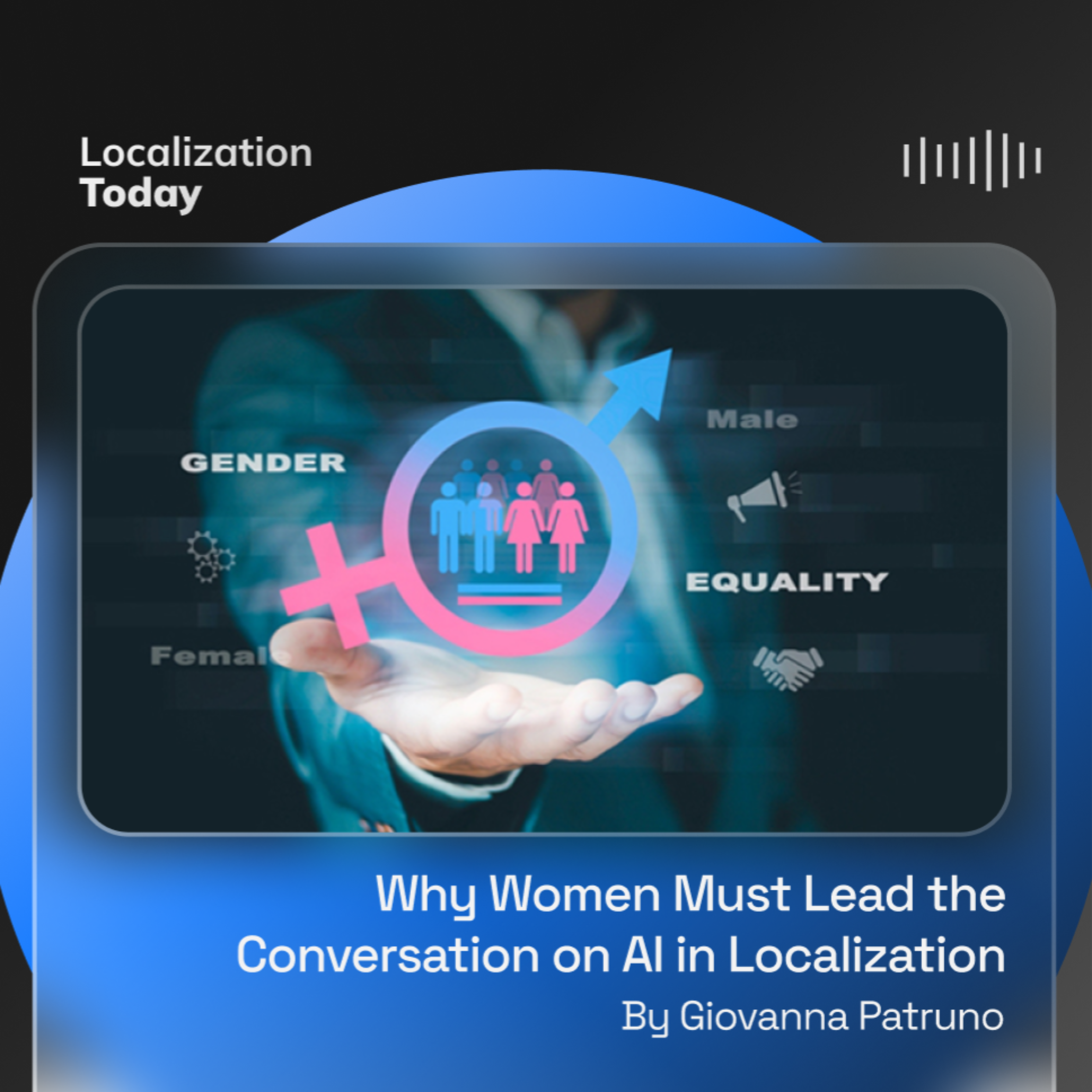
[00:00:00] Why Women Must Lead the Conversation on AI in Localization by Giovanna Portrano the localization industry is entering a phase in which artificial intelligence is no longer a supporting technology, but a core layer of infrastructure. AI systems increasingly determine how language work is routed, evaluated and priced.
[00:00:25] Decisions that once lived in the hands of practitioners or small teams are now embedded into models, orchestration layers and evaluation frameworks that operate at scale.
[00:00:36] Localization has become an AI mediated system, not simply a service discipline augmented by tools. This shift represents a redistribution of authority.
[00:00:47] As AI driven systems move upstream, influence concentrates around those who design, configure and govern them.
[00:00:55] These choices shape which forms of expertise are encoded into systems, which skills are amplified, and how professional value is defined across the industry.
[00:01:06] Increasingly, AI governance defines what localization work looks like, who performs it, and how success is measured. Participation in AI governance has therefore become a strategic issue, as the people who make these decisions will shape how localization evolves. As an AI mediated profession, these decision makers will be responsible for mitigating risks like bias and for building fair and resilient workflows across the industry.
[00:01:35] When decision making authority is concentrated within homogeneous groups, the range of assumptions encoded into systems narrows.
[00:01:44] Over time, those assumptions harden into infrastructure, influencing how quality is defined, how work is allocated, and which forms of expertise are recognized or rendered invisible. That's why diversity in AI governance roles, and specifically women's involvement, is crucial for the future of the industry.
[00:02:05] Currently, these leadership positions are disproportionately filled by men.
[00:02:11] If women continue to be excluded from shaping AI strategy, the industry risks developing systems without sufficient domain insights. But with diverse expertise at the governance level, the industry can reduce risk, improve system resilience, and support more sustainable innovation.
[00:02:30] A familiar question in 2008, Sylvia Avri Silvera, Eva Claudinova and Anna N. Schlegel founded Women in Localization in response to a different but structurally similar imbalance.
[00:02:46] Women were doing essential high value work across the language industry, yet their expertise rarely translated into leadership influence.
[00:02:55] Talent and experience were widespread, but access to decision making authority was not.
[00:03:01] The organization emerged to address the gap by building community, amplifying professional visibility, and creating pathways into leadership.
[00:03:10] Over the past two decades, those efforts have helped thousands of women advance their careers and shape the industry from within.
[00:03:18] Today, as AI reshapes localization's foundations, the same structural question reappears in a new form. Who has influence over the systems that will define the industry's future?
[00:03:31] The Current Landscape in today's localization industry, women lead complex global programs, manage linguistic quality across markets, oversee vendor ecosystems, and advise organizations on global content strategy. Their expertise spans linguistic, cultural, operational, and increasingly technical domains.
[00:03:55] And yet role distribution across the industry reveals a persistent imbalance.
[00:04:01] Women are heavily represented in execution focused positions such as project management, quality assurance, linguistic review, and delivery coordination.
[00:04:12] These roles require sophisticated judgment, contextual awareness, and the ability to manage complexity under pressure. They are also the roles most directly exposed to AI driven restructuring, automation, and redefinition. By contrast, leaders who shape how AI is selected, governed, and embedded into systems are primarily male. They include senior technology leadership, AI strategy and innovation roles, product ownership for language technologies, and executive positions that determine investment priorities and operating models. The consequences of this imbalance extend beyond representation.
[00:04:54] Decisions being made now will affect the inclusivity and sustainability of future technologies and processes.
[00:05:02] They will also determine which roles are amplified by AI and which are diminished, which skills are rewarded and which are deprioritized, and whose expertise is treated as central.
[00:05:14] Absence from those decisions translates into reduced influence over how the profession evolves.
[00:05:21] Bias as a System Level Risk as AI systems take on greater responsibility within localization workflows, questions of bias move from abstract ethics to concrete system design.
[00:05:35] Bias in AI is not limited to outputs. It is embedded in training, data selection, optimization objectives, evaluation thresholds, and feedback loops. Once encoded, these assumptions are propagated at scale, shaping outcomes far beyond their original context.
[00:05:54] In localization, these risks are intensified by the cultural and contextual nature of language. Work models trained primarily on high resource languages and dominant cultural norms can marginalize less resourced languages, regional varieties, and culturally specific forms of expression.
[00:06:14] Over time, this can produce homogenization where linguistic diversity is flattened in favor of statistically efficient patterns that fail contextually.
[00:06:24] Evaluation systems introduce an additional layer of risk automated quality estimation, confidence scoring, and routing logic increasingly determine which content receives human attention and which does not.
[00:06:39] Systems optimized for speed or surface level fluency may systematically undervalue pragmatic meaning, stylistic intent, or market specific appropriateness.
[00:06:50] These failures often surface indirectly through brand erosion, regulatory exposure, or declining customer trust.
[00:06:58] Governance structures determine how such risks are identified and addressed.
[00:07:03] Many of the professionals best positioned to mitigate these risks are women with deep experience in linguistic quality, cultural mediation, and operational complexity.
[00:07:14] Excluding those perspectives from AI governance increases the likelihood that localization systems will optimize for efficiency at the expense of relevance, trust, and long term sustainability.
[00:07:27] Encoding Expertise at Scale as AI becomes embedded in localization infrastructure, expertise is encoded into models, decision rules, escalation logic, and orchestration frameworks that operate at scale.
[00:07:44] Therefore, decisions about quality thresholds model evaluation Criteria, feedback mechanisms, and workflow orchestration shape how language work is structured and valued. Once embedded, these decisions are difficult to reverse, particularly as AI systems are integrated across content pipelines and business processes.
[00:08:05] Women participating in these upstream decisions is not symbolic it is a practical requirement for building systems that reflect the full scope of localization work.
[00:08:18] Inclusive AI Governance Ensuring that women help shape AI's role in localization is a shared responsibility across the ecosystem. Organizations adopting AI enabled localization solution should involve the professionals closest to the work in selection and implementation decisions.
[00:08:39] Technology providers should seek diverse perspectives during design, testing and iteration, as well as consider the downstream impact of their systems on professional roles.
[00:08:50] Industry leaders should examine who participates in strategic technology decisions and whose expertise is missing.
[00:08:58] These steps are not about optics they are about building systems that work technically, operationally, and culturally. Transformations of this scale succeed when governance reflects the complexity of the domains they affect.
[00:09:14] We Shape AI One initiative that is targeting this issue is Women in Localizations We Shape AI, which creates pathways for women with deep localization expertise to engage where AI systems are designed, evaluated, and governed. The initiative emphasizes fluency, access and influence rather than tool adoption.
[00:09:38] It supports women in developing the technical understanding needed to participate in strategic discussions about AI deployment and evaluation.
[00:09:47] It also connects practitioners across roles and regions to share insight into how systems operate in practice, including where automation succeeds and where it falls short. Women in Localization was founded on the recognition that talent alone does not guarantee influence, and that lesson remains relevant today. As authority moves upstream into AI systems, those without access to governance risk being sidelined. Regardless of experience.
[00:10:16] Creating pathways into that layer helps ensure that AI enabled localization systems are shaped by those who understand the work they mediate.
[00:10:26] Entering a New Phase the localization industry has reached a point where innovation is defined less by adopting new tools and more by governing complex systems.
[00:10:38] The question is whether this transformation will be guided by a narrow set of perspectives or informed by the full breadth of explanation the industry has developed. Decision making from homogeneous groups narrows the range of questions asked and limits the industry's ability to anticipate unintended consequences?
[00:10:57] Conversely, inclusive governance expands the solution space and strengthens long term outcomes. Will localization remain a domain driven field grounded in linguistic and cultural expertise, or will it evolve into a model where value is defined primarily by automation potential?
[00:11:15] The answer to this question is being written in decisions about model selection, workflow, orchestration, evaluation criteria, and investment priorities.
[00:11:26] Participation in those decisions will shape career paths, professional identity, and the future character of the localization industry.
[00:11:35] Ensuring that women participate in shaping AI governance is essential to building a localization industry that is resilient, credible and fit for a global AI mediated future.
[00:11:48] This article was written by Giovanna Petruno. She is a brand communication consultant with over two decades of experience in localization and content Strategy. She helps B2B technology companies showcase their unique value to build trust, drive influence and support long term global growth.
[00:12:09] Originally published on multilingual magazine issue 249 January 2026.