Episode Transcript
[00:00:03] Speaker A: Hello and welcome to Localization Today, where we explore how language, technology and community converge to unlock ideas for everyone everywhere. I'm Eddie Arrieta, CEO at Multilingual Media.
Today's conversation focuses on transformation at scale. WeLocalize, founded in 1997, has grown into a global provider of language services supporting enterprise clients across more than 300 languages, spanning translation, localization, AI enabled workflows, multilingual data, and managed language solutions. We'll explore how a company with that depth and history is evolving through rebranding new service models and platforms like Opal and what that says about where the industry is heading. Our guest is Paul Karl, CEO of WeLocalYze. Over the past three years, he has been leading the company through a period of significant change, aligning technology, services and talent to meet shifting enterprise demands. Paul, welcome to the show.
[00:01:12] Speaker B: Thanks, Eddie.
[00:01:13] Speaker A: Paul, once again, of course, we've been preparing for our conversation for quite some time and we were also saying that we joined the industry at roughly about the same time.
So we have a similar, at least period of time where we enjoyed the being part of this amazing industry. And you've been leading localized. We localize for the past three years. Now.
What surprised you the most when you stepped into the role? What can you tell us about that in this conversation?
[00:01:43] Speaker B: Yeah, sure. Well, yeah, we did join at roughly the same time. I remember us meeting three years ago and we let the audience decide. We let the audience decide as we look how much older we look at this point.
Look, I was new to the industry, okay, So I was new to localization, working in the local language services industry. I had been a buyer of language services, so I'd been on the customer side.
And so I think what surprised me when I joined welocalize is just the complexity of delivering language services, I think to the uninitiated, to most buyers, particularly those who don't come out of the industry, I think it's easy to underestimate what's really involved in putting together a sort of a global language supply chain and the process complexity and the edge cases and the management of talent.
So I think that was the, you know, and obviously, you know, with a truly global, you know, footprint from a, both a talent and a technology standpoint. So I think when I first joined and I was, you know, going to school on learning the business, that was probably the most biggest surprise.
[00:03:01] Speaker A: And of course, the past three years have been significantly, let's say, different.
For anyone who has been in the industry for the past 20 years, 15 years, things change very quickly after you join, or perhaps that is why you join. You know, looking at the industry today versus, you know, three years ago, what are the things that have changed? The way in which, you know, you take on your priorities, your leadership priorities. What has changed?
[00:03:35] Speaker B: Yeah, well, certainly the last three years has been, you know, pretty disruptive. You know, I joined in March of 2023. You know, the ChatGPT was launched in November of 2022.
So that definitely coincided. I mean, I think that what we're going through now with artificial intelligence is every bit as meaningful as, you know, fundamental shifts in technology and disruption that went on with the Internet period in the early 2000s, the late 90s, early 2000s. I mean, I think it's arguably as profound as the Industrial Revolution. I mean, we are just in one of those sort of once in a generation, massive technological shift. So I, I think certainly that is, you know, we've been living that over the last three years.
I think every, every industry is living this to some greater or lesser degree. Yeah, this is just a pervasive, disruptive kind of effect across many, many sectors.
From the standpoint of how does that. Well, okay, so what does the environment mean in terms of leadership approach? Leadership priorities?
A couple of things. One is that the.
We have had an obsessive focus on clients.
And yeah, look, having client focus and client orientation is a pretty good principle at the best of times. But when, when there is disruption going on, the best thing you can do to try to understand what that means is get really close to clients to understand how are they being impacted, what's going on on the insides of their organizations. Right.
How are they seeing demands shift and change?
How is the accountability model changing?
And for a company like ours, who serves many different types of clients in many different industries, that's been a really important thing, because unless you understand how clients are shifting, it's hard to.
It's hard to know what to do. Where do you invest, what do you prioritize? So anyway, staying very, very close to clients has been one aspect.
The second one has been going deeper and specializing in the way that we develop offerings and we serve those clients. And so when things are shifting around, understanding how you can add more value to a client's organization or a client's business is a pretty good strategy. And particularly when things are changing so rapidly.
And so that is, I would say, another big priority. The other, the other thing, Eddie, which I think is possibly less of a business priority, more of a talent culture thing is, is really thinking hard about Our culture and how we are operating faster, more boldly.
You know, we say internally operating with a startup mindset, as you highlighted at the beginning. Welocalize been around for, you know, 20 years, right?
But with everything changing, you almost have to go back to first principles and operate like a startup. So we, we regard ourselves as a startup business, even though we've been around for 20 years.
Because you have to go back and question everything right from first principle. Why are we doing things this way? Doesn't make any sense.
With client demand and, you know, requirements changing, how do we rethink what we do?
And so that has been a very deliberate set of initiatives and focus for myself and the executive team to tilt the culture to more of a startup kind of mindset.
[00:07:51] Speaker A: And that's really insightful. Paul, thank you for sharing. For sharing. And clearly you just talked about listening to your customers and paying attention to what they have to think about or what their demands are.
So you work with large global brands across over 300 languages. Now. How has the enterprise demand changed in the recent years? Before they were not saying AI, that's for sure. Now they are saying AI. What's happening there?
[00:08:19] Speaker B: Well, I think that for us, we serve, and we'll get onto this in a little bit if we talk about the way that we've evolved our branding. But as I mentioned, we have specialized the business around our primary customers. And so we have four or five primary customer types who are quite different. And the way in which demand has changed among those different customers has changed quite a bit. It has varied. So one group of customers is, you know, localization functions. So localization managers on the insides of large corporations. The demand landscape for those localization departments has gotten very, very messy over the last couple of years.
And that is reflective of the fact that those internal LOC functions are under tremendous pressure internally within those enterprises.
Early on, I think translation localization was viewed as a sort of a priority use case for AI on the insides of many enterprises.
And so those LO teams were under tremendous pressure to adopt AI. I mean, ironically, many loake teams had been adopting machine translation for many years. But, you know, anyway, they're under pressure. So.
The way those conversations have changed over the last couple of years is how do you think through solutions that incorporate artificial intelligence, that respond to the complexities and the nuances of delivering languages, but which help LOC functions be successful on the insides of their enterprises.
You know, with the, with the pressure to adopt AI. So it's been very consulted, consultative, those conversations.
Most, you know, it's fair to say most Lok functions, they don't know exactly what they want. Right. You know, prior to 2023, it's like, well, I want CAT tool and I want machine translation. I want to add these languages and I want to add these content types.
The conversations more recently have been far more consultative. How do you reimagine the entire. Right. Workflow and delivery apparatus to take advantage of AI, but also to, you know, incorporate the complexities of language services? So those have been the conversations with localization functions on the other end of the spectrum, you know, let's say life sciences. So our clients in life sciences, you know, they tend to be clinical case managers, you know, running drug discovery and pharmaceutical companies or contract research organizations.
They've been a lot more hesitant.
So, you know, they, you know, we are operating in a highly regulated environment. You know, feedback from.
Feedback from patients. In the. In the context of a clinical trial, they have been more reluctant to explore AI.
They're, you know, maybe what are you doing in other parts of your business? What are some ideas?
But they're, you know, less. Less pressure on those organizations and those buyers for, for incorporating AI into the, you know, into the. Into the workflow. So the demand there has been less about, you know, AI and efficiency. It's been more about how can you add value beyond, you know, the strict boundaries of translation. Right. Elsewhere in the clinical trial.
So anyway, and everyone. And then there are other buyers that are somewhere in between. So everything's changed for sure.
But I think it really has varied depending on who those specific buyers are.
[00:12:11] Speaker A: And of course, there is a new rebranding. So I'm trying to now connect, if you can help me. How does the rebrand. Rebranding and the whole conceptualization process behind that connect with these new demands and, you know, the new times we're going through.
[00:12:27] Speaker B: Yeah. So great question. So the re. So we just rebranded or evolved, I would say, our brand architecture in the last 30 days.
You know, the reality is, is that we have now evolved our brand architecture to be more in line with our strategy. So we've been executing on a certain strateg strategy over the last couple of years. And what we found was that our branding didn't no longer reflected our strategy or the company we were. So as I mentioned earlier, over the last couple of years, we've had an intense focus on clients and an intense focus on delivering specialized solutions to those clients. And as part of that, we have organized the business around client segments.
You know, so each of our client segments, you know, has a general manager, they oversee a commercial and go to market team, they oversee operations, they oversee product and technology teams, all in service of those clients.
And we found that over the last couple of years, you know, the majority of our revenue is not coming from localization departments.
In fact, two thirds of our revenues come from outside of localization departments, which is problematic when your corporate, you know, name has localization in it. So you know, we localize has localization embedded in the name.
And to 2/3 of our clients the word localization actually doesn't mean anything. It, you know, it has, it has no meaning. So we felt we needed to change our corporate logo to better reflect.
And then we also found that for a couple of our client segments, principally Life Sciences, we never really had a brand that resonated. We didn't have a brand at all actually to speak specifically to pharmaceutical companies and medical device manufacturers and contract research organizations.
So we basically, you know, we, we created, we WELO Global, which is our new corporate name.
WELocalize is now overseeing the business which basically faces off against localization functions.
We created Welo Life Sciences which is uniquely facing off against pharmaceutical companies and medical device manufacturers.
We have parcip, which is against legal functions as well as law firms, principally IP attorneys and paralegals.
We have Adapt, which is effectively a multilingual marketing agency.
And we have Wheelo Data which we created a couple of years ago, which is really serving foundation model builders and research labs, providing training data for improving the performance of foundation models. So that's now that architecture sort of much more accurately reflects how we are organized and how we're going to market.
The way to think about it, Eddie, and the way we talk about it internally is if you remember when Google started as Google back in the 90s as a search engine and then Google as a company got bigger, they added, you know, they added YouTube and they added Waymo, right. Autonomous driving.
And they created a, you know, a new corporate name, Alphabet and Alpha. So Alphabet serves as an umbrella across the Google search business and Waymo and YouTube.
And that's kind of structure we've created. We've created a corporate, you know, logo or brand which serves as an umbrella and really describes the connective tissue which is our culture, which spans our business as well as our, you know, competence in multi, all things multilingual.
But then the logos that are below it, we Localize Willow Life Sciences park, ip, Adapt and Welo Data, they are the client facing brands, right. With the teams that are speaking to those clients in a ways you Know, in a way that's very relevant and that's where our marketing efforts are and our sales and commercial efforts as well.
[00:17:10] Speaker A: And of course, you have mentioned, rightly so, an evolution of the brand and of course an evolution of how the team sees itself, evolution of the talent within the organization. And within you mentioned it, all things mold multilingual.
What does this shift mean? And I know this is probably the elephant in the room. Many companies avoid talking about this, but what does this shift mean for linguists, for language professionals? How are the roles evolving within the new ecosystem, the new environment that you are building with it within the organization?
[00:17:50] Speaker B: Yeah, well, so the.
You are. I agree with you that there is not enough conversation about that. The implication of the shifting landscape for linguists, there's obviously a bunch of surveys and we've done some and some are more public that indicate very clearly that the level of happiness among the linguist population has never been lower. In fact, many are either leaving the industry or considering leaving the industry. So it is a very challenging environment.
We are trying to be proactive in this regard. Actually, we think that the implication of generative AI for linguists is not that different than the implication of generative AI for language service, you know, language service providers and others.
And it's not too different from the implication of generative AI in other professions or other industries or segments. And that is that in, in very general terms, you know, generalists will struggle. Generalists in any profession will tend to struggle in a world where, you know, a model or an agent will be very good at the general work.
And so we see the implication of. That is one of the implications is around specialization.
And we think that's true.
You know, we think that's true of linguists. We think it's true of many other professions. And that is to say there are, you know, becoming the expert at the tone of voice or the language of a specific enterprise or developing the specialization for very specific content, medical content. Right, let's say, or legal content.
We think that that is a good approach for linguists among everyone to remain relevant and valuable.
One of the things we have started to do is to create a language academy where we are trying to.
We've developed training programs around three areas to try to provide linguists with the opportunity to spend to develop more specialized skill sets. I think it's just a start. We've had a number who have taken that up.
But anyway, in general terms, I think specialization from a linguist standpoint is going to be one strategy to remain relevant and valuable to Clients.
The other one that we think about is becoming an absolute expert in leveraging AI tools to increase productivity and throughput. And so if you think about, for instance, software engineering, which is probably the most advanced when it comes to the adaptation of agents to support software engineers, okay, so the latest tools, whether it's Claude code or codex or cursor, the tools are so good now that software engineers, you know, 90% of the code, they don't write 90% of their code anymore, right? And they're five to 10 times more productive. They can generate five to 10 times more output than in the, in, you know, in the old days.
If you want to survive as a software engineer, you have to know how to use these tools to be five to ten times more productive.
A software engineer who doesn't use the tools, how do they compete against a software engineer who's five to ten times more productive?
It's just not possible.
So we think that as AI and agentic systems become more embedded in more workflows across language services, another strategy for linguists is, well, how do I leverage these tools to be more productive than anybody else to be able to generate more throughput than anybody else?
Now that is possibly a controversial statement. I know a lot of linguists, you know, kind of, you know, anti, to some degree these tools and post editing is horrible and it's, and, and, and it's not, it undermines my skills and my training and, and, and so on. But, but I, but I think that there will be, there, there will be a body of translation work where you know, these tools are absolutely embedded and, and you know, to be competitive, you know, I learn how to use them in a way that's highly productive and
[00:22:47] Speaker A: productivity is the conversation of the year. Last year we thought agentic it was, and probably we'll find a way to connect productivity with impact and then see, okay, you're both as productive. Who has more impact with the same level of production that you have. And those of course, things that you're mentioning and the tools that you're creating connect immediately with your AI enabled services.
Let's talk about Opal. How does it reflect WeLocalize's broader strategy and fit into this conversation?
[00:23:20] Speaker B: Yeah, great question. So we recognized, I would say a couple of years ago now that AI and agents in particular were likely to be very powerful in the infrastructure of multilingual infrastructure. So we started investing in, well, okay, how do you train and organize models to work together to be very effective at delivering multilingual content?
And you know, we, we Were working. We were in production all through last year. We did a lot of science around this and testing and refining and.
And basically Opal, you know, the state of OPAL now, which is effectively an agentic system, you know, to deliver multilingual content. It. It is. It is, call it the modern version of a machine translation engine.
It is very materially more effective than machine translation. So in all of the testing we've done across umpteen different languages and content types, you know, generates very much greater, higher quality content than machine translation.
And that has two impacts. One is it allows linguists, you know, to the extent that there's a review process, it allow. It allows linguists to operate faster and be more productive.
And second of all, to the extent that you are just, you know, automating, there's no linguist in the loop, and you're just automating the content straight through processing, you can be sure that there are many, much fewer critical errors that slip through. Okay, okay. So it is much more performant than machine translation.
You know, we are, at this point, it's better than CAT tools as well. I mean, we have a.
A hypothesis that sometime in, you know, the coming years, agentic systems will be at the core of multilingual infrastructure. They will, you know, they will replace CAT tools. They will, you know, there will be no more fuzzy matches.
They will work in conjunction with machine translation because they kind of work together. But agentic systems will be at the core of multilingual infrastructure. So how that fits into our strategy is we committed to.
We think we can play a role in building those agentic systems. They're very different than building traditional software. These agentic systems are, I don't want to say organic, but they're somewhat organic. They need to be trained. They need to have, you know, enterprise content that they ingest. They need memory systems and recall systems and context. In fact, what we found is that it really leverages the kind of experience and capabilities as a practitioner, Right. Linguists and working with clients for 20 years, it really leverages those skills in building these systems to work really effectively.
So we're committed to that pathway.
We're 100% behind Opal. We have also made a strategic decision that we are quite happy if clients want to use OPAL with another and get the servicing done with another lsp.
We're also happy if they want to get the servicing done with us. So we are selling and distributing and pushing OPAL as sort of a standalone. As a standalone thing, separate and apart from the servicing bit.
[00:27:11] Speaker A: Thank you thank you, Paul. Of course you've mentioned agentic systems and others have said, hey, we have different agents. I hear you saying agentic system over and over again. Of course, when we talk about what happens to companies at the operational level, what does it actually mean to have these agentic systems running for, you know, the enterprises and the companies that you're running these 1400 of languages?
[00:27:39] Speaker B: Well, the it. So it depends. So when it comes to OPAL as an agentic system, it's quite simply taking source, it's taking a source content and it's pushing out target, right. The content in a target language at a very high level of quality. So that is, that is, you know, it's got a very specific use case.
But I think that there are many use cases that can, you know, that can be, where agentic systems can be useful. So for instance, for ourselves, for ourselves, we are rolling out agentic systems within our operations team. Okay. So the team that manages clients, receives projects, dispatches work to linguists, make sure that our on time delivery is, we're hitting our on time delivery targets. I mean, as you may know, what goes on in the operations or the client delivery team of a language service provider, it tends to be very manual. There's a lot of receiving emails, extracting information, creating projects, copy pasting files from here to here.
Agentix Systems can automate a lot of that work. And so we see the structure of the operations team in the future as being quite different. You know, you may have a team leader and they're overseeing a bunch of agents doing a lot of the work that are currently done by people and one that actually leaves more interesting work to be done by people.
Right. I mean that you, you know, our operations team can spend more time with clients, they can spend more time solutioning, they can spend more time doing interesting work as opposed to repetitive work. So that's one use case.
There are many other use cases that we're working on. The other one is, you know, we have a number of, an awful lot of tickets that are thrown up by Zendesk or help desks, right. Both internally and with clients. You know, we are, that is a great use case for agents at this point. Agents are doing, you know, nearly two thirds of that work, which is, I forgot my password. How do I log into this? I got kicked out of the system, right? All of that stuff. Agents are very good at that. So we are, we are taking for ourselves as a company, right? We're taking a sort of a top down and a bottom up approach. There are a couple of areas where we're driving. We know agents are going to, you know, improve our ability to, to be productive, to serve clients. We're driving those areas. You know, one is within operations, as I mentioned, another one is help desks. But we're also taking a bottoms up approach where we're letting the team just explore and experiment with these tools and come up with use cases that are, you know, particularly useful for their specific circumstances and their specific teams. So we're sort of taking a top down, bottoms up approach. I suspect that in most enterprises they're doing the same things right that I think everyone is experimenting and exploring with Agentix systems at the moment.
[00:30:57] Speaker A: And it's a very exciting time.
Claims are rampant and some claims can be backed, some can be backed and of course clients finally will have the word to say if something is working for them or not. You are mentioning high quality.
I think there's a huge expectation. We've talked about productivity. I think productivity is one of the expected outcomes of this entire transition we're going through. High quality is something that you're mentioning. Machine translation, large language models, humans. How do you combine all of these within your systems to ensure that level of quality that you are now expecting from your team as well?
[00:31:42] Speaker B: So I think that's right. We, we look, I think that the application of AI or agents done the right way, you should get higher productivity and higher quality.
If you remember back to the, you know, the auto automobile industry, right, where Toyota, you know, revolutionized the, you know, the Toyota production system, they revolutionized the way automobiles were manufactured and they could man and, and those methodologies allowed Toyota to produce cheaper vehicles and higher quality vehicles. So there was not the trade off. You got both.
I think the promise or the prospect of agents and AI is that you can get both. You can get more productivity and you can get higher quality.
Now the way that we are now, partly what we can see on the specifically when it comes to operations, okay, is that when you have a team that's doing a tremendous amount of manual work day in, day out, you get human errors. Applying agents can reduce those human errors. And now but the way to do that is to have very good control systems around those agents that monitor and can deal with edge cases or exceptions very easily and very, you know, very, very easily by the, by the operations team.
So part of what, what you don't want to do is deploy agents and have no governance around it. It's very important. What we found is if you really want, you know, these things not to go off the rails. And you really do want to use these agents to improve quality, reduce error rates. Having the monitoring and the governance around it is crucial. So we've been quite deliberate in the way we're building and deploying agents to ensure that they have that governance. There is a user interface.
So, you know, our operations team can interrogate what's going on. They can work back through reasoning traces, you know, and, and, and errors can be detected. So that's, that's been a very important part of how we've, you know, gone about deploying, building and deploying agents.
[00:34:09] Speaker A: And another question, of course, that comes to mind right away. Governance, extremely important.
Privacy.
What, what, what are you putting in place that helps your enterprise clients and different projects you have ensure that, that you have in place the, the, the right ELE is insured?
[00:34:30] Speaker B: Yeah, well, privacy, data security, cybersecurity, I mean, you know, you just, the largest and most sophisticated companies in the world just won't do business with you unless you are pretty robust in terms of those things.
So we've had a lot of that stuff in place for a while. I mean, we, we're heavily ISO certified in our processes. We go through regular audits when it comes to data security privacy. And so as have constructed or incorporated models into our workflow, we have made sure that we have, you know, we would never put any, you know, of our own information or client's information into a public model. Right. All of the models we're using are, you know, they're enterprise versions, they're behind firewalls, they're completely secure. So we've, in the way that we have set up our AI infrastructure, it's been consistent with the kind of the data security and privacy and ISO certifications that we've had in place for years.
[00:35:39] Speaker A: And this is a very, very critical point of conversation for many enterprises. Thank you once again for having this conversation. I want to talk shifting gears here about the future language industry. Was a lot of pessimism, a lot of panic, especially among LSPs, many linguists of translators. And now we've seen things evolve a little bit.
Where does welocalize, aim to lead in the future of the language services industry and where do you think the industry is going?
[00:36:12] Speaker B: Well, I think you're right, Eddie. There was a fair amount of sort of existential pessimism a couple of years ago. Right. Is the industry going to go away? Right.
Is localization and translation a solved problem?
I think that it's pretty clear at this point that, that it's not going away at all, right? I mean, there is still tremendous demand.
I think it will look really different. I mean, what we've seen is that at the core of that difference is what we've seen as the nature of unfolding demand, okay? And that is that the application of AI and agentic tools will make translation a lot more efficient and a lot cheaper. There's no doubt about that. We've seen it, okay? But as the cost of translation comes down, demand will explode. And we're already seeing that not only will demand explode from a reduced cost of translation, but also content generally is exploding because one of the main use cases of AI is content creation, particularly in marketing. You know, the volume of marketing content has really increased in the last year or two, whether it's marketing collateral, customer communications, blog posts. Right? All of the. A lot of this stuff needs translating, right? So I think you have to imagine an industry. Now, this may be extreme, but however many words, multilingual words, the language industry, you know, delivers today, I think you have to imagine an industry where everything is 10 times bigger, right? There's 10 times as many words, but each word is translated, right, At a fraction of the cost. And obviously it's going to happen in different rates. Whether you're talking about life science, regulated industries or tech. Right. Or legal or financial content, there's all going to be different rates of change.
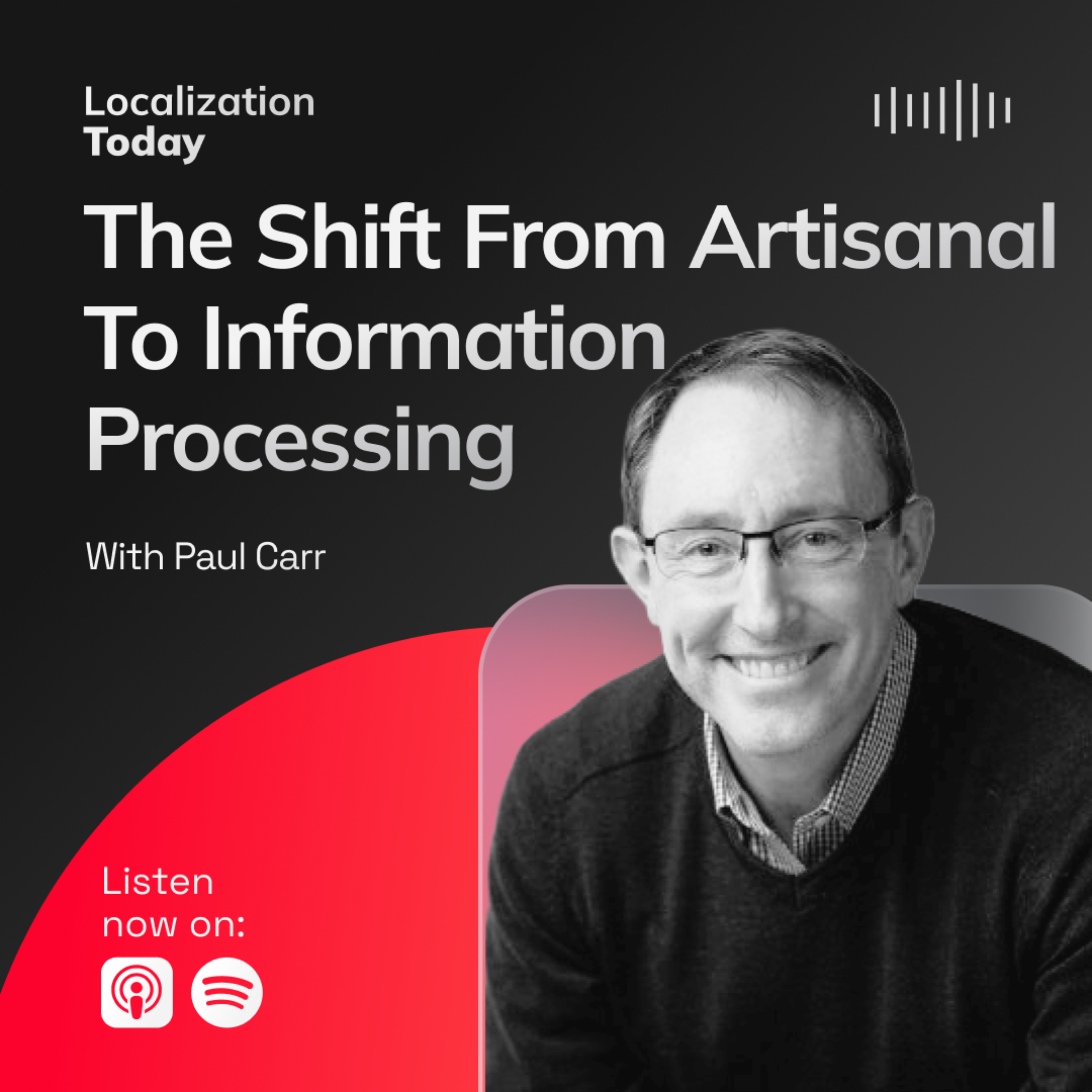
But I think that you have to imagine an industry which is dealing. It's going to look more like information processing than it looks like an artisanal industry. Now, this may be really bad news for many, many linguists because processing doesn't sound terribly. I can imagine it doesn't sound terribly appealing, but I think that's where the industry's going. And so I think what that means is for, you know, the technology stack is going to look different. Agents and AI is going to be at the centerpiece of it.
I think for LSPs, you know, LSPs are going to have to look pretty different because, you know, you cannot process 10 times the volume with the model that the traditional LSP model. Everything needs to be more technology enabled. And I think for linguists who are obviously going to have a crucial and vital role, I think how do you operate in a very high volume kind of translation environment, or how do you specialize in ways that create defensibility for a set of skills?
I think that is the sorts of changes that are going to go on there. So the pathway that we're on is to be able to evolve our model to Be one, more specialized and two, to be able to be a lot more technology enabled to rise to that challenge. Right? A lot more content, but processed at a lot lower cost.
[00:39:40] Speaker A: And clearly, Paul, there is a lot to be understood in terms of the aggregated data that comes out from these large volumes of translations. Is this something that you're looking within welocalize to get into like helping organizations understand these vast amounts of volumes of information? What do they actually mean?
[00:40:03] Speaker B: Yeah, I think that that is part of the consultative approach that we're taking, right, with localization departments. Because localization departments need to help their enterprises, right. In terms of.
So how do you help the localization departments help their enterprises reimagine the sorts of volumes of content that are able to be translated and how they can be handled and processed in a really efficient way. And so that's why we think that the nature of our interactions with clients is really discovering together, right? It's, it's consultative, it's solutions oriented.
That's going to be, I think, I think that's going to be a very important. Right. Approach to this.
The second one is just continuing to, you know, continuing to invest in the technologies that are going to enable us to scale, right. And to be able to handle a lot greater in, you know, volumes of translation work, but you know, in a highly automated and technology enabled way. And as you know, I mean, the models are evolving, technology's evolving. It seems like every week or two there's another announcement from Anthropic or OpenAI or Gemini, right? So that requires constant research and understanding, right. How that occurs. The other thing which it circles back to our strategy with Opal is that I think a very challenging part of this industry is going to be smaller LSPs who, you know, struggle to invest in building technology or AI. Right.
And so one of the, I think the industry benefits actually from having a diverse, right. And prolific number of LSPs serving different clients. So this is why one of the priorities for us is to distribute, distribute, but help support that broader ecosystem of smaller LSPs with our opal product so they can deliver kind of cutting edge AI enablement to their clients without having to incur the kind of investments which are very material to build the technology itself.
[00:42:30] Speaker A: And of course, we are very grateful with your time. You've been very generous. Paul, thank you so much for doing this conversation.
Before we go, are there any final messages, comments to the industry, to your team, to our audience at large, Anything, anything, Any final words you'd like to share with Us before we go.
[00:42:49] Speaker B: Well, look, I think coming off of what the kind of existential fears that the industry had a couple of years ago, I think, I know there's a lot of anxiety across the industry, whether it's linguists or in LSPs or technology providers. I mean, there's anxiety, okay.
I think for me, I mean, I have, I. And we actually at Willow Global, we have a very strong conviction that this industry as a whole, right? It may look different in the future, but it is going to be thriving, right? It is going to be growing. It's growing.
There is, you know, never a time in history more than today, when multilingual expertise, translation, interpretation is so valuable to companies. Right.
And so at the very aggregate level, I don't think we should have too much anxiety about where this industry is going. I think it's. I think it's.
I think it's. I think it's flourishing and it will continue to flourish. You know, I think that, you know, like I said, I think that the nature of the industry, the complexion of the industry and the way LSPs look and way what linguists do and what technology companies use is really going to change.
But that's. It's sort of a natural order of things. It's happened multiple times in the past. For those who are old enough to remember the Internet revolution, they remember the Internet. There's a lot of people who don't remember the Internet. They're too young.
But I think this is an interesting period when history can provide some comfort and perspective that it's all going to be all right, things are going to change, but it's all going to be, we're going to be fine, I would say. What do you do in that sort of an environment?
You can choose to a degree to be anxious and nervous and stressed, or you can choose to go back to school and be curious and learn new skills, new things, be open minded.
I think that's a fair health.
That's a lot healthier mindset to have at this point in, you know, at this point in the industry's evolution.
[00:45:16] Speaker A: And we agree with it. We've seen it. We've seen it in the companies that come with that type of mindset. And it's a lot easier to innovate and to look for new opportunities when you have that mindset. Paul, thank you very much for doing this.
[00:45:29] Speaker B: You're welcome, Eddie, thank you.
[00:45:30] Speaker A: All right. And thank you for everyone who is listening to our conversation here in localization today. Once again, a big thank you to Paul Carl for sharing how WeLocalYze is evolving to meet the demands of a rapidly changing industry, from scaling across 300 plus languages to integrating AI into real enterprise workflows.
As language services expand beyond traditional translation into data automation and global content strategy, conversations like this help clarify what that transformation actually looks like in practice. Catch new episodes of localization today on Spotify, Apple Podcasts and YouTube. Subscribe, rate and share so others can find the show. I'm Eddie Arrieta with Multilingual Media. Thanks for listening and we will see you next time. Goodbye.