Episode Transcript
[00:00:00] THE Human architecture of AI why the future of our industry depends on the people we cannot afford to lose By Marizia Gregorio I am Marizia Gregorio, CEO of novalinguists, a boutique linguistic services firm based in Genoa, Liguria, active for more than 30 years and internationally recognized for its expertise in marketing, translation and transcreation, legal translation and interpreting, linguistic coaching and training, localization, and advanced relocation services.
[00:00:33] Over the past three years I have witnessed the impact of artificial intelligence on our industry from the inside. But long before AI became a headline, we had already begun to diversify deliberately and strategically toward areas where human presence, relational depth, and professional responsibility are irreplaceable.
[00:00:54] We chose to invest in legal translation, high level interpreting, and linguistic coaching and training not because these domains are immune to automation, but they also demand something AI cannot replicate trust, nuance, and accountability. I did not conform to the dominant narrative. I did not pretend I could scale like a tech giant.
[00:01:17] I cannot invest like the large platforms, and I do not wish to. I chose to remain small, to remain a boutique company with everything that entails. This is not a limitation, it is a position.
[00:01:30] And it is from this position, practical, operational, and anything but theoretical, that the following reflection emerges. AI has entered the language industry with unprecedented speed. Localization was an early testing ground for automation, and this gave us a privileged yet uncomfortable vantage point.
[00:01:48] We see the promises of acceleration, but we also see the emerging fractures when technology is introduced without understanding the work it is meant to support. In many organizations, the sequence unfolds in a predictable way. The AI strategy is announced, pilots are launched that perform well in control demonstrations. Machine generated content is produced in large quantities, and only afterward are humans brought in to restore coherence, accuracy, and responsibility.
[00:02:18] The weight of quality and accountability is shifted quietly and almost entirely onto professionals who were never involved in the system's design.
[00:02:26] This choreography is not malicious, but it is incomplete. What is missing is a clear understanding of who those humans are, what expertise they bring, and what happens if they disappear. The expression human in the loop appears everywhere in AI discourse, yet the human is rarely described. This vagueness creates the illusion that oversight is a generic function that any human will do. That judgment can be improvised.
[00:02:53] In reality. The human who stabilizes AI output is not an abstract figure. It is a trained professional with linguistic, cultural, legal, and contextual competence. It is a linguist, the cultural mediator, the reviewer, the editor, the small provider who ensures that meaning, tone, and risk are managed responsibly.
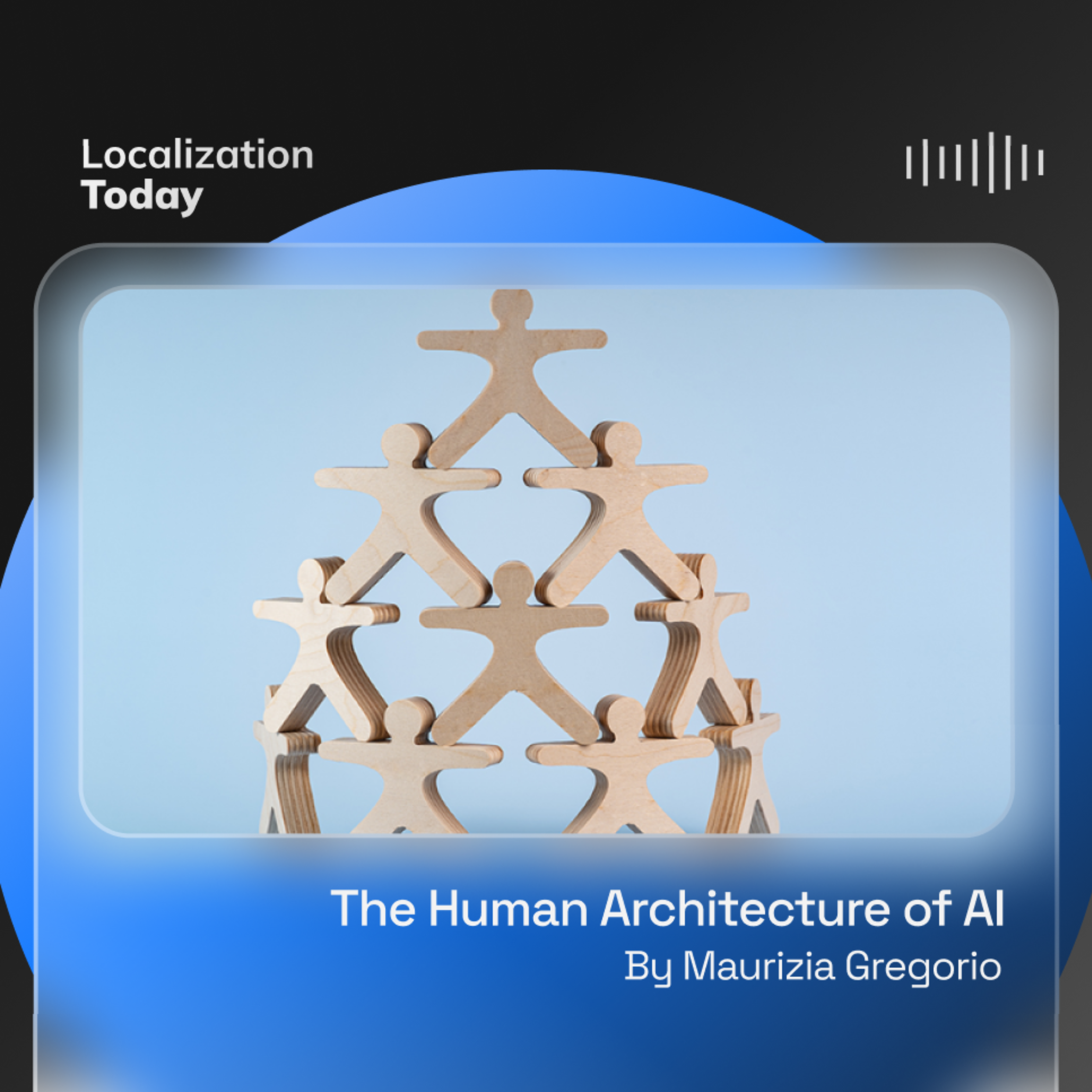
[00:03:15] These are not transitional roles. They are the structural interface between meaning and consequence to visualize this. I chose to represent the correct AI integration process not as a sequence of boxes, but as a sequence of people. Each step is embodied by a real professional, because the process itself is fundamentally human.
[00:03:35] Figure 1 is not a representation of corporate roles, nor an attempt to revive hierarchical structures from the past.
[00:03:42] It is a cognitive map of how responsible AI integration actually unfolds when it is done correctly. Every figure represents a type of thinking, a form of expertise, a layer of accountability that no automation can replace without destabilizing the entire system.
[00:03:59] At the top stands the person who understands the work, the one capable of grasping nuance, risk, and purpose before any automation is introduced.
[00:04:09] At the center is the person who clarifies the process, the facilitator, who brings order to complexity and ensures that workflows are coherent and accountable.
[00:04:19] On the sides stand the linguist and the governance professional, the two pillars of quality and responsibility, meaning and oversight. Below them are the individuals who identify where automation can help, who introduce AI without destabilizing the system, and who monitor and refine the output to ensure that the cycle remains safe and aligned.
[00:04:39] And finally, closing the loop stands the person responsible for the post mortem, the retrospective analyst, who reviews the process itself.
[00:04:49] This final step is not about reviewing the system, not the content, understanding what worked, what failed, and what must be improved before the cycle begins again.
[00:04:59] Without this phase, the process becomes static, fragile, and unable to evolve. This architecture matters. If the industry continues to treat linguists as optional, universities will stop offering linguistic and cultural training. Academic programs respond to market signals. If the market signals that linguistic expertise is obsolete, the pipeline of future professionals will collapse. And without trained linguists, there will be no competent oversight, no one capable of evaluating meaning, risk, cultural resonance, or legal implications.
[00:05:34] The very functions that keep AI systems safe and aligned would disappear. This is not a distant scenario. It is a medium term structural risk. There is a deeper paradox that must be acknowledged. If we automate every layer of the workflow, not only execution, but also governance, oversight and decision making, then it endangers the entire chain of human judgment represented in the diagram. If AI becomes agentic, capable of making autonomous decisions without human checkpoints, then the thinker, the facilitator, the linguist, the governance professional, the implementer, the analyst, and even the postmortem reviewer all become theoretically replaceable. And once those layers disappear, even senior leadership roles lose their foundation.
[00:06:22] A system that removes its base will eventually remove its apex.
[00:06:26] This is not alarmism. It is the logical conclusion of a worldview that treats human expertise as a cost rather than a structural asset. The only sustainable path is one in which humans and technology operate in tandem.
[00:06:40] Technology must amplify human decision making, not replace it. Guardrails are not constraints but architecture. They preserve human judgment, ensure accountability, maintain professional pathways, and incentivize necessary university training. They prevent the erosion of oversight and protect the integrity of decision making at every level. AI can accelerate, enrich, and extend human capability, but it cannot replace the human foundation without destabilizing the entire structure.
[00:07:10] After three decades in this industry and three years navigating the AI transition from the inside, I am convinced that the central question is no longer whether AI will transform our work. It already has.
[00:07:23] The real question is whether we will build systems that rely on human oversight or systems that quietly eliminate them and the direction and accountability they provide.
[00:07:33] The linguist is not a footnote. The governance professional is not a luxury. The human shape process is not a metaphor. It is the architecture of a sustainable future. And architecture is not something you remove once the building is standing. It is what keeps the building standing. This article was written by Marizia Gregario. She is a trained translator and interpreter with more than 30 years of experience in localization and multilingual communication.
[00:08:01] As the founder of Nova Linguists, a boutique focused on linguistic supervision and communication risk governance, she later expanded her path by becoming an executive coach and then a counselor. Integrating deep listening, mediation, and support through complex transitions.
[00:08:19] Originally published in Multilingual Magazine, Issue 251, 4-20-26.