Episode Transcript
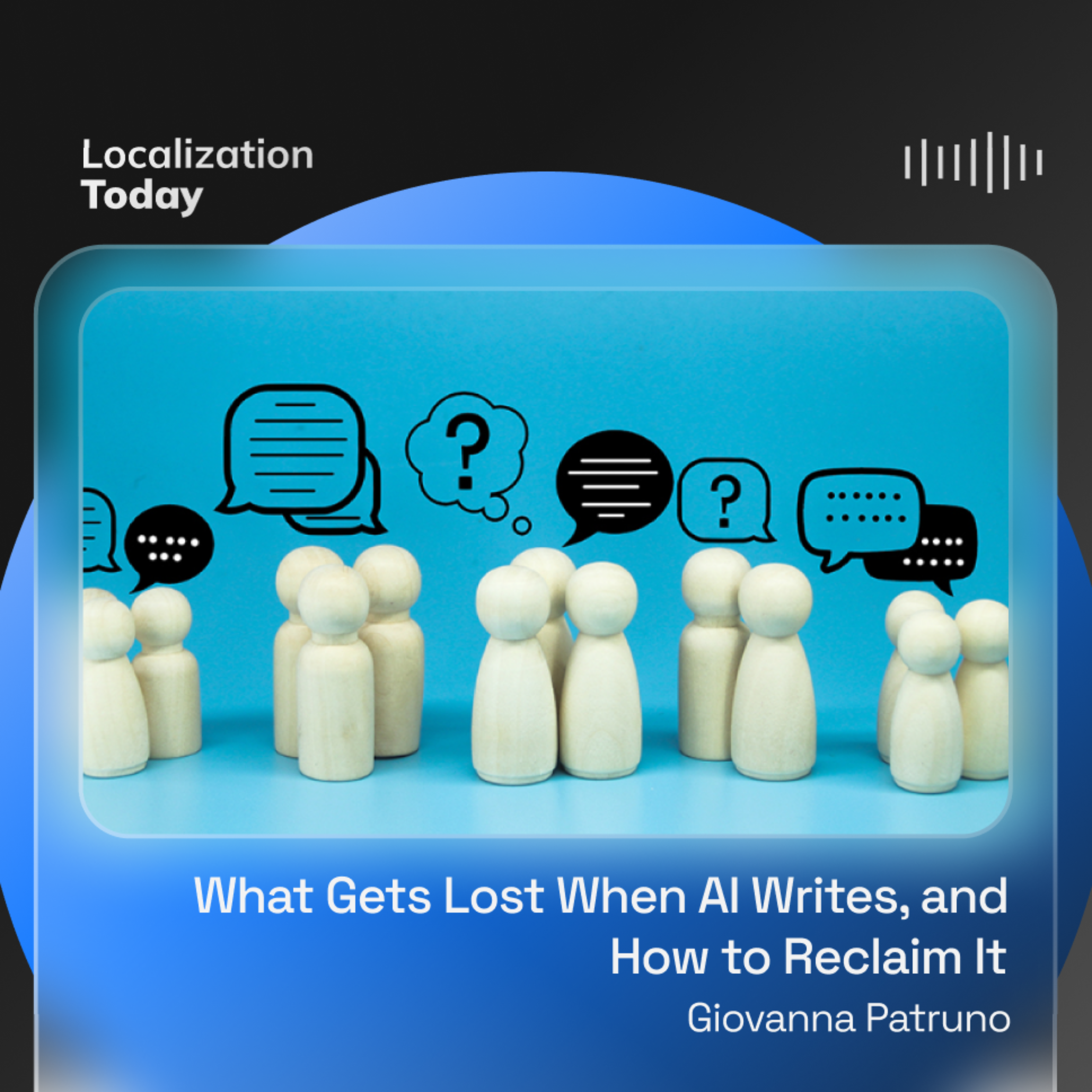
[00:00:00] What Gets Lost when AI Writes and How to Reclaim It By Giovanna Petruno we're living through a paradox in the history of human expression.
[00:00:10] Never has it been easier to produce fluent, grammatically correct text, and never has so much writing felt so empty.
[00:00:18] With a few keystrokes, anyone can generate articles, posts, explanations, and summaries on almost any topic.
[00:00:26] Artificial intelligence writing tools promise to democratize communication, to remove friction from the act of writing, and to let ideas flow effortlessly from line to page. Yet as these tools spread, a quieter collapse is underway. We're surrounded by words and increasingly starved for meaning.
[00:00:46] Scroll through any content heavy platform and the pattern quickly becomes visible.
[00:00:50] Blog posts read smoothly but leave no trace. Articles satisfy every formal requirement while advancing no real argument. Explanatory text informs without illuminating. The prose is competent, the grammar is flawless, the structure is sound, and yet something essential is missing. These are not acts of communication so much as performances of it language that looks right and sounds right but ultimately says very little.
[00:01:18] What this reveals isn't a failure of technology, but a misunderstanding we've long held about communication itself. We've treated it as a technical skill, something defined by vocabulary, grammar, structure, and clarity, as though the ability to produce well formed sentences were the same as the ability to communicate.
[00:01:38] AI generated content exposes the limits of that assumption. Fluency, it turns out, was never the hard part. The harder work is having something worth saying and caring whether it's understood. The functions we forgot what's being lost becomes clearer when we revisit Roman Jacobson's model of communication developed in the 1960s. It offers a surprisingly precise lens for understanding our current moment. Jacobson argued that any act of communication operates across six distinct functions, each tied to a different element of the communicative situation.
[00:02:14] The referential function conveys information about the world facts, descriptions, explanations.
[00:02:21] This is what we typically mean when we talk about content.
[00:02:24] The emotive function expresses the speaker's attitude or perspective. The cognitive function addresses the receiver directly, seeking to influence, persuade, or prompt action.
[00:02:36] The phatic function establishes or sustains social connection, as in a How are you? That affirms relationship rather than requests information.
[00:02:45] The metalingual function turns language back on itself, clarifying terms or reflecting on how meaning is being made. The poetic function finally draws attention to form, to how something is said, rather than only to what is said. Jacobson's central insight was that communication is never one dimensional.
[00:03:04] A powerful essay does more than convey information.
[00:03:07] It introduces a perspective, establishes a relationship with a voice, invites response or reflection, and deploys Language with care and intention, often doing all of this at once.
[00:03:19] Now consider the typical AI generated article.
[00:03:22] It performs the referential function competently, arranging facts and claims into coherent informational structures. Beyond that, however, it's largely hollow. There is no genuine emotive function because no person stands behind the text with experience or stakes in the matter.
[00:03:39] There's no authentic cognitive function because the system has no concern for whether the reader is persuaded or moved to act. There's no phatic function because it's not trying to build a relationship over time.
[00:03:52] The metalingual function appears only in a procedural sense, and the poetic function is usually absent unless it's explicitly requested. What we're discovering is that communication, reduced to a single function, feels profoundly empty even when it's technically correct. When five of the six functions fall away, what remains is language that resembles communication without fully performing it.
[00:04:15] The illusion of just words.
[00:04:19] This helps explain a troubling shift, the slow collapse of the distinction between writing and communicating. As AI tools become commonplace, writing is increasingly treated as a production task. The central question becomes, how do I generate 500 words on this topic, rather than what do I actually want to say? And why does it matter? The emphasis moves away from having something to communicate and towards simply having produced text, from message to medium, from from substance to output. Underlying this shift is the assumption that words themselves carry meaning and that communication is achieved simply by assembling them correctly.
[00:04:57] But words aren't self contained containers whose meaning remains stable regardless of who uses them or for what purpose. They're instruments of human social and cognitive activity. Strip away the human context, the person with something at stake, the relationship being navigated, the effort to understand or be understood. And language may remain fluent, but it no longer truly communicates.
[00:05:20] This matters because communication isn't about transferring information alone. It's how we build shared understanding, negotiate differences, establish trust, refine our thinking, and construct meaning together.
[00:05:33] When communication is reduced to the production of acceptable text, we lose something essential, not only about what makes communication effective, but about what makes collective intelligence possible at all.
[00:05:46] The epistemic dimensions of human communication, the spread of AI generated content, functions as an inadvertent natural experiment. By attending to what's consistently absent from algorithmically produced text, we gain insight into which dimensions of communication are essential rather than incidental.
[00:06:06] What emerges is a view of communication as fundamentally epistemic rather than mechanical, with important implications for how language relates to knowledge, judgment, and understanding. At the center of this framework is communicative salience, the capacity to recognize what's worth articulating within a given discourse context. This capacity operates prior to expression itself. It depends on experiential reasoning. The ability to notice patterns, tensions, or gaps within an informational landscape through accumulated knowledge and situated judgment. Recognizing that AI generated content often lacks a clear argumentative structure or a distinct thesis is itself an example of this capacity. It reflects an act of critical noticing that develops through sustained engagement with discourse over time. Large language models, which operate through statistical pattern recognition rather than lived experience, can't perform this selection function in any meaningful sense. They lack a capacity for concern, for having anything at stake in what is being said which is essential to meaningful communication.
[00:07:13] Closely related is the question of stakes.
[00:07:16] Meaningful communication depends not only on what is said, but also on whether the communicator has something at stake in being understood.
[00:07:24] As J.L. austin's account of speech acts makes clear, producing an utterance isn't the same as achieving effects through what's said. AI systems remain largely confined to the former.
[00:07:35] They can reproduce the linguistic signals associated with intent, persuasion, or clarification, but they have no investment in whether their words actually persuade, clarify, or move anyone to action.
[00:07:48] Their objective ends with task completion.
[00:07:51] Human communication aimed at understanding behaves differently.
[00:07:54] It anticipates misinterpretation, supplies context, and adapts in response to feedback.
[00:08:01] These aren't stylistic choices, but signs of a genuine commitment to shared meaning. A third dimension concerns evaluative synthesis, which goes beyond the aggregation of information.
[00:08:12] Communication becomes meaningful through interpretation as information is situated within particular value frameworks and knowledge contexts.
[00:08:20] Two communicators with access to the same facts may produce radically different communications because they apply different evaluative criteria, attend to different contextual cues, or orient themselves toward different standards of relevance. In this sense, communication is never neutral in a non pejorative way. It always reflects perspective, expressing how someone understands a subject, what they value, and what they judge to matter.
[00:08:47] Genuine communication also functions as a mode of inquiry rather than a channel of transmission.
[00:08:54] It involves articulating provisional understanding, exposing it to dialogue, and refining it through exchange. Kenneth Burke described rhetoric as symbolic action, emphasizing that language is a form of social participation and collective sense making.
[00:09:10] AI systems can signal uncertainty through formal hedging, but they can engage in genuine intellectual struggle because they have no understanding to revise.
[00:09:20] This inquiry driven dimension of communication depends on vulnerability, the willingness to articulate incomplete thinking and allow it to be challenged, something that requires the cognitive and social stakes present only in human discourse communities.
[00:09:35] Finally, there is what Mikhail Bakhtin described as the dialogic dimension of communication, the recognition that Every utterance exists in relation to what has already been said and to what's anticipated in response.
[00:09:48] Meaning accumulates over time and through relationships. A communicator who engages repeatedly with an audience develops a recognizable discourse identity, a consistent voice, set of concerns, and intellectual trajectory.
[00:10:03] Readers form expectations, notice shifts in thinking, and interpret new communications in light of this evolving context. This diachronic dimension of communication, in which understanding deepens through sustained engagement, represents a fundamentally different phenomenon from discrete acts of text generation, however sophisticated they may appear.
[00:10:24] The Translator's Paradox when source Text has no source Umberto Eco captured this problem succinctly when he described translation as a form of negotiation rather than conversion.
[00:10:37] Meaning, ego argued, doesn't live inside words themselves. It emerges through interpretation, constrained by intent, context, and use. In Mouse or Rat, he famously defined translation as the effort to say almost the same thing, emphasizing judgment, responsibility, and an understanding of what a text is trying to do.
[00:10:59] That framework assumes a communicative act to negotiate with some intention, perspective, or purpose embedded in the source. AI generated text breaks that assumption. There's no originating act of communication, only linguistically plausible output. For the translator, this isn't a technical inconvenience but a categorical shift. Without intent to interpret, there is nothing to negotiate, only surface language to process.
[00:11:26] Translation makes this problem impossible to ignore because the discipline itself is built on the assumption that meaning originates with human communicators.
[00:11:36] From Eugene Nida to Lawrence Venuti, translation theorists have emphasized that translation isn't a matter of linguistic substitution but of intercultural communication.
[00:11:47] The translator's task extends beyond preserving semantic content to convey communicative intent, rhetorical effect, and cultural resonance.
[00:11:56] AI generated text, however, confronts translators with an unprecedented epistemological problem.
[00:12:03] How does one translate a text that has no originating communicator at all? This paradox exposes a truth about language that translators have long understood.
[00:12:12] Words do not carry meaning independently. They function as instruments through which human communicators attempt to make meaning within particular contexts for particular purposes and for particular audiences.
[00:12:25] When professional translators engage with a source text, they work within what Christian Nod describes as a principle of function and loyalty, remaining faithful to the text's communicative purpose while honoring the intent of its human author.
[00:12:41] AI generated content severs this relationship. There's no originating perspective to interpret, no situated intent to preserve, and no stake in how the message is received.
[00:12:52] Consider how translators typically respond to ambiguity or cultural specificity in a source text. They may consult the author's other work, examine the publication context, draw on cultural knowledge from the source language community, or even contact the author directly.
[00:13:09] These practices assume that meaning exists behind the text, that the text is an expression of human thought, requiring interpretation and careful transmission.
[00:13:18] With AI generated content, this hermeneutic framework collapses. The text doesn't express a perspective. It's the product of statistical pattern recognition rendered as prose. This helps explain why machine translation of machine generated content can appear adequate in ways that would alarm professional translators if applied to human communication.
[00:13:40] When a source text operates almost entirely at the referential level, conveying information without emotive force, persuasive intent, or cultural embeddedness, little of value is lost in automated translation.
[00:13:53] Empty text becomes empty text in another language, with surface meaning preserved, but nothing deeper at risk. The apparent success of machine translating AI generated content thus reflects the thinness of both texts, not the sophistication of the translation process.
[00:14:10] By contrast, translating genuine human communication, especially material rich in cultural reference, rhetorical nuance, or domain specific register, requires the translator to act as an intercultural communicator in their own right. This demands sensitivity both to what words denote and to what they connote within particular cultural contexts, to how they position the speaker in relation to the audience, to what shared knowledge they assume, and to what effects they aim to achieve. Translators must judge when to preserve foreignness and when to adapt, when literal rendering would obscure meaning and when paraphrased, would distort it. These decisions resist automation because they depend on the very capacities that distinguish human communication from text generation, experiential knowledge, cultural competence, evaluative judgment, and the recognition that one is mediating between two human minds, seeking understanding across linguistic and cultural boundaries. The multilingual dimension makes the limits of treating communication as mere text production unmistakable.
[00:15:13] Languages aren't neutral codes that map cleanly onto one another.
[00:15:17] They embody different ways of organizing experience, expressing relationships, and constructing meaning.
[00:15:24] What's explicit in one language may remain implicit in another.
[00:15:28] Norms of politeness, degrees of directness, and the metaphors that resonate all vary across cultures.
[00:15:35] Professional translators navigate these differences by understanding languages as systems of human meaning making rather than as interchangeable inventories of words and rules. They ask not what do these words say?
[00:15:47] But what is this person trying to communicate? And how can I help them do so in another language?
[00:15:53] That question presumes a human communicator with intent precisely what AI generated content lacks the higher bar.
[00:16:03] What does this mean for communication? In the age of AI, we may be entering a moment in which communication gains value precisely because it's harder to counterfeit. When grammatically correct text is easy to produce. The differentiator is no longer fluency but insight, the ability to recognize what matters and to make meaning from it. When the tools are universally available, what distinguishes communicators is not how efficiently they generate words, but what they choose to say and why they believe it deserves to be said. This raises the bar for communication, but likely a necessary one. Clarity remains important, but it's no longer sufficient. The more demanding questions come earlier. Is there something here worth articulating? Have I noticed a pattern, tension, or implication others might miss?
[00:16:51] Does my perspective, shaped by experience, contribute anything new? Am I engaging in communication as a way of understanding and being understood, rather than simply producing output? Seen this way, the shift may be healthy. For too long, communication has been treated as a matter of competent execution. Meet the word count, follow the format, apply the right conventions, and consider the task complete. But communication has never been about mechanical correctness alone.
[00:17:20] It's about people thinking together, sharing what they have learned, testing ideas, persuading one another, building common ground, and refining understanding through exchange. The irony is that AI tools, by making the surface mechanics of writing almost effortless, may force us to confront what communication actually requires. When form can be generated instantly, the burden shifts to intention and substance.
[00:17:46] We are left with a more fundamental one. No system can answer for us. What are you trying to do by communicating? And why should anyone care?
[00:17:56] Reclaiming Communication this moment calls for a more deliberate approach to communication, one that treats writing not as automatic output but as intentional action.
[00:18:08] Instead of reflexively turning to AI to generate text, we need greater clarity about what we're trying to accomplish when we communicate, whether that's offering insight, seeking understanding, or contributing something of genuine value. Without that clarity, even powerful tools merely accelerate the production of words while diminishing what actually matters. It also calls for renewed respect for communication that operates across multiple functions.
[00:18:35] Writing that endures is not only informative but but also expressive, persuasive, relational, and attentive to form.
[00:18:43] The essayist who reveals their thinking as it unfolds, the blogger who builds an ongoing relationship with readers, the colleague who works through a complex problem in prose and invites response are all doing something AI can't replicate.
[00:18:57] They're present in their communication in ways that give it weight and meaning.
[00:19:01] Most importantly, this moment invites resistance to the reduction of communication to text production alone.
[00:19:08] When we outsource the articulation of our ideas entirely to AI, we give up the work of thinking through them, struggling to express them, and learning in the process.
[00:19:18] Communication has always functioned as a technology of thought, not merely a channel for transmission.
[00:19:25] Writing is how we discover what we believe, refine our understanding, and develop a voice that's recognizably our own, the irreducible human element.
[00:19:36] In the end, the question Are words enough? Answers itself they never were.
[00:19:42] Communication requires a communicator, someone with experience, perspective, stakes, and purpose. It calls for more than the production of text. It requires the harder commitment of having something to say and caring whether it's understood. The age of AI isn't making communication obsolete, it's revealing what communication has always been a fundamentally human activity that goes well beyond arranging words into acceptable patterns.
[00:20:08] As we move through this new landscape, the challenge isn't to compete with machines in generating text, but to reclaim communication as something richer and more consequential, an expression of thought, an active relationship, a means of collective sense making, and a practice that deepens our humanity.
[00:20:26] Machines can provide words, meaning, purpose, perspective, and genuine connection remain ours to create.
[00:20:34] This article was written by Giovanna Petruno, a brand communication consultant with over two decades of experience in localization and content Strategy. She helps B2B technology companies showcase their unique value to build trust, drive influence, and support long term global growth.
[00:20:53] Originally published in Multilingual Magazine, Issue 251, April 2026.