Episode Transcript
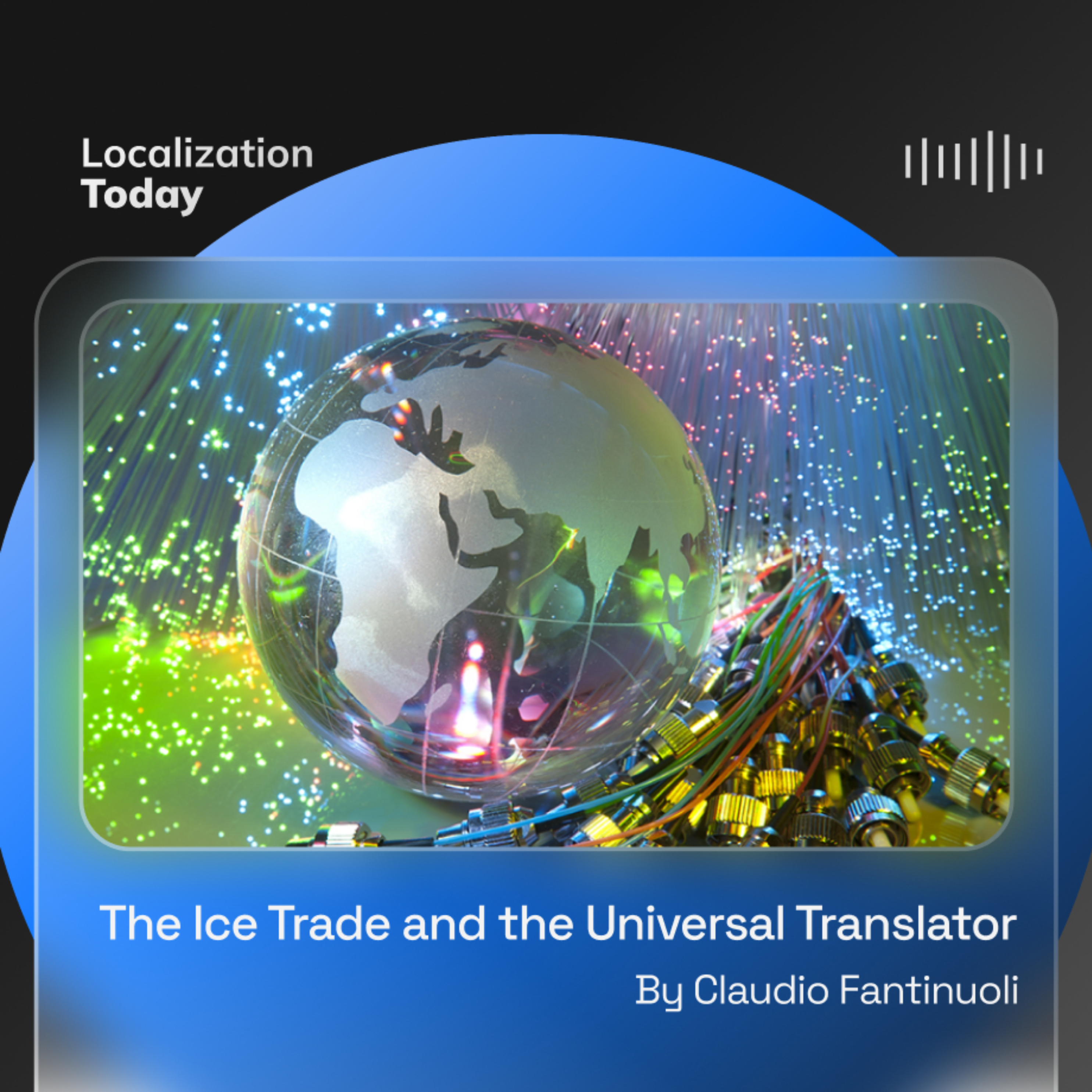
[00:00:00] Translating the ICE Trade and the Universal Translator by Claudio Fontignoli Language AI is moving out of the data center and into our devices.
[00:00:12] What this means for society is clear enough. What it means for the industry is not. In the 19th century, one of Boston's most lucrative exports was winter. Crews sawed blocks of ice out of frozen New England ponds, packed them in sawdust, and shipped them to Calcutta, Rio de Janeiro, and Havana. The trade rested on a single assumption. Cold was scarce and you could not make it where you needed it, so you built a supply chain to bring it instead. Then came the ice factory, a plant on the edge of town, making cold on demand. No pond required. Sovereign by definition.
[00:00:49] And then in the 1920s, the domestic refrigerator. Cold was in every household within a generation, an intercontinental trade folded into a white box, humming in the kitchen. AI in general and language technology in particular is living through the same three acts compressed from a century into roughly a decade. Act one the big data centers hosting AI in the cloud is where most of us still are.
[00:01:17] Act 2 Smaller sovereign and owned AI near our doorsteps is emerging as a strategic alternative.
[00:01:25] And act three AI in our pockets is a promise that is quickly becoming reality.
[00:01:31] Act 1 Cold from far away the case for Cloud AI packed into huge data centers and owned by big corporations is not a marketing case.
[00:01:43] Anyone who dismisses it has never tried to build a product.
[00:01:46] The fastest route to high quality translation in your software today is an API key and 15 lines of code. You are buying not just a model but the apparatus around it. Inference, scaling, failover, gpu, procurement, updates you never have to install, and you are buying the frontier.
[00:02:05] Convenience and power in one envelope are a rare combination, and it explains the past few years.
[00:02:12] But the ICE always came with a bill. The first cost is literal. Every API call costs money. The second is strategic AI computation is becoming a company's nervous system rather than a garnish on the product. And outsourcing your nervous system to a vendor whose pricing terms and deprecation schedule you do not control is an uncomfortable place to stand.
[00:02:35] The third cost matters most to many.
[00:02:38] Every API call sends someone's data somewhere else.
[00:02:41] Finally, the big data centers consume an incredible amount of energy with a clear impact on the environment.
[00:02:49] Act 2 Ice Factory the first set of opportunities to lower costs does not require abandoning the cloud, but rather moving the plant, at least metaphorically, closer to town. Open weight models can be downloaded, deployed and fine tuned. They allow organizations to run capable AI systems on their own infrastructure and adapt them to their own data rather than relying solely on models shaped by the average of the Internet. The data in turn remains under the organization's control, even if the underlying IT infrastructure still typically resides in one of the major data centers. The costs remain significant.
[00:03:28] Deployment, maintenance, and customization require expertise, time, and budget. Yet this is increasingly a viable strategic approach to AI. One indication of its growing importance came in August 2026 with reports that Nvidia had agreed to acquire Hugging Face, one of the most important platforms for open AI models, for approximately $13 billion.
[00:03:53] Act 3 refrigerator in the Kitchen A third path is emerging quickly, driven by two curves converging at high speed, the rising computational power of phones and laptops and the shrinking of models through distillation, quantization, and the less glamorous engineering work of making things smaller without making them significantly worse. This is no longer theoretical.
[00:04:17] Speech recognition, machine translation, text to speech, and even sign language models can increasingly run directly on our own devices, as Google is demonstrating across its products with models embedded in Pixel phones, the Chrome browser, and elsewhere. And from the user's perspective, they often run essentially for free, since inference takes place on hardware they already own. None of these are frontier models, but they do not need to write your legal brief or debug your code. They need to do one thing well on a device you already own, at virtually no additional cost, with no data leaving the device.
[00:04:57] Specialization is how the refrigerator won.
[00:05:00] It did not need to be a factory, it only needed to be cold.
[00:05:04] Language AI is not just another feature, it's the foundation.
[00:05:09] Lost in the conversation is an under discussed detail.
[00:05:13] Language is not simply one application of AI among many it is increasingly the medium through which many other AI capabilities are expressed. Reasoning, planning, tool use, and agentic behavior all depend heavily on linguistic representations and interaction. In that respect, AI is not so different from us.
[00:05:34] Our linguistic faculty is not merely one achievement among others it is one of the instruments through which we build, coordinate, and express many of them.
[00:05:44] This means that any system with sufficiently broad capabilities is likely to have strong language abilities built into it, not merely as a bolted on module, but as part of how IT functions. Machine translation and interpreting are in this sense increasingly expressions of that broader competence rather than entirely separate technological achievements.
[00:06:05] Translation can emerge as a behavior elicited from capabilities the system already possesses, not as a dedicated capability.
[00:06:13] The consequence is that language AI will increasingly be wherever AI is, and as AI moves on to our devices, translation and interpreting will move with it. They may no longer be products that someone explicitly sets out to build, but rather side effects of general purpose capabilities arriving anyway.
[00:06:33] Who delivers the ICE now?
[00:06:35] Where will language AI reside in the future, and what will that mean for the language industry?
[00:06:41] Will centralized cloud language services disappear as the ice delivery business did?
[00:06:46] Almost certainly not, and certainly not soon. Scale, orchestration, quality assurance, and accountability all argue for continuity.
[00:06:56] Domestic refrigerators did not end industrial refrigeration, but they did end the ICE delivery business completely and relatively quickly for society at large. Free, private, offline translation and interpreting on ordinary devices is straightforwardly good. It promises one of history's largest communications access expansions with the greatest impact among the world's least served.
[00:07:22] But would be naive to assume this transition will come without consequences, bringing both opportunities and challenges.
[00:07:29] Nobody honestly knows what those consequences will be.
[00:07:32] The optimistic reading is that commodity translation was never really our business, and that its disappearance will clarify what is judgment, accountability, cultural mediation, and those situations in which being approximately right is effectively the same as being wrong.
[00:07:50] The pessimistic reading is that markets rarely draw the line where practitioners would like it drawn, and that good enough, free and instant, has a habit of redefining what counts as good enough.
[00:08:02] Both readings have proved correct before in other industries and at different moments.
[00:08:08] What I am confident about is the direction of travel. The cold is coming home, and with it may come the dawn of abundant private, low cost, and increasingly sustainable communication. This article was written by Claudio Fontignuoli. He is an executive level manager, innovator and researcher specializing in digital transformation and speech technologies. He is an Associate professor of Interpreting Studies and Language Technology at Mainz University and the founder of Interpret Bank, a computer assisted interpreting tool. Originally published in Multilingual Magazine issue 256October 2026.