Episode Transcript
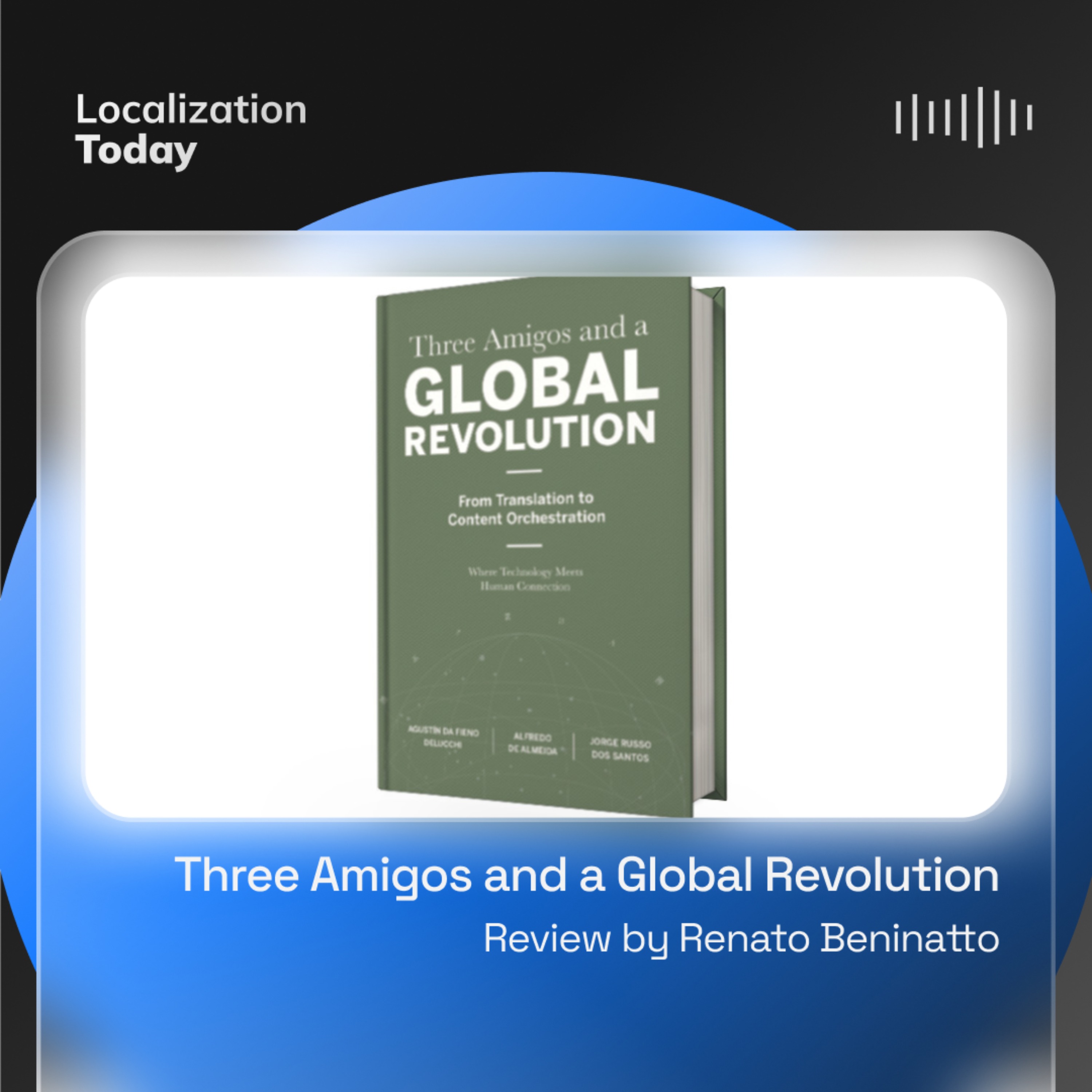
[00:00:00] Three Amigos and A Global Revolution Review by Renato Benignado Most histories of localization are histories of technology.
[00:00:09] Floppy disks, then translation, memory, then Unicode, then neural networks, then whatever we are calling the latest wave this week. Very few are histories of three friends who happened to be standing in the same building in Dublin when it all began.
[00:00:24] Three Amigos and a Global Revolution by Agostin da Fino deluchi, Alfredo de Almedia and Jorge Russo dos Santos is both, which is why I could not put it down. I met Augustin, Alfredo and Jorge through the localization certificate at the University of Washington, where they invited me as a guest speaker. Guest speakers usually arrive, talk, and then leave, but visit after visit. I notice that these three men do not teach localization as a list of tools.
[00:00:55] They teach it as a series of decisions made by people under pressure. Now I know where that came from. Microsoft, Dublin in the late 1990s, when a Brazilian, a Peruvian, and a Portuguese engineer found each other and never quite let go. The title deserves a word. When I first saw it, I thought of the Disney film the Three Caballeros, released in 1944 as a piece of good neighbor diplomacy in which Donald Duck is shown around Latin America by a Brazilian parrot and a Mexican rooster. It was cheerful, colorful, and a little too aware of its own agenda.
[00:01:32] This book borrows the amigos and skips the agenda. The cast is a Brazilian, a Peruvian, and a Portuguese. No ducks were involved and the friendship is documented rather than staged. It is the perfect title because it promises warmth and delivers evidence.
[00:01:48] Reading their journey gave me a kind of double vision. I lived the same three decades, but from a different angle, first as a translator and then as a language service provider. I was always on the receiving end of files, deadlines, and the release schedules that their teams produced. They tell a story from inside the client. I tell it, if I am honest, from inside the vendor. It was a pleasure to finally get to look backstage.
[00:02:15] I had seen the consequences of many of their decisions from my desk, but I had never seen the room in which they were made. There is a line that people love to quote about history.
[00:02:24] It does not repeat itself, but it rhymes. It's usually attributed to Mark Twain, but whoever said it, this book proves it. When translation memory arrived, translators feared for the artistry of their craft and worried that speed would beat quality.
[00:02:40] When machine translation matured, the same fears returned with a different accent.
[00:02:45] Today, with generative AI, we are singing the third verse. The authors do not pretend the melody is identical each time. The tools are different, the stakes higher and the speed unrecognizable. But the refrain is skepticism, adoption, redefinition, and a profession that ends up doing something more valuable than before.
[00:03:07] Anyone anxious about the current moment will find it useful to see how those who were at the heart of it handled the previous ones. My favorite part of the book are the techtime capsules. Each one freezes a period in a page. The workstation, the memory, the bandwidth, the daily output of a translator, the cost of the tools, the size of the market.
[00:03:28] They are small and they are devastating. In 1990-1994 a translator produced 1500-2000 words per day on a machine with 4 to 8 megabytes of RAM. Content traveled on 1.44 megabyte floppy disks, and a release cycle took 3 to 4 months.
[00:03:48] The entire industry was worth about a billion dollars.
[00:03:52] By 1999 to 2003, daily output had roughly doubled, release cycles had shrunk to 46 weeks, and the market had grown about ninefold. Read those numbers carefully because they tell a story that is easy to miss.
[00:04:07] Individual productivity only doubled, yet the industry grew nine times over.
[00:04:12] The growth did not come from anyone typing faster. It came from more content and better tools. When language becomes cheaper and quicker to produce, we do not translate the same amount for less money.
[00:04:25] We translate everything. That has been the truth for the past 30 years, and I have never seen it laid out so clearly. Change arrived slowly at first, then very swiftly. For a long time it felt like progress, requiring patience. One standard, one tool, one workflow at a time.
[00:04:44] Then the curve bend and a career that began in faxing and cataloging floppy disks has evolved into supervising machines that can draft, translate and reason across languages in mere seconds. These three authors were there for both the slow and the fast times of this global revolution. That is what gives this book its authority. The authors are not futurists guessing from a distance. They are practitioners who kept their notes. The chapters in this book move from Dublin to content orchestration, from the first cognitive services to intent driven content creation, and I will let you discover them without spoilers. What I will say is that the conclusion, with its simple message that technology changes while people connect, is not a sentimental afterthought. It is the core of the thesis. In an industry that too often measures itself in cost per word, the authors remind us that the work has always been about results for real people in real markets, not output. I have been saying that for a while now, and it was refreshing to find three friends who arrived at the same conclusion by following a completely different road so here is my single request. Read this book and then hand it to someone who joined our industry after 2020. They have never met a floppy disk and they deserve to know how we got here and who carried us. The tools will keep changing. The friendship, if we are lucky, is the part that scales this article was written by Renato Benignado, co founder of Nimzy Insights, originally published in Multilingual Magazine Issue 257, November 2026.