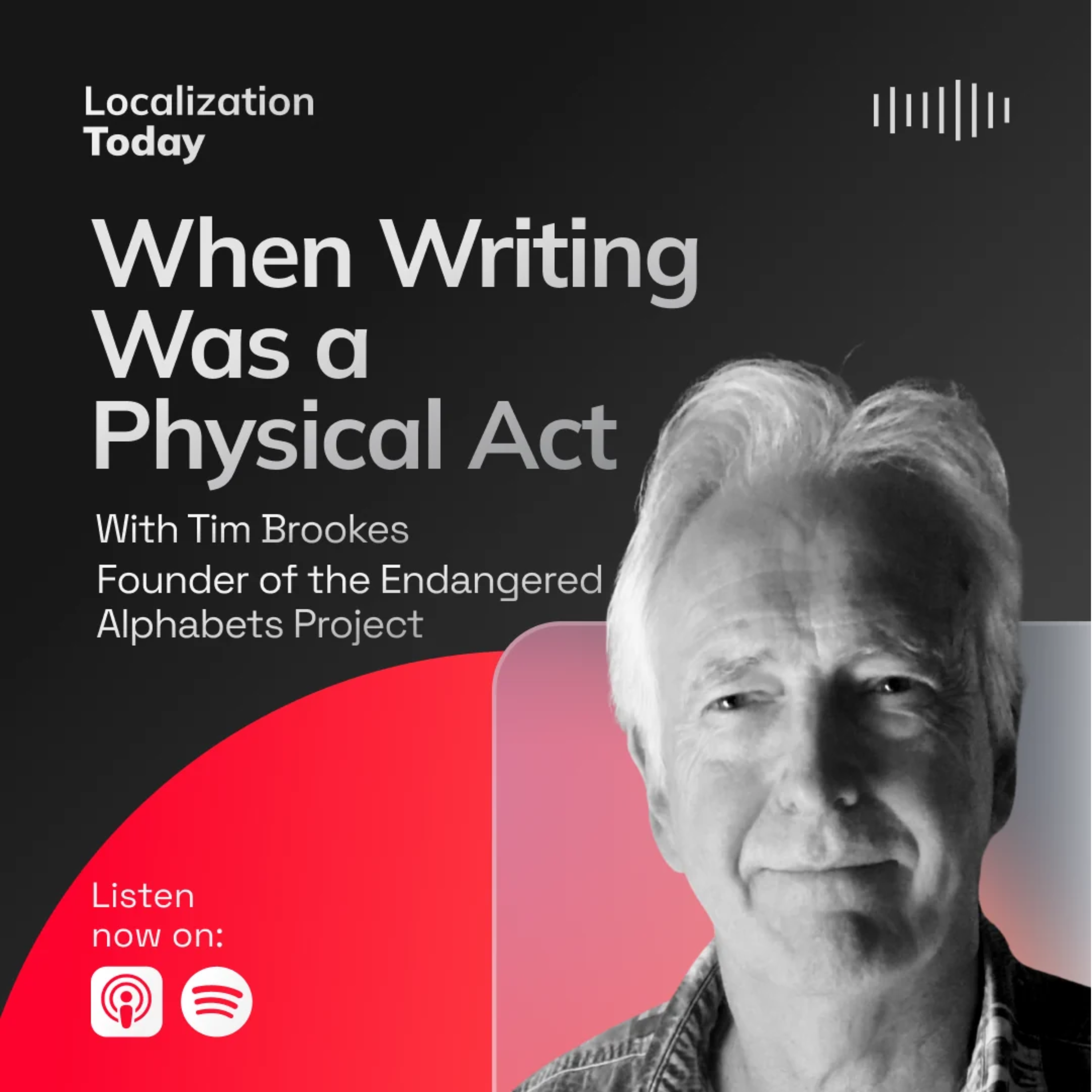
[00:00:02] Speaker A: Welcome to Localization Today, the podcast where we explore how language, technology and culture coverage to unlock ideas for everyone everywhere. I'm Camila Sabogal, media producer of Multilingual Media, and your host for today. We tend to think of writing as something permanent. Words printed on a page, carved into stone, or displayed on a screen. We read them, interpret them, and rarely stop to consider how they came into existence. But before ink becomes a letter, before a thought becomes a word on a page, something remarkable happens. What if understanding writing means paying attention not to just what remains, but to the moment of its creation? Our guest today has spent years challenging the way we think about writing. Tim Brooks is an author, multilingual columnist, and founder of the Endangered Alphabets Project. Through his work including Writing Beyond Writing and By Hand, can the Art of Writing Survive, he has explored the beauty, diversity and cultural significance of writing systems around the world. Now he's taking the exploration in a fascinating new direction. His latest project, Liquid, is a Kickstarter campaign for a book, an auto visual experience that invites us to reconsider writing itself, not simply as a system of symbols, but as a physical, fluid, and deeply human act of creation. Tim, welcome back to look today.
[00:01:29] Speaker B: It's always a pleasure. It's always a pleasure seeing you.
[00:01:33] Speaker A: So good. Thank you for feeling that way. I feel very inspired every time we talk, so thank you for wanting to be here as well. So tell us, Tim, about this new campaign that you have. Tell us about your vision with this thing that you want to create, please.
[00:01:50] Speaker B: Yes. Yeah. And vision is a great word because it all began by seeing something.
So, as some of your listeners know, I wrote a book called By Hand, which was looking really closely at the act of writing by hand and trying to figure out what it consists of, what it does for us. There's a lot of research that shows that writing by hand is not just a question of making marks on a page, but actually involves comprehension, it involves reflection, it involves spontaneous editing, all kinds of very, very deep things.
So in the process of doing that, I became friends with and followed a lot of calligraphers, and a lot of calligraphers began following me, especially as I actually wrote the book by hand with a pen using ink, which I hadn't done for 30 years.
So I open up my Instagram feed about three months ago, and sure enough, there's a reel there by a calligrapher and the camera is really, really close up and he draws the first stroke and it's glistening, it is so charged with ink. His pen is so charged with ink that the light catches it on the side. There's so much ink in that line, and it's black ink, but it turns gold.
And I looked at this and I thought, this is fascinating. And I wrote in my journal, the pen is solid, but the writing is liquid.
And it became clear that what he was doing was, in essence, sculpting with liquid.
And I spoke to one of the top calligraphers in the world about this, and he said, you, yes, but you could also call it choreographing liquid.
And those are two such rich words, I thought, you know, this is so interesting because, as you say, when we look at writing, the majority of time, we are looking at writing not as an act, but as act that is already finished. And so it's imprinted in a book. It is on, you know, a vinyl cutter, on a sign on the wall. You know, it's a sign outside a shop, whatever.
And all of those are what I think of as the dry phase of writing. So one of the remarkable things that writing does is that it starts out as a liquid.
And after a certain number of seconds, depending on the material and the paper and whatever, it dries.
And we know the dry phase because that's what we normally see. And it may last for years or centuries or thousands of years.
And it's static. It has that quality of permanence. And it also means you can save it or you can send it somewhere. But I got really interested in those first few seconds in the act of creation. So what is it that actually happens? Because without that, you wouldn't have the dry phase.
So what goes on at this moment of revelation, really, when something that is inside you, that is invisible, which is a thought or an idea, appears, and it appears, it becomes visible, it becomes tangible, and you form it, you know, on the page or whatever it is that you're using.
And I thought, this is absolutely fascinating because when that idea is inside you, it's also liquid. You know, your brain is 80% water. You need fluid for the synapses to work, for ideas to move around.
And it's, in a sense, it's extraordinarily volatile, because when you think about thinking, then thinking is an extremely volatile activity where things are happening. And then this liquid phase, it's like an interim phase between the extraordinary volatility of ideas in the brain and the long term permanence of dry writing.
And right in the middle there, you've got this sculpting or choreography that takes place.
And so, ever since Then I've been talking to writers. I've been watching myself write. I've been interviewing calligraphers and ink makers and painters and saying, what is it about this liquid medium that makes it something that is one of the great inventions of humankind,
[00:07:03] Speaker A: one of the greatest inventions. And would you say it's like an expression or a manifestation rather than an invention?
[00:07:11] Speaker B: I guess it's an invention only in the sense that there was a time when it didn't exist. But, yes, it's certainly a manifestation.
And what's also interesting about it is that it's something that everybody manifests in their own way.
And so if you have 40 people in the room and you ask them all to write the letter G with whatever pen or pencil they have in their pocket, they will all be different.
And the great thing about a liquid medium is that it is so sensitive to the needs and the desires and the thinking and the physical posture and the mood of the individual,
[00:07:57] Speaker A: of the emotion.
Like, you need these actions so you can print the liquid into paper. So it's a whole. Like, it's a whole movement of your body and mind that needs to happen. So this thought becomes matter.
[00:08:16] Speaker B: Exactly. Something that is immaterial becomes material. Yes. It's kind of an ecosystem. At one point, I actually think of it as being a marriage, only it's a polyamorous marriage, because it's a marriage between the. The self, you know, the ideas, the hand, the arm, the pen, the ink, the paper. Everything is working together.
[00:08:41] Speaker A: I like the polyamory marriage analogy and the ecosystem analogy.
Tim, you have spent years exploring these systems. We have spoken in the past in the same podcast about your, I don't want to say, maybe fixation with carving these symbols and then share them with other cultures and shipping them so they can have access to seeing them, their own writing. Right.
And how did you. And now are you taking more of a philosophical approach to this? Is there something that you have learned about this new experience of yours with writing?
[00:09:23] Speaker B: Yeah. So really there's been this step, this step, rise, progression, which has had four steps, and there's, like, a book that goes with each one. So the first step. Yes. Was just kind of ransacking the world and traveling the world virtually, unfortunately, rather than physically most of the time, to find these minority scripts and to learn about them and to start informing people about them, because most of them are entirely unknown to most people.
The second step was what my book Writing Beyond Writing was all about, where I imagined someone saying to me, okay, so you found all these things, what do they tell you about writing itself?
And what they really tell you is that our notions of writing in the privileged world, especially in the Latin using world, are extremely narrow.
We've taken them as being gospel, but only because we don't know anything else. You know, these are the areas that our ancestors have overrun, conquered, whatever. And so therefore, we kind of look at this and we say, this is what writing is like. This is what language is like. And when you travel beyond those realms, you discover writing can be many, many other things. So that was my book, Writing Beyond Writing, the third book by Hand, really came about when I started discovering that some marginalized cultures whose writing had been suppressed or even banned were reviving it by teaching calligraphy. And I thought that was so interesting because I'm seeing photographs of Kathmandu in Nepal, for example, where they're having these, like, gorilla calligraphy workshops, and people are writing their own names in their own script for the first time and holding up. And they are transformed by that experience because it connects them to their ancestor, their sense of value, to their sense that this is their land and has been all along, even if they were marginalized for a century.
And also that writing in that script, they were echoing the posture and the gestures and the movements of their ancestors. It was really a body thing that was going on, not just a mind thing. And it was connecting the generations.
But in the west, exactly the opposite is happening, where the way we're treating writing right now is actually separating the generations.
Where you have younger people who can't read their grandparents writing, you get grandparents who can't understand the technologies that their grandchildren are using.
It's actually causing this schism as opposed to drawing people closer together.
So that's really where I've been going. And then the more I look at this extraordinarily deep and complicated question, what is writing?
The more it becomes clear that it has something to do not only with the marks on the page that represent how we say something, but it has something to do with, as you said earlier, us manifesting something of ourselves.
And so the question then becomes, how does that happen?
And also what is happening historically to that, especially in the digital age and, you know, this age of transformation of writing.
[00:13:10] Speaker A: Definitely. It makes me think about memory, you know, like. Of course, like. And how you describe the writing process is so whole that you are involving, like, movements from your ancestors, basically, you know, and when you connect with those, you have these experiences that they're very, very, very hard to describe for someone who has never had them in the past. And I think that most of the times we can be pretty cynical about why are we preserving stuff, what are we keeping them? Why are we talking about preserving? Right, because the past is the past. And no, there's so much information, so so much wisdom in our own genes. Right, that can definitely connect us with a bunch of truths, truths that have been left behind in these new ways to approach everything.
[00:14:06] Speaker B: So I heard just a couple of days ago that Japanese calligraphy has been added to the World index of culture in urgent need of saving. So Japanese calligraphy may be the absolute high point of writing as we know it, just as an indication of how seriously the Japanese took and take writing when printing was introduced. Instead of doing what we did in the west, which is to say, here are a number of blocks that have individual letters, and we're going to convert what you've written by hand into those letters, because that's all we know how to do.
They created wood blocks based on the calligraphy of the calligraphers, which took an unbelievable amount of skill. And then there had to be multiple blocks because you're printing in different colors.
And the notion that that may have been at the absolute high point of an understanding of writing and that it should be endangered right now is something that we really need to pay attention to.
[00:15:24] Speaker A: Yes, because it's like another way of inhabiting reality, basically, because it's not only like, yeah, this new character means this to whomever, but how is your mental process like, so you can express yourself in this different, highly, very different way to write or manifest your thought into paper or matter.
[00:15:50] Speaker B: And in fact, one of the things that is interesting me a great deal is how does writing influence and help thinking?
So, for example, I wrote a piece on my substack yesterday. Was it yesterday? During a Kickstarter campaign. Everything goes by so quickly where I was thinking about the fact someone said to me, you know, when you write with ink, when you write with liquid, there's no backspace, there's no delete button. And I thought, this is such an interesting notion because if you know you can delete anything, then it means that your attitude to what you're writing is very disposable.
And it also means that there's no impetus to think before you write.
The notion is that you can just dash something down and then that's probably good enough. And if not, then you can just fix it.
Whereas I had this experience a number of years ago when I was so busy and I was so broke that the only time I had to write was when I was driving. And so I would have, like, an envelope, and I'd be thinking about something, and every so often I would come up with a word or a phrase, and then I would put the envelope on the steering wheel and I would write that, you know, one or two word phrase down. And of course, it was dangerous,
[00:17:20] Speaker A: but
[00:17:20] Speaker B: it meant that whatever I wrote had been challenged and rethought and mulled over a lot before it ever hit the page. And after a while, I thought, you know, this is kind of dangerous. I could kill myself. And I got a Dictaphone nowadays, obviously, you could use your phone for this. And I started dictating stuff, and I thought, this is great. You know, I can just spiel it all off and it's done. And then I transcribe it, and it's good. And what I discovered was that my writing was awful. If there was no enforced period of thought, then you just put down what the first thing that comes to you. And I have this saying that if you write off the top of your head, you're writing dandruff, whereas if you're using a liquid medium, you can't correct. It means you consider everything.
And when you consider everything, and this is the really interesting part, it changes your posture, it changes your breathing, it changes your attitude toward your writing and toward your surroundings and toward the world in general.
And so this is just one of many ways in which this notion of liquid writing turns out to have the kind of feedback where it affects our liquid thinking, it affects our liquid movement.
[00:18:53] Speaker A: Thank you for that. I have experienced that myself. Like, you slow down. Definitely like you as a being, slow down in a way that we don't know we can, because. Yeah. I mean. Yeah. If we are constantly in the world that we are in the Western world that we are, it's hard to picture a different kind of transcending this world. Right. I believe that. Yeah. Yeah, I know you're right. And. And thank you for. For doing this activism that is so rare because we normally don't stop thinking. Think about this and your campaign. I wish you the best of luck because this is very beautiful. And I think it's important for people to have access to these kinds of philosophies and questionings and everything that you are doing.
Have you ever done a Kickstarter campaign in the past?
[00:19:46] Speaker B: I've done 12.
[00:19:47] Speaker A: And has it been for you?
[00:19:49] Speaker B: They've all been successful. I've also consulted on, I think four, and three of those have been successful, and one was not successful because the people who created it thought all they have to do is put the page up and, you know, build it and they will come. And it's a lot of work.
And I have to apologize for, like, tugging on people's sleeves time and again, et cetera.
[00:20:16] Speaker A: I have another Kickstarter campaign.
[00:20:18] Speaker B: Yes, exactly. And it's a stressful time, but as you say, the stuff that I do, nobody else is doing. And a commercial printer, I'm sorry, a commercial publisher, wouldn't see the profit in it. So this has become a viable way. You know,
[00:20:39] Speaker A: of course that's the way to go these days. Like. Yeah. When you're, like, trying to find different ways to take something out and to make it public every time, it's more difficult if you don't do it in a certain way, you know, and we have been like, appreciating diversity in this conversation. Right. And how rich it can be that we cannot even picture it. And I wish you the best of luck with your, with your campaign. Thank you so much for joining us and for continuing to challenge and nurture the way we think about writing, language and, and the cultures that give them meaning. Tim, is there something else you would like to say before we go?
Of course. Inviting people to support the Kickstarter campaign and follow your work. Where can we find you?
[00:21:25] Speaker B: So my work in General
[email protected] Probably the best way to find the Kickstarter is simply to go to kickstarter.com and search liquid and you'll find just a couple of things. One is obviously me.
And I also, I've just started a substack and that is attracting a lot of attention. So I'm posting on that every day.
[00:21:51] Speaker A: Congratulations for, for that one and ting. Again, thank you for joining us today and for keeping us in mind on your. In your projects. And to everyone watching or listening, thank you for joining us for another episode of Localization Today. If you enjoy this conversation, make sure you to subscribe and follow us for more discussions about language, technology, and the people shaping the future of global communication. I am Camila Sabogal and I'll see you next time.
Goodbye.