Episode Transcript
[00:00:00] Translation as Infrastructure How TOS has Evolved over two decades in pursuit of one vision By Jopp van der Meer and Anne Maj Van der Meer since its founding in 2004, Taoz has played many roles in the language industry, first research and advocacy organization, then data provider and now software and consulting company.
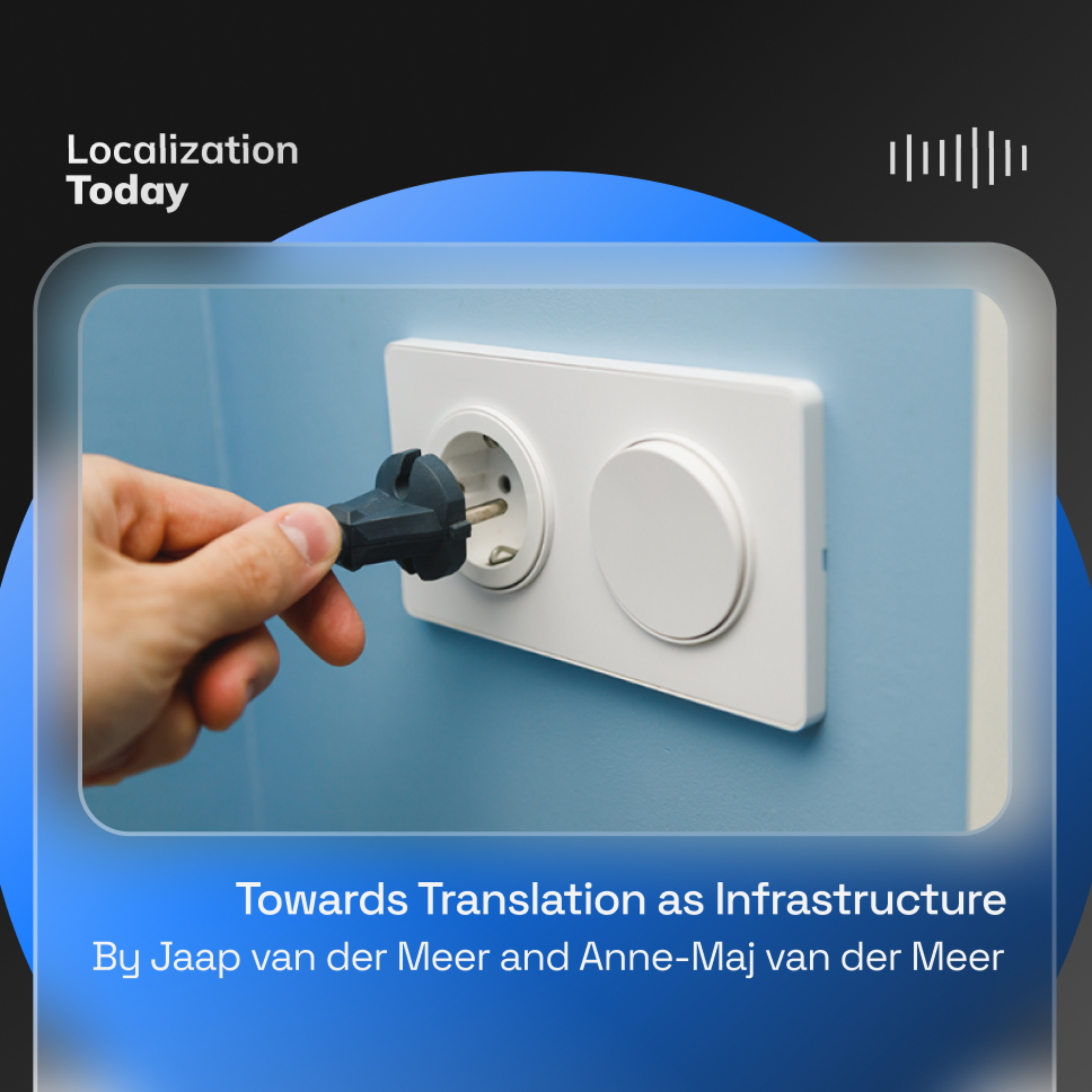
[00:00:24] Driving all of its changes has been a vision of transforming translation from an exclusive, exclusive and expensive service into an ordinary infrastructure feature. Its provocative launching slogan was translation out of the wall, evoking the idea of a resource access as easily as electricity or the Internet. After 21 years, that founding vision is becoming ever closer to reality. At taws, we believe the next phase of progress lies in specialized language models that bridge the gap between the capabilities of artificial intelligence and AI and real world needs.
[00:00:59] In this article, we tell the story of how TA pursued its ideals by continuously adapting to the needs of a complex industry and by focusing on areas where it could maximize its impact.
[00:01:11] With our founding goal now in sight, we conclude by proposing what's needed to take the industry the rest of the way.
[00:01:18] Automation Advocacy TAS began as the Translation Automation User Society, a think tank for the global language industry which was just starting to utilize machine translation.
[00:01:32] To us, it was obvious that improving and implementing this technology was the key to achieving our grand vision, and that the only thing we still needed to make automatic translation better was more and higher quality data. In those think tank years, TAS advocated for automated and data driven workflows, introducing concepts like fully automatic useful translation and designing dynamic quality frameworks to move away from the old static quality standard. But while research and development progressed, the appetite for these concepts in the wider industry was limited.
[00:02:06] Companies were intrigued by the promise of automated workflows, yet they were cautious and hesitant. The risks seemed high, the technology untested, and the business case uncertain. Radical changes were imminent for the translation profession, yet adoption lagged behind and the economic reality slowed progress. Business incentives hadn't aligned with technological potential and as a result, the industry moved cautiously. Looking back, these delays seem almost inevitable. Innovation rarely moves in a straight line, especially in an operational, decentralized and risk averse industry like ours.
[00:02:44] Technology was often ready long before the mindset was that created moments when it felt, frankly, like TAS was speaking into a headwind.
[00:02:53] At times, our push toward automation was misinterpreted as a disregard for human intelligence and the craftsmanship in translation, but that was never the case.
[00:03:03] Even back then, our argument was that technology should protect the profession by taking over repetitive mechanical tasks that never required human insight, and by freeing linguists to focus on their creativity.
[00:03:16] A Data centered world in 2018, Taaz started preparing for the AI driven future.
[00:03:23] The transformation was built on a massive multilingual Data repository launched 10 years earlier, Natural Language Processing. NLP engineers cleaned, enhanced and tuned this data with the latest techniques and Taoz provided it along with in house expertise to nearly all MT and AI model developers.
[00:03:44] Slowly the revolution Taaz envisioned a world of hyper automated global data rich language workflows arrived and is still with us today.
[00:03:53] However, it has taken a form that is undeniably more corporate scaled and commercially driven than early idealists may have hoped for. But this is also the natural evolution of any technology.
[00:04:06] Once the underlying science matures, the business side eventually wakes up. That is what happened here. Business models, procurement and content volumes caught up with the technological possibilities.
[00:04:19] The intervening years were merely a waiting period for economic incentives to align. Unfortunately, the inefficiency of human translation didn't disappear with the adoption of automation. It just took a new shape. Where we once spent time on repetitive mechanical translation, we now spend it reviewing and correcting MT output that may actually already be good enough.
[00:04:41] And that is exactly why technologies like quality estimation and automatic post editing have become essential. They reduce unnecessary review cycles and ensure that human effort is reserved for decisions that truly require human judgment. After all, the goal was never human free translation. It was to eliminate human waste so linguists can focus on what matters most.
[00:05:07] Yes, automation has made processes cheaper, but cost reduction was never the real promise. Automation forced the industry to confront what human intelligence in translation is actually for expertise in nuance, meaning, culture and intent, all the elements machines still cannot replicate. If automation is used only to drive prices down, the industry misses the opportunity entirely. But if it is used to rethink workflows, redesign roles, and elevate human contribution, then it not only makes us cheaper, but also a lot smarter. The Inflection Point the past couple of years saw the acceleration of AI into the mainstream. Large language models, LLMs became central to every conversation and use case.
[00:05:55] Suddenly everyone seemed to be high on AI, and language and translation were a central test case for it.
[00:06:01] Specialized providers with decades of knowledge and expertise were sought to bypass entirely as translations, quality evaluation, post editing, and more complex language tasks were run directly through AI in the hopes of saving time and money.
[00:06:17] Automation suddenly went from optional to sufficient.
[00:06:21] Of course, traditional workflows did not disappear overnight, but the old linear processes, manual quality checks, and static service models were certainly exposed as too slow, rigid and costly to meet the speed and scale that businesses now expected. The Excitement was palpable, but reality soon tempered the hype. Not every task could be solved by simply running content through an AI model. Integrating AI and LLM successfully into traditional workflows is far more complex.
[00:06:53] For example, LLMs struggle with QE and APE tasks, outputting unreliable and inconsistent results without careful training and fine tuning. Running everything through an LLM may save time in the short term, but risks introducing errors, inconsistencies, and potential privacy and copyright issues. The disruption of AI in our industry clarified the role of every stakeholder.
[00:07:19] Technology companies pushed the limits of what machines could generate, and enterprises demanded faster, cheaper, and more dynamic content pipelines.
[00:07:28] In the middle stood the translation industry and its language service providers, LSPs, highly knowledgeable, deeply specialized, but structurally unprepared for this pace of change.
[00:07:40] The opportunity was not to resist AI, but to shape how it enters our space.
[00:07:46] The question shifted from will AI take over our jobs? To how do we integrate AI responsibly, efficiently, and with quality at the core?
[00:07:56] And that is where TAOZ positioned itself. Tus's ambition was always to have a product in the market that could help the industry realize the vision of content available in every language to every human being on the planet. That opportunity arose in 2021, when Uber requested our help creating a model that automatically filtered poor quality output its MT engines.
[00:08:19] The data that TAS had spent years curating, now enabled the creation of the first version of the EPIC application programming interface.
[00:08:28] This experience highlighted taus's evolving role from provider of data and research to developer, helping organizations apply AI effectively and responsibly shift to specialized models.
[00:08:41] Over the past two decades, the lesson has been clear. No single stakeholder can transform the industry alone. Technology providers innovate rapidly, enterprises scale content exponentially, and LSPs sit at the crucial intersection of linguistic expertise, cultural understanding, and operational delivery.
[00:09:02] LSPs hold the key to ensuring that global communication remains accurate, meaningful, and human centered.
[00:09:09] They have the data, the skills, and the people.
[00:09:12] They may have new names now, such as Global Content Solutions Providers and Language Solutions Integrators, but at taws we call them AI Service Integrators.
[00:09:25] They are the ones best positioned to ensure that AI tools deliver reliable, accurate, and high quality content. It's an essential role.
[00:09:33] Yet with so many organizations experimenting with the same LLMs, questions naturally arise about innovation.
[00:09:41] If every LSP starts from the same generic model, differentiation seems impossible.
[00:09:47] This is exactly where specialization returns. Innovation now happens at the layer above the base model in domain adaptation, workflow design, quality control, data tuning, and human in the loop optimization.
[00:10:02] Generic models homogenize the baseline, but specialization restores the competitive edge.
[00:10:07] It reintroduces the deep vertical knowledge that LSPs have built over decades and makes it tangible, defensible, and uniquely valuable. As data has become abundant, the definition of data scarcity is shifting. The next decisive resource is no longer raw data, but high quality domain specific, well annotated data and the expertise to interpret and structure it.
[00:10:32] General datasets can train baseline models, but specialized models rely on deep knowledge from legal translators, medical editors, financial reviewers, and other experts who understand the stakes and subtleties of their fields.
[00:10:47] The future's scarce resource is not merely data itself, but the combination of data and domain intelligence. To tackle these challenges, taas developed the EPIC Partner program, creating a structured and proactive approach to specialized model training.
[00:11:03] We partner with companies around the world to train specialized models for epic, whether it is for specific language combinations or adapt it to distinct domains in order to obtain more accurate results and increase cost and time savings. Consider a legal translation in which small errors in terminology can have major consequences.
[00:11:23] In clinical trials, misinterpreting a protocol can jeopardize regulatory approval.
[00:11:29] Gaming content, by contrast, demands attention to colloquial tone, humor, and player engagement. Our specialized models aim to leverage these nuances, combining curated domain specific datasets with NLP expertise to train models that are not only accurate but also aligned with real world needs.
[00:11:50] Grounded Optimism in hindsight, tus's two decade arc has followed a consistent logic. First articulate the vision, then build frameworks, then prepare the data, and finally, when the market is ready, deliver the technology.
[00:12:08] We are now in that final phase where vision becomes execution and stakeholders across the industry converge around a shared need, scaling multilingual communication without sacrificing quality. If there is one CONSTANT in the TA's story, it is the belief that better access to knowledge and information moves civilization forward.
[00:12:28] That mission has not changed, only the tools have.
[00:12:32] With the right partnerships, the next 20 years can bring us closer than ever to making that vision real. The future hinges on humans and AI working together with companies like tos, providing the expertise and technology to make it possible.
[00:12:46] Of course we remain optimistic, but it is no longer the utopian optimism of 20 years ago. It has evolved into a pragmatic optimism shaped by experience.
[00:12:57] We now understand how slowly industry structures change, how long it takes for economic incentives to shift, and how messy and uneven AI adoption can be.
[00:13:07] But we also see that transformation accelerates when real business pressure arrives, and that pressure is here now.
[00:13:14] So we remain optimistic not because the technology is flawless but because the industry finally has both a motivation and the tools to evolve in meaningful ways.
[00:13:24] Looking ahead, the industry will need to balance speed and scale with trust in AI and creativity. For humans, success will come from putting each player, AI and humans in a place where they can shine and maximize their strengths.
[00:13:39] By focusing on specialized model training and close collaboration with industry stakeholders, Taoz aims to continue pushing towards translation as infrastructure and a positive future for our industry.
[00:13:52] This article was written by Jaap van der Meer. He is founder and CEO of TAS and a language industry pioneer. He launched early translation software, set industry standards and speaks and writes widely on translation technology and globalization.
[00:14:08] And Anne Maj van der Meer, She's Head of growth at TAS, leading sales, marketing and TAS conferences.
[00:14:16] With over 20 years experience in the language industry, she is often featured in online events, blogs, reports and other industry resources.
[00:14:26] Originally published in multilingual magazine issue 250 March 2026.