Episode Transcript
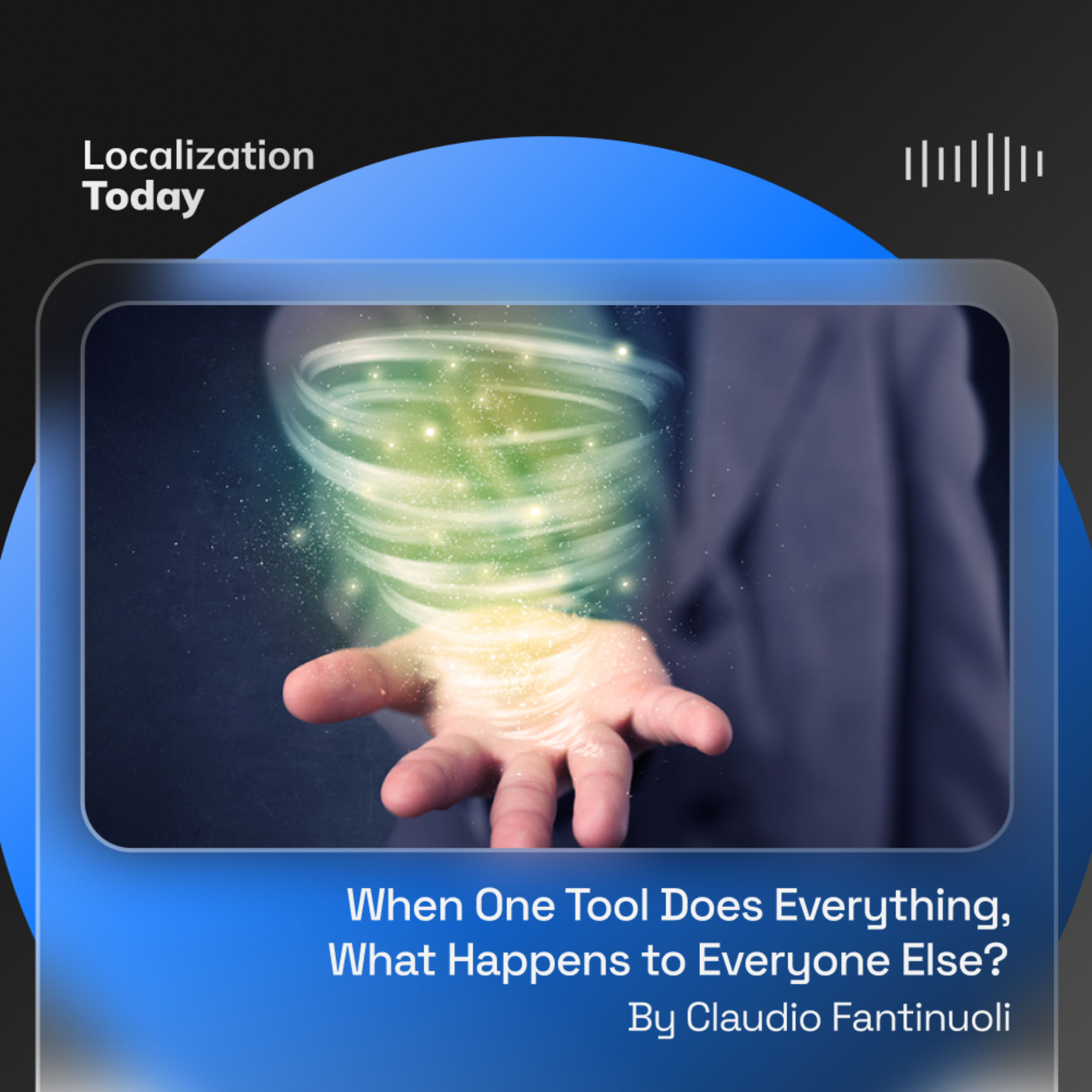
[00:00:00] When one tool does everything, what happens to everyone else? By Claudio Fontignoli the rise of highly capable artificial intelligence is not just another wave of technological disruption, another incremental advance of the kind we have seen many times before. It is a different kind of wave altogether. Technological change has always been part of business.
[00:00:24] New tools arrive, old processes fade, and companies either adapt or disappear.
[00:00:30] For much of modern history, the pattern was orderly enough.
[00:00:34] One specialized technology displaced another.
[00:00:37] Digital cameras replaced film cameras. Neural machine translation eclipsed statistical machine translation.
[00:00:44] Rule based speech recognition gave way to end to end models. Each transition was painful for businesses built on the older technology, but the shape of the disruption was familiar. That is no longer the kind of technological change we are living through today.
[00:01:00] Specialized technologies are not being defeated only by better specialized technologies.
[00:01:05] They are being absorbed by systems that arrive not as superior solutions to one narrow problem, but as platforms capable of handling dozens of problems at once.
[00:01:15] That is the real shock of modern AI. And it is a shock language technology companies have been slow to fully reckon with. Frontier models like ChatGPT, Claude, Gemini, and Deepseek are not specialized tools in any traditional sense. They write code, analyze data, generate images, answer legal questions, solve mathematical problems, and hold nuanced conversations in the language industry.
[00:01:42] Translation, transcription, interpreting, summarization, and terminology extraction capabilities that entire technology companies were built to provide are becoming features inside models that also do everything else, from the smartphone lesson to the teaching bot.
[00:02:00] Consider what happened to the photo camera when digital cameras replaced film. The disruption was painful but legible. A better technology displaced an older one in the same form factor, serving the same purpose.
[00:02:15] Some companies, such as Kodak, failed to survive, others retooled. New players emerged. The industry changed, but the usual logic of technological displacement was still recognizable. What happened next was different.
[00:02:29] The smartphone did not arrive as a better camera. In pure optical terms. It was not. Professional photographers did not throw away their cannons. But the smartphone camera was good enough for nearly everyone else, always in their pocket and part of a device that already did a hundred other things.
[00:02:47] The camera had not been defeated. It had been absorbed, reduced from a product category to a feature.
[00:02:54] Compact cameras collapsed, and so did an entire industry.
[00:02:58] Software and knowledge services offer a similar version of the same story.
[00:03:02] Chegg had built a substantial business around structured homework help. Then ChatGPT arrived and students discovered they could get explanations, summaries, and problem solving assistants faster, cheaper, and without a dedicated subscription. Chegg's core product had not necessarily become worse.
[00:03:20] It had become a feature inside someone else's platform. Its valuation fell from nearly $14.7 billion in early 2021 to around $115 million by April 2026. The threat many technology companies face today is not being replaced by a better version of themselves.
[00:03:39] It is being swallowed by something broader. Language technology companies should read both cases carefully. Their product may be the compact camera.
[00:03:49] We know the direction, not the destination.
[00:03:52] Are specialized language technology companies doomed? Not necessarily, but the reasons why are more demanding than the industry sometimes likes to admit. The rise of highly capable machines does not destroy specialization.
[00:04:06] It destroys the lazy version of it. The assumption that doing one thing competently is by itself a defensible business.
[00:04:15] What survives is a narrower, harder earned kind of advantage. The challenges of having systems that can do everything are real.
[00:04:23] No one can draw the full map from here and find the right answers to maintain a value proposition in a landscape dominated by generalist hyperscalers. Because one thing is sure for a specialized language technology company, building or competing to build generalist highly capable machines is virtually out of reach. The capital requirements, compute infrastructure and breadth of training data belong to a small handful of hyperscalers. Specialized companies are playing a different game. The question is how to play that game well. Three directions might offer some perspectives, even if none offers guaranteed safety. The first direction is the quality advantage. If your system is only marginally better than what leading hyperscalers offer, that margin may disappear within one or two product cycles. The only durable position is being meaningfully better for use cases that practitioners actually pay to preserve better on real documents, real audio and real workflows, not only on synthetic benchmarks.
[00:05:25] The second is niche applications fit over breadth. A purpose built system for edge deployment, domain specific terminology or high stakes. Live interpreting does not need to beat a frontier model across the board. It needs to be the most sensible choice in its environment that is defensible as long as the niche remains real and the specialization remains deep. The third is careful diversification.
[00:05:50] DeepL's expansion beyond translation into writing assistance, document processing and broader productivity tools, or translated's more structural bet with PI Campus, an AI school and venture ecosystem in Rome. Both point in the same direction, compensate for erosion in the core category before it becomes structural. No single direction is enough, and the companies most likely to endure are those that pursue all three at once.
[00:06:18] Quality, niche fit and diversification.
[00:06:22] The wave is already moving.
[00:06:24] We do not have a formula to tackle this technological earthquake. Nobody does. The honest position for specialized language technology companies right now is perhaps not a strategy in the conventional sense, but a state of heightened awareness. The current disruption appears structural. The pace of frontier improvement seems faster than in previous cycles. In this industry, the capital asymmetry with hyperscalers is unlikely to narrow soon. What general models cannot do today, they may well do adequately within two or three product cycles. What we can say with some confidence is that the companies most at risk are probably not those without definitive answers. They are those that have stopped asking the right questions. Those mistaking a temporary quality lead for a durable position are waiting for the situation to stabilize before committing to a direction. There is a scene at the end of Point Break where Bodi, finally cornered, begs to be released to ride the 50 year storm at Bell's Beach, a wave no one survives. He knows what it costs. He paddles out anyway. The companies that endure this moment will not be those searching for safety in the lineup. They will be those that have read the wave clearly enough to commit to it, even while knowing that the wave itself may still change shape. This article was written by Claudio Fontignuoli. He is an executive level manager, innovator, and researcher specializing in digital transformation and speech technologies. He is an associate professor of interpreting studies and language technology at Mainz University and the founder of Interpret Bank, a computer assisted interpreting tool. Originally published in Multilingual Magazine Issue 252, June 2026.