Episode Transcript
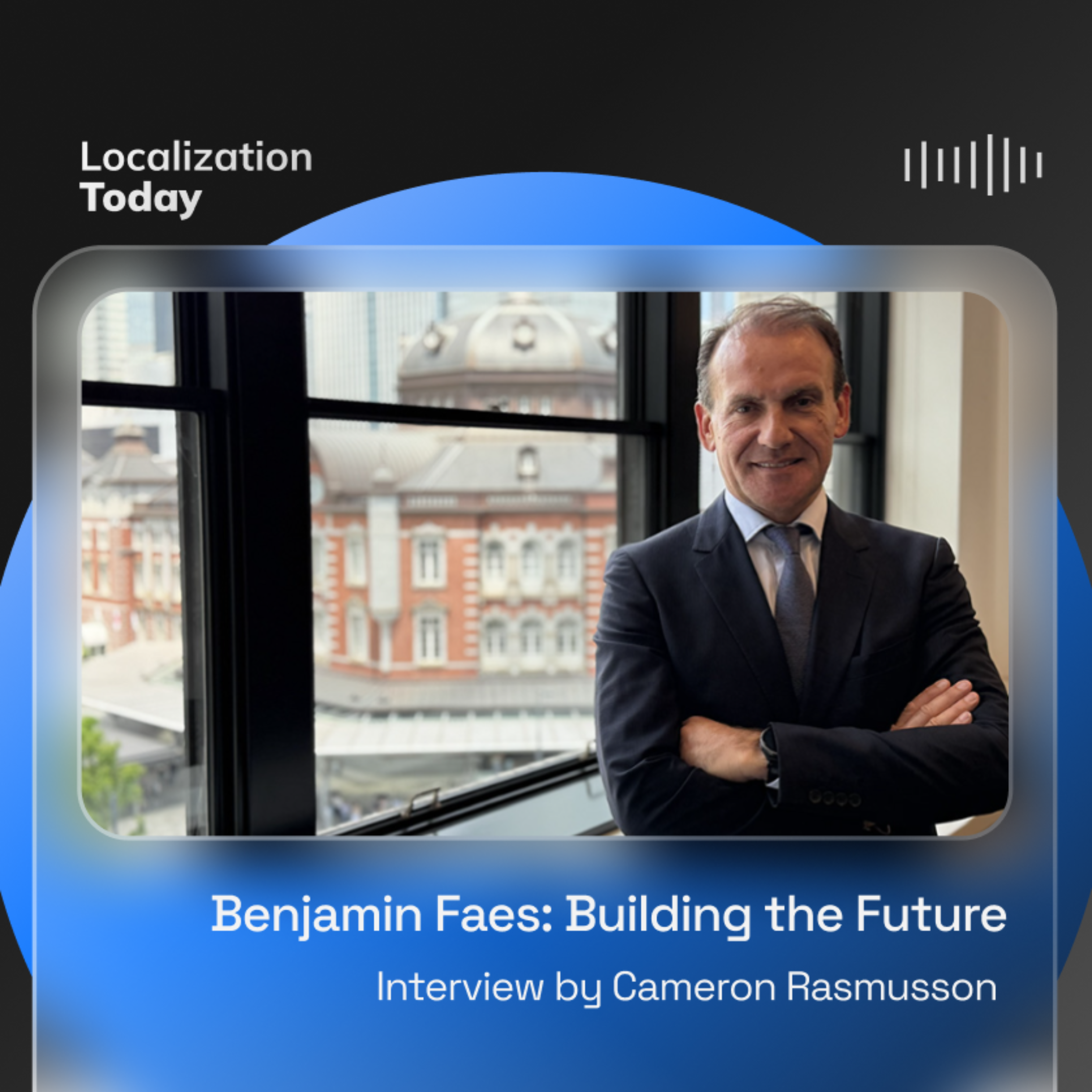
[00:00:00] Speaker A: Benjamin Fais Building the Future Interview by Cameron Rasmussen Business leaders of all stripes face a daunting challenge in the mid-2020s. How does one position a company for success when the future is increasingly unpredictable?
The decisions of today will inevitably echo, for good or ill, in the marketplace of tomorrow, and that creates a high pressure environment for anyone occupying a leadership role.
That is exactly the environment that Benjamin Fais stepped into in January 2025 when he assumed the leadership of RWS, one of the world's largest language companies. A veteran of major corporate entities and no stranger to strategic positioning during disruptive eras, Fae takes the reins at a time when these skills are essential. He views the moment as one of great opportunity, and given RWS's assets and position in the industry, it could be one of unparalleled growth if guided by the right playbook.
We asked him about the factors shaping his vision, the experiences that prepared him for the role, and the opportunities he's pursuing. A year and a Half into the job it's been a year and a half since you joined RWS as Chief Executive Officer CEO. Could you tell us how you've settled in and about the accompanying challenges and rewarding experiences?
[00:01:17] Speaker B: I didn't really settle in.
I landed running. When you join a company mid transformation, revenue shifting, artificial intelligence, AI rewriting, client expectations, the whole industry in flux. The luxury of a quiet first hundred days doesn't exist. And honestly, I wouldn't have wanted it any other way. The biggest challenge?
Speed of change versus depth of heritage.
RWS has nearly seven decades of expertise, 45 plus patents and relationships with 85 of the world's top 100 brands. You don't throw that away, but you also can't preserve it in amber. My job has been to honor what makes RWS exceptional while completely rewiring how we go to market, how we build products, and how we think about what we sell. The most rewarding part has been the people.
When I arrived, I expected deep domain expertise.
What I found was something rarer genuine hunger for reinvention. Our teams didn't need convincing that AI changes everything.
They needed a framework and the permission to move fast.
Giving them that and then watching them sprint has been the best part of the job.
[00:02:28] Speaker A: You've worked for major companies like AOL, YouTube and Google. How have those experiences prepared you for this role?
[00:02:36] Speaker B: Every one of those chapters taught me the same lesson from a different angle.
Technology doesn't replace human value, it redefines where that value sits. At aol, I lived through a company that believed its Walled Garden was the product, and I watched the open web prove otherwise. It taught me that platforms win when they serve ecosystems, not when they try to own them. At YouTube, I was part of inventing a monetization model for something the market said couldn't be monetized. User generated video.
That experience hardwired me to look at disrupted markets and see revenue models that don't yet exist. At Google Cloud, I learned what it means to sell transformation to enterprises that are simultaneously terrified and excited by technology.
That's essentially what I do every day at RWS, the thread connecting all of it. I've spent 25 years at the intersection of technology, content and global scale.
RWS sits at exactly that intersection. The difference is that here I get to shape the future of the company, and by extension, the future of an entire industry.
[00:03:44] Speaker A: Speaking of the past 25 years, they've seen no shortage of technological disruption. How has that shaped your perspective on weathering change and positioning for future prosperity?
[00:03:54] Speaker B: You don't weather disruption, you become the disruption.
That's the mental shift we've made here at rws. Concretely, we've reorganized the entire company around three Generate, Transform, and Protect. Each designed to capture a distinct value pool in the AI economy.
Generate is about intelligent content creation and enterprise knowledge. Transform is about making content work across every language, market and cultural context at scale.
Protect safeguards intellectual property in a world where AI makes copying trivially easy. Together, they form a complete offering for any enterprise deploying AI globally. We've also invested heavily in relaunching the RWS brand with a bold visual identity that signals who we are becoming.
That might sound cosmetic, but it's been a genuine catalyst for our pivot. When your people, your clients and your market see a brand that looks and feels like a technology company, it accelerates the shift in perception and in behavior. It gave the entire organization a visual anchor for the transformation. Alignment comes from clarity of mission. Our mission is to build the cultural intelligence layer for enterprise AI. Every product decision, every hire, and every partnership gets tested against it. When 7,000 people share a single organizing idea, that's genuinely exciting and genuinely true. Alignment isn't something you have to force. It pulls.
[00:05:25] Speaker A: The coming years could well see the most significant industrial changes yet. How do you perceive the dynamics of that change? And what are the dangers and opportunities?
[00:05:34] Speaker B: The single biggest dynamic is this. AI has decoupled language from the people who speak it. A large language model, LLM, can produce grammatically perfect text in 50 languages without understanding any of them. That's extraordinary and terrifying. In equal measure. It's extraordinary because it democratizes access.
A startup in Nairobi can now serve customers in Japan, but it's terrifying because grammatically correct is not the same as culturally intelligent.
An AI that translates a financial services disclaimer perfectly but misses the regulatory nuance in Germany or the tone expectations in Japan creates real commercial and legal risk.
That gap between linguistic output and cultural intelligence is where our industry must live now. The biggest danger is commoditization, a race to the bottom where language is treated as a feature toggle inside an LLM.
The biggest opportunity is the opposite, becoming the critical governance layer that makes enterprise AI trustworthy across cultures. The companies that will thrive are those that can combine deep human expertise with scalable technology to deliver cultural intelligence enterprise speed. That's precisely the space we're building into.
[00:06:49] Speaker A: You mentioned how your career experience honed your ability to envision and pioneer new revenue models. To the extent you can share details, what do you envision for rws?
[00:06:59] Speaker B: I see three significant growth vectors that barely existed two years ago. First, AI data services through train AI. Every frontier AI model needs massive volumes of high quality, culturally nuanced training data, preference data, evaluation data, red teaming data. We have more than 250,000 data specialists, linguists and domain experts across 175 countries.
That's an asset almost no one else can replicate at our scale and quality threshold.
Second, AI powered multimedia transformation.
We acquired PaperCups IP to integrate AI dubbing and subtitling directly into the new Tratos platform. The AI dubbing market alone is roughly a billion dollar opportunity.
Brands need their video content to feel native in every market, not just captioned. Third, and this is the one I'm most excited about, Cultural intelligence as a SaaS layer language Weaver Pro built through our strategic partnership with Cohere is the clearest expression of this. It combines frontier neural machine translation with the cultural and domain expertise that only RWS can provide.
The new Trados platform takes it further an end to end environment where AI and human expertise work together seamlessly. The trajectory is to make this available as infrastructure that any enterprise can plug into their AI stack, not translation as a service.
Cultural intelligence as infrastructure when you came
[00:08:32] Speaker A: on board in early January 2025, former CEO Ian L. Moqadam stayed on until the end of the month to facilitate the transition. What lessons did you take away from his leadership?
[00:08:43] Speaker B: Ian was generous, pragmatic and genuinely committed to a smooth transition, which says a lot about his character. The most important thing I took from him was context, not just the business mechanics but the unwritten map. Which clients had been with us for decades, which teams had been through the hardest restructuring, where the institutional memory lived. He also reinforced something I already believed. RWS's people are its real moat. Capabilities can be copied, patents expire. But a global community of linguists, domain experts and cultural specialists who genuinely care about quality, that's built over decades, not quarters. Ian understood that deeply, and I'm grateful he made sure I did too.
[00:09:28] Speaker A: As you indicated before, AI is rewriting markets across the world in ways that are both exciting and daunting. Could you talk in more detail about how AI fits into RWS's strategic vision? And what is its appropriate role?
[00:09:42] Speaker B: AI isn't a feature we bolt on. It's the architecture of everything we're building. On the offering side, our entire product strategy revolves around what we call the Cultural Intelligence layer.
Again, language Weaver Pro, launched through our partnership with Cohere, integrates Frontier NMT with quality estimation models. Trained by our own linguists and deep domain expertise, the new Trados platform brings it all an end to end environment that delivers near instant human caliber translation quality at scale. It frees our specialists to focus on the work that truly requires human judgment, like cultural adaptation, regulatory nuance and brand voice. And that same intelligence doesn't stop at creating and adapting a brand's content. Increasingly, it protects it. Our recent acquisition of Obviously is a good example. Obviously brings an AI driven platform that lets enterprise, legal, marketing and finance teams track their brand and IP assets, identify threats like counterfeits and copycats, and quantify the commercial impact of infringement. Combined with our patent and localization capabilities, it creates a single global brand guardianship platform. One place to create, localize, register, monitor and enforce a brand across every market a client operates in. It's the natural extension of the cultural Intelligence layer. If you understand what a brand means in every context, you're uniquely positioned to defend it internally. We've unified all our technology teams, so we build the AI intelligence layer once and surface it across every product. Our delivery platform automates workflows end to end. That's a structural change, not a superficial one. As for the appropriate role of AI, generally, I have a strong view. The industry has been obsessed with maximizing iq, making models smarter.
What's missing is EQ making them wiser, culturally aware, contextually sensitive, brand safe. Every AI experience, from your morning briefing to your autonomous car, will need to adapt to who you are, where you are and what you mean, not just what you said. Building that layer of understanding is the next great challenge in AI. And it happens to be RWS's reason for being.
[00:12:04] Speaker A: Thinking about the business landscape in which you compete. What do you consider to be the one element that sets RWS apart?
[00:12:11] Speaker B: Depth, not breadth. We have 68 years of accumulated knowledge about how language, culture and meaning actually work in the real world. Across regulated industries, legal jurisdictions and brand ecosystems.
We've codified that into 45 AI patents, more than 100 peer reviewed papers, and the workflows of 80 of the world's top 100 brands.
We have a quarter of a million experts who don't just speak languages, they understand the cultural operating systems behind them. No pure play AI company has that and no legacy translation company has our technology ambition. We occupy a unique position. Deep human expertise scaled by proprietary AI delivered as enterprise grade infrastructure. My job is to make sure we never lose the depth while we dramatically accelerate the scale.
[00:13:04] Speaker A: Given the stressful nature of leading a company through transformative times, what helps you relax and unwind?
[00:13:10] Speaker B: I'm a visual person, so photography and videography are my reset button. There's something about framing a shot that forces you to slow down and see what's in front of you.
I've recently got into action cameras and love capturing movement and light in ways you can't with the naked eye. I'm also religious about sports.
Every morning I alternate between running, cycling and weights. A ritual that gets me physically ready and mentally energized before the day begins. There's a clarity that comes from pushing your body first thing that no amount of coffee can replicate. And honestly, I read a lot, mostly about technology, culture and how they collide. I find it hard to separate curiosity from work, which I think is a good sign that I'm in the right job.
[00:13:58] Speaker A: Is there anything you want to add?
[00:14:00] Speaker B: Just this. I think our industry is at an inflection point that's far more exciting than the narrative suggests. The dominant story is that AI kills language services.
I think the truth is the opposite. AI is creating an entirely new category of enterprise need. Cultural intelligence at scale. The volume of content that needs cultural adaptation is about to explode as AI generated content floods every channel.
Regulatory requirements around AI safety and cultural appropriateness are accelerating.
Demand for trustworthy human validated AI output is growing, not shrinking. The companies and the people who built this industry have exactly the expertise the AI economy needs.
Our job, RWS's job, this industry's job, is to repackage that expertise for a new era. Not to defend the old model, but to architect the new one. I came to RWS because I believe we can do that. Eighteen months in, I'm more convinced than ever.
[00:15:02] Speaker A: This article was written by Cameron Rasmussen. He is senior writer and editor for Multilingual Media. Originally published in Multilingual Magazine, Issue 253, August 2026.