Episode Transcript
[00:00:15] Speaker A: Hello, everyone, and welcome to another edition of Localization Today Live.
Thank you for joining us in this special conversation to honor Haitian Heritage Month.
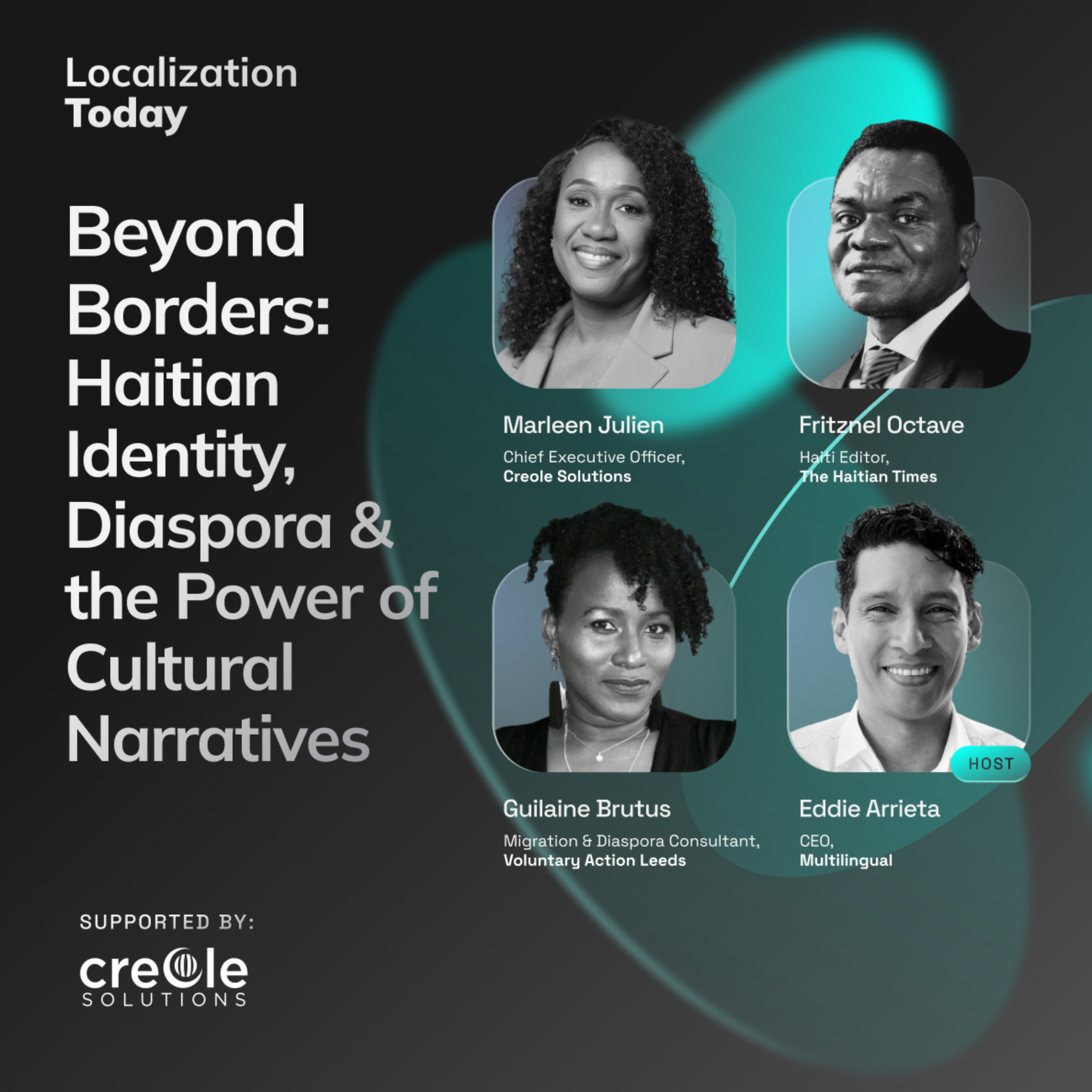
Beyond Borders is the name of this series, Beyond Haitian Identity, Diaspora and the Power of Cultural Narratives.
Some of you have joined us because you've registered through our newsletters or you've registered through the different social media channels that we used, including our mailers. If you don't know what we're talking about, please go to our website, multilingual.com where you can find more about us.
And the idea of today's panel is to let us know where in the world you are up. Sorry. And is to understand better Haitian Heritage Month. Now, before we begin, please let us know where in the world you're looking or you're watching from. If you're watching this as a recording, please put the city, the country, whatever you feel comfortable with to let us know where in the world you're watching from. And also, as always, we will have a Q and A moment to go over your questions, so feel free to leave the questions whenever you have them in the comments, whether you are watching on YouTube or you're watching on LinkedIn or if you're watching later. My name is Eddie Arrieta. I'm the CEO here at Multilingual Media and I'll be moderating today's panel.
Before we begin, of course, we'd like to take a moment to thank Creole Solutions for supporting this space and helping make conversations like this possible. Their work around Haitian Creole language access, cultural advocacy and professional opportunities for Haitian linguists reflects many of the themes we'll be discussing today. And most importantly, thank you everyone watching from around the world. We really appreciate you taking the time to be here with us. As always, we love to know where you are joining from.
So drop the city, the country once again, whatever you're comfortable with on the chat, and we'll be mentioning it throughout this conversation.
One of the best parts of this conversation is seeing how global our community is. So I see.
Let me read now. I haven't been reading. You see Germany. And. And we are reading. Thank you everyone watching from Germany. Valparaiso, Indiana, usa.
[00:02:55] Speaker B: That's great.
[00:02:56] Speaker A: Brazil.
Great. We're in Brazil. That is wonderful.
Thank you everyone from for dropping your places.
If you haven't already, take a look at our Localization Today podcast where we talk with leaders in the localization industry who are shaping the present and future of technology and business.
There's a QR code on the screen.
You want to scan it and have access to localization today. This conversation will be there in audio if you want to listen to it again later. And there will be versions of it released with subtitles.
If there are any ways in which you think we could improve this space, you let us know in the comments. Comments as well. Hello from Oaxaca, Frale Gonzalez. Hello. And we are gonna get started with this panel. We're really excited to get going. And of course, as I mentioned earlier, today's discussion digs into how Haitian identity is shaped, preserved and reimagined across borders through journalism, migration, education, language access and storytelling. We'll be talking about diaspora identity, media representation, cultural continuity, nation building, and the role language plays in shaping collective memory and perception. And now let me introduce today's panelists. Like I mentioned, we will have a QA section drop your questions and put them in the comments of this stream.
First, we are joined by Fritzno. Octave Fresnel is a journalist, writer and speaker with the Haitian Times and co host of the 1904 Renaissance podcast. His work explores Haiti underreported stories, black transnational narratives, leadership, and diaspora journalism. A. Friesnell Octave. Welcome. We're also joined by Ghislaine Brutus. And I'm just guessing, so you will have to correct me.
Ghislaine, perhaps you will have to correct me, is a migration and diaspora consultant and cultural curriculum specialist whose work focuses on nation building, intercultural development, and cultural continuity across generations.
Finally, we are joined by Marlene Julienne. Marlene is the founder and CEO of Creole Solutions, a company focused on Haitian Creole language access, localization, workforce development and cultural advocacy. She's also a strong advocate for linguistic equity and plain language initiatives supporting Haitian communities globally. Thank you all for joining us and thank you for being here.
[00:05:59] Speaker B: Thank you for having me.
[00:06:01] Speaker C: Yes. Hello, Eddie. Hello, everyone.
[00:06:03] Speaker B: Hello, Marlene.
[00:06:04] Speaker A: And it seems, it seems since one of our panelists went out for a stroll. And of course, once again, thank you to our great audience.
Please correct me. How do I properly pronounce your name?
[00:06:21] Speaker D: It's Ghislaine Gillen.
[00:06:23] Speaker A: That sounds so much better.
[00:06:24] Speaker B: Of course,
[00:06:28] Speaker A: Ghislaine Brutus.
Great. Marlene, Guylaine and Fresnel, thank you so much for opening up to this conversation and we're really looking forward to getting your perspectives.
And if it's okay with you, we'd like to start with a warm up question. Let's say, how can Haitian professionals, artists, educators, media voices collaborate to reshape global perceptions on Haiti in more nuance and human ways? Something that humans need to be doing. So I don't know who Would like to take that first question, so I'll
[00:07:13] Speaker B: let ladies go first, please.
[00:07:18] Speaker C: We've had so many conversations about that topic. I think you would be perfect for it.
[00:07:25] Speaker B: Well, all right, since you guys allowed me, let me.
Let me try to get my 2 cents on this question.
So the way to. You need to look at.
Look at it. Look at, look at it. Look at Haiti particularly. It's.
It's basically based on how it's perceived around the world. What kind of narrative has been created on Haiti. So Haiti is too often reduced to instability, you know, poverty, disaster. This is not a secret for everyone, because that's the narrative that most in the world who usually hear about Haiti, that's what, that's what, that's the story.
They usually. Okay. So in order for anyone, any professionals that's been in, journalists being artists, anyone working toward making Haiti on this, you know, you know, understood by the world.
So it will be.
She's trying as best to contain this kind of a mainstream narrative about the country, because across sectors. So Haiti, it produces excellence. It's not just about instability, political instability. It's not about gang violence as it is the main narrative now. Haiti is an insecure country. It's.
It's controlled by a gang. That's. That's what most people think of Haiti when you say the word Haiti as a country.
So being in medicine, being in academia and sport and art and entrepreneurship and public service, you know, music, food, you know, the environment as a whole, we have enough to, you know, contain this, this, this negative narrative that been portrayed for so long.
[00:09:55] Speaker A: Thank you, Fraser, for, for your perspective. Ghislaine or Marlene, I don't know if you have anything to add to here. Just jump on if you, if you, if you believe so.
[00:10:06] Speaker C: Yeah, what he said was beautiful. And I would like to add that this, for especially this year, we have seen this happening. We have seen Haitians in the global stage. We've seen young entrepreneurs. And I'm proud to say that Haiti's finally going to be playing soccer, going to the World cup this year. This was big for us. So I do feel that Haiti is getting a different. There's a. Haitians are taking over our narrative, and we are being looked at differently. It's happening slowly, but I feel like, especially on social media, the way people perceive Haitians is slowly changing.
[00:10:46] Speaker D: Yeah, Marlene, that is true.
I, for me, personally, as someone who grew up outside of Haiti and had to sort of rediscover culture, my culture, my cultural roots, I see it as a personal journey I see it as if you're a professional, regardless of the field that you're in. I think whatever you do, you do it well. You try to seek knowledge on yourself.
So if you're an artist, you make sure you connect to that, to your roots. And whatever you do, you do it well. You present your art, your journalism, your movies, your music. You present it in a way because you know that you're an ambassador to your culture, to your language and to your country. So whatever you do, if you do it well, it reflects well on your country. It's like a domino effect. It will reflect well on your country. So I believe that it's an individual battle to make sure that you remain an ambassador to your culture, to your country, and to your language. If you don't know, then you learn and you integrate it into whatever work you're doing.
[00:12:04] Speaker A: And it's incredible to be able to connect with that level of excellence.
Frisnol if we can focus a little bit on some of your journalistic coverage of Haiti and the diaspora, perhaps this is, I imagine, kind of like an iceberg where you just see the tip and sometimes you ignore all of the greatness that is within and it takes a huge level of self consciousness, like you're suggesting. Ghislaine, being able to really connect with your roots, being able to connect with your identity and really anchor the positive elements and then move forward from there. And I would like to know from your perspective, Fresno, what have you seen? What have you encountered in the underrepresented stories that talk a little bit about this, the non so famous greatness of Haiti and its diaspora?
[00:13:07] Speaker B: One of the things from, you know, the longest I've been a journalist in working in the field, one of the things I which is very bothersome to me is that patience usually is perceived in. In term of ex exceptionalism. So, like, whenever someone is successful, I mean, at least the one people, people know about who. Who you know who is perceived, you know who are. Who is perceived as a successful person.
And then the world will present it as an exception.
So to me, it's like, I mean, I know so many successful Haitians. We are a nation of about 12 million people, and then so many of us work hard to succeed. Haitians believe in education.
This is culture. This is basically part of our DNA. Our DNA. The minute a child is born in Haiti. So the parents, the parents don't talk, don't think about anything else than how I'm going to prepare for that child education. Being a girl or a boy. So through education we know everything is basically possible if you are educated. Even though of course things are hard and depending on where what parts of Haiti you forms and how challenges infrastructures and basic infrastructure to help you to support what you want to accomplish in life is.
But we all fight through challenges and break barriers to succeed.
But then, so when you, you come, you come up to the podium and as someone perceive as successful and then they will present you as an exception, like it's not normal, it's not normal that you succeed. So this is really bothersome to me, as I said before. So that's one of the narrative I try hard to counter in my, in my core reporting.
So to show that okay, one person, one, one Haitian student succeed at an Ivy League in the US is not an exception.
We have so many, so many that could do the same thing if they were given the same opportunity, maybe even succeed way better than that one person you see, because maybe, you know, more skills, more intelligent, but we don't discover it because that's not the mission. That's not the vision we have about the country. That's not the mission we give ourselves.
That's one thing. And then another thing is that Haiti is, is the poorest country. And then Western hemisphere. This is a killer for me.
Whenever I come across a headline in the mainstream media or whatever, NGOs report and then that's the introduction to their report. This is always a killer to me because I know to the core and I believe that it is not the poorest country in the western.
We are by far one of the greatest country in the, in the region.
But are not we impoverished? Yes.
Are not we pilfered? Yes.
Are we holding those who dilapidated the country's resources accountable? No.
Are we a country of chronic impunity as a disease that never get cured? Yes.
But we can go on and on. There's so many different factors that combine together causing this not just internally, but externally.
We have foreign powers who, you know, basically foster this kind of, you know, behavior, you know, core behavior and impunity, you know, you know, help sustain this long history of impunity in Haiti. As also we have national leaders who don't care about, you know, projecting a better image of the country, you know, threaten institutions. So, but making institutions weaker, weaker, weaker so they can profit for themselves. Of course we have this like this exists in any other country in the world. It's not just in Haiti, but then in Haiti the focus is particularly put on those things. And then that's why me and My core work reporting, been writing to my book Haiti, between testing us and hope, is a testimony to this belief that while we have problems in the country, but we have more to offer the world, to offer ourselves and then to offer the world, then the sum of the problem, the challenges we have.
[00:19:11] Speaker A: Glenn, I wanted to touch base with you on this as well, because it feels like the Haitian export being the talent of.
We used to call it in our hometown, we call it the brain drain.
All of our citizens go to the capital of Colombia because we are a small city, so they don't stay here.
Glenn, what do you see in the diaspora communities contributing to nation building while living outside of the country of origin? What is happening culturally with the diasporas? What do you see in this conversation?
[00:19:52] Speaker D: What do I see?
Well, over the years, I've been paying more attention because of the work that I do.
And we all know that nation building doesn't only happen internally, it happens externally as well.
And within the diaspora community. When it comes to nation building, we're not just sending remittance home. We're the financial capital, where the knowledge capital, we safeguard knowledge and we transmit it intergenerationally while we're outside, where social capital, we build global networks, local networks, regional networks from where we live, the spaces that we occupy, we reconnect them with Haiti. You see a lot of tour companies, you see a lot of history books being written. You see now there's. There's more focus on young people. There's children's cartoons and all sorts of things being recreated to kind of carry that culture on and carry that. That knowledge, social knowledge on.
Yeah, where it's social, I mean, cultural capital as well, preserving our languages, like Marlene and history and values.
So someone born in the diaspora who may have Haitian parents, one or two, both Haitian parents, might not know the language very well. Like myself, I learned the language, might not know the language very well. But they hold within them this sort of cultural and social capital because the way they eat, the way they behave, their values, it comes from their parents, it comes from their culture, and they carry that on. You see a lot of battles about piclis. Oh, that's not how piclis is done. That's, you know, and these are people that were born and raised in the diaspora, these little things that they hold on to, that's culture. That's. That's preserving culture and that's continuing culture and that's nation building because they go on and they create businesses and those businesses, although they survive outside of Haiti because of the situation that we know within Haiti. That doesn't mean that they don't want to. They crave that sort of reconnection.
They crave that need to build within the country. So, yeah, I think the diaspora is doing a lot of nation building from supporting their families, from organizations and from continuing the culture, the language, where they live, in the spaces that they occupy.
[00:22:32] Speaker A: Thank you, Marlene, Feel free to tell us about your experience with the diaspora.
But of course, we are also here to talk about the language industry.
And it's very interesting because I see governments across Latin America, the Caribbean, investing in agricultural projects because they are in industries that are $10 billion a year. And here we have a language industry that is knowledge intensive, that in the most conservative estimates is $30 billion a year. Conservative estimates, and the more optimistic estimates say 60, $70 billion a year.
We have in Creole Solutions a great success case. And it'd be really interesting to hear your perspective, Marlene, on how do you see the language industry, particularly creating meaningful opportunities for Haitian professionals both inside Haiti and across the diaspora, like you already know people doing with you. So thank you for being here also today.
[00:23:44] Speaker C: Thank you, Eddie. Great question. And as you know, Creole solutions just hit 11 years. So we've been in business for 11 years. So if there wasn't a demand for our services because we only work in one language, we wouldn't have existed, we wouldn't still be in existence.
And this has been our hardest year, I'll be honest. It's been a hard year because there's been federal contract cuts, immigration policy, and a wave of our friend AI causing translation costs. And yet we're still busy accrel solutions because there are 13 numbers worldwide and over 1.2 million Haitian Americans.
So I see Haitian Creole. And of course, because Haitian Creole is a lower, low resource language, there's still demand for Haitian Creole. AI companies may need language, need language professionals to make sure that their data is correct. So there is a lot of work within the diaspora, like you said, in the agricultural sector, they have a lot of Haitian employees, a lot of immigrants from Haiti working in the agriculture cultural sector. In Latin America and in the US These people need resources in their language so they could do their work like instruction manuals and employee employment benefits. They all, all this needs to be translated into Haitian Creole. So despite the difficulties, the economy, there's still a big demand for Haitian Creole translation. And let's talk about, hey, let's go to Haiti. Haiti people are.
We know that Haiti has an education problem because a lot of our educational resources, they're either in French or they are outdated or both.
So to build our country, we also need to our language. We need to have materials in our language. So this is another area where language professionals can work. They can create more job opportunities for language professionals. And Ghislaine was talking about tours and tourism and the Haitian diaspora, wanting to connect with Haiti. I have met so many Haitian Americans that want to connect with their language, like Ghislaine, that want to learn the language and a culture, but not in, like, a cut and paste app that doesn't, you know, factor our culture and the nuances of the Haitian language. So there are opportunities for them there. There's opportunities in health care and legal. A lot of Haitians need interpreters to go to court. We had so many cases. We had. We had so much work in the beginning of the year where we needed to go in asylum, interviews with Haitians, healthcare. About 80% of our work is in the health care sector. So there's still a lot of work for Haitian professionals. So at Creosolutions, what we do is we train language professionals because many times they come in, they may speak both languages, but they don't have the skills of a translator or an interpreter. So what we do is we do a lot of training, and then we offer them job opportunities. And this has helped so many people in Haiti. I'll give you an example. There is Jean Luc, who's been working with us for years and since he started.
I remember the first picture he sent me was a picture of his son going to school. And he was so proud that he was able to earn a living with something he learned in school. And then he would send me pictures of his house being built. And now he has built his own house in Haiti, and he's working and he's.
And he, you know, and that's where the dignity comes in. Giving them an opportunity to work in something that they learn in school and something that they're competent in. So this is. Yeah, so these are some of the ways that language, the language industry can create economic opportunities for Haitian professionals in Haiti and in the diaspora.
[00:27:58] Speaker A: And it's incredible. It's incredible the parallels that we can draw across the entire region where we understand, you know, when you have an edge on a type of knowledge, and then you just need to, like, dig, dig, dig into it and really believe in what you have. I want to take a minute just to say hello to some of those that have told us where they are from.
If you came into the live session later, please Tell us where in the world you are located.
Stainless Ste. In Norway.
We also have Santiago de Compostela. Have you heard of the. Of the. Is this the same? This is the same Camino de Santiago, right? The.
The.
The journey. Well, Oscar and nice. Nice to say hello to you from Argentina, Lastenia Gonzalez. Hello. Thank you for. For. For joining from Poland. Oh, Sebastian, that's great. Thank you so much for. For joining from. From many places. I'm surprised there are no Haitians.
I need to. I need to see some. I need to see Black Forest, Germany. Dana, I'm sure. Dana, thank you so much for. For being here with us.
I have to say there must be some Haitians.
They are. They need to engage. They need to engage.
We need to activate.
[00:29:36] Speaker B: Yes, yes, they're here.
[00:29:41] Speaker A: Yes, yes.
Very, very, very interesting conversation. And of course, it's a conversation on cultural resilience.
So what does cultural resilience look like for Haitians today, particular in the communities navigating displacement, the political instability, generational change?
Only you can answer this.
[00:30:15] Speaker D: It's on the floor. I'll go first because I know Fritzner has a library of information that he wants to share.
So for me, because I've gone through this, this sort of lived experience as a Haitian in the diaspora. I've lived through, you know, multiple cultures, multiple countries, and I think resilience within the Haitian diaspora to me is a personal, personal journey.
Resilience is louder for me. It's louder when it's. When it's silent and when it's within the group. You know, it's within the group. And it's a journey of learning, adapting and improving. Right? You're. You're improving on what you know. You're improving on the skills you have, you're improving on your knowledge, you're improving on your cultural identity.
You're cementing yourself within, you know, the culture. And culture is fluid. So we don't want to think that. We don't want people to think that. Okay, I'm Haitian. I'm Haitian. You know, I was born in Haiti. I left when I was 2. I grew up in the Turks and Caicos. I finished high school and college in Miami. Now I'm living in the UK So that all of that has some role to pay play with, you know, with Ghislaine Brutus today, with shaping my identity, shaping the way I think, shaping the way I behave. So culture is always fluid. But what, What I learned for me, as, As a, as. As a Haitian, what I learned with my within, my journey is that for some reason, because of the negative narrative, you constantly have to sort of hold on to something that makes you Haitian. So because of all the negative, I've gone through school with people who refuse to speak Creole. I've gone to school with people who refuse to say their mother is their mother when they're walking the streets in the Caribbean.
I've gone to school with people who just shut down that sort of window, that connection between Haiti because of stigma, because, you know, I rode buses to school in the Caribbean where kids used to throw eggs at the Haitian workers on bicycles, you know. And so a lot of my peers had to had this personal battle of denial.
I didn't, thank God, because I had a mother that kind of ingrained in me. This is who you are. So she was very grounded within her culture. She loved her country, she loved the food she loved. And she kind of instilled in me this sort of pride. So regardless of what noise there was outside, I was able to hold on to who I am, and that end up making me seek information about religion, information about art, information about language, information about food, information about everything that makes Haiti what Haiti is, the history and everything. So I engulfed in all of this.
So it really helped me on that identity journey. So that's my resilience, right? I was able to overcome the stigma, the discrimination, the negative talk. And even if you do it now, I really don't care because I know who I am. And I think that's the most important thing that a parent can give to a child living the Diaspora.
Love for their language, love for their country, love for the culture. Not in a nationalist kind of way, but you have to love who you are in order to communicate with other cultures.
Then you'll come from a place of cultural sovereignty, from a place of respect. When you're talking to someone else because you're not inferior, you're standing on the same sort of platform that the other person is standing on, because you know who you are, you know yourself, and you know all those little puzzles, pieces that make up who you are. And I think that's cultural resilience.
It's. It's. Culture is a stagnant, like I said, it's. It's ever evolving, ever changing, ever collecting these different elements of places you've been, people you've met, languages you speak.
So it. It's knowing that that happens and knowing who you are. I think that's resilience, and I think that's cultural resilience. Because once you don't lose Yourself and. And you don't become this individual that's. That has to deny themselves to feel comfortable. I think that's resilience.
[00:35:01] Speaker A: Thank you, Elaine.
If I were in the audience, I would have had so many questions so far.
I want to see how many dozens of questions we have. Please remember to leave your questions there. Fresnel. As I was listening to the answer so eloquently put, I thought, what's there to be resilient on? You've talked about the greatness that you see, the elements that are within this conversation.
What do you consider is there to be resilient on free snow from what you see?
[00:35:41] Speaker B: So Eddie Gillen just took that question so well.
I don't know how to start, but I'll say one thing, is that cultural resilience for Haitians today looks like continuity under pressure.
I always recall what happened in 1916 when the US occupied Haiti.
So one of the things that beside the military battle, so, you know, giants United States, the greatest army, you know, in the world at the time, and now more also than ever, we could not resist that militarily.
And then that was the first time, very first time you have a foreign invasion on the Haitian soil since independence. So it's been over a hundred years by then.
So we couldn't resist the military aspect of it. But culturally, the Americans tried. They tried, they tried, they tried every way they could to have Haitian adoption.
The core value of American culture reject themselves.
That evasion was unsuccessful.
100% they couldn't.
And to these days, despite all the television invasion, Internet, you name it all, new technologies that allow, you know, a dissemination of information, the movies and all this, the core of Haitian identity remains and will not get this. It will not disappear.
So that's how you. This is resilience. But at the same time, another aspect of it is that while we resist under pressure to preserve who we are as a people, we cannot romanticize it.
So that's the danger because as Gillen said earlier, culture is growing, so we need to adapt. We adjust. We look at things that for a certain period of time was.
Was value to us, to society as a whole. But at certain points, because of evolution of societies and all different mutations and then become like, obsolete and we need to get away from. And then, you know, make. Make the proper adjustment to, For. For. For. For we.
We perceive ourselves to be. To be useful to ourselves and then to society as a whole.
Now I have two kids.
They both were born here in the US So from very early on, so what I try to instill in them. Is that so? I consider we here in the US because of all things that happen back home.
So we hear this, that there's a circumstances put us in the US but, but in, in a perfect world we should have been in, in Haiti they were, they should have been born in the same village where I was born in the perfect world.
So that with that being said is that we here, we're going to take opportunity that could this country offer offers us based on value added to our value.
But we're not going to adopt anything that's going to be detrimental to ourselves, to our self worth.
We're adding value.
That's the theme in my house.
And so that said, we're going to preserve anything that's of value to us from our own culture, from our own identity, and then embrace whatever from the external world that can add to this value we already have. And so on that same token, you look at Haitian community in the US or in Canada or even in Latin America, Brazil, Chile. So wherever they are, what they do, they have their own church, they have their own marketplace, they have this, you know, on law store, mom and pop in the corner store to sell what Haitians want to eat, what Haitians want to wear is that that's part of our culture. That's the resilience. So I'm talking about. So they don't, as Gillette said earlier, we Haitians never deny who they are, despite difficulty and challenges. So of course throughout time you have, you know, depending on where you are because of persecutions and one form or the other, usually people tend to try to hide their identity. But that was in the past in here in the US especially where kids were bullied in school because they're Haitians or they would they dress in way or they selling food.
Okay, but this time get evolved. Today we are stronger than ever as a community.
But all we need is more collaboration among us. So all sector of our communities to make sure that we preserve more, we adjust more, we modify what needs to be modified and for the better of our community, of our kids or generations to come.
And yeah, that's basically about it.
[00:42:10] Speaker A: Marlene. And thank you very much, Fresnel. Marlene. Therefore, it seems that language, and more particularly language access becomes the one of the top priorities in the cultural resilience of Haitian heritage.
If you don't have that, then you start losing some of that greatness Fritzel that you're mentioning and then you don't have a way to filter those external influences in a way that can adhere to your values and those principles.
Marlene, Haitian Creole, often excluded from systems, from technologies that people rely on.
Language access. Language offers them many gaps, many gaps, many opportunities. And those needs to be tackled to ensure that resilience that we've been talking about. But of course, very open, Marlene, as well, to hear any of your thoughts on resilience as a business person. Of course, you know a lot about that, too.
[00:43:22] Speaker C: Yes.
So I've been hearing the word. It's funny you use the word resilience, because when you hear about Haitians, you hear two things. Like Fisnel say, you either hear it's the poorest country in the western hemisphere, or the people are resilient.
But I also feel that because we have this status of being resilient people, we are able to endure so much that. That we suffer. We suffer.
People may be like, oh, it's Haitians, you know, they can survive another earthquake, they can survive another disaster. So I think we really need to be careful about saying, it's kind of like saying, you know, black people are stronger, so they could be slaves that they could deal with more. So. But as a business person, we've had to really, especially, like I said, this has been one of the most difficult years for us.
So we have had to really pivot for our business to survive and for us to continue to work. And so our team could continue to have work. So this is how I have been resilient as a person. I had to really study the market and make the best decisions for my company and for my team.
So when you were talking about language access, I feel like nation building cannot be done in a language that people do not understand.
So we really need to. For Haitians to really come out of where they are. Language access is one of the most important tools.
It can be used in education and infrastructure and healthcare. We know how healthcare, it's urgent now when it comes to healthcare in the US and the United States, because people, if you're speaking with them in a language they do not understand, they're not going to get the care that they need. So this is how I feel. But when it comes to resilience, I really feel like we use that word too much about Haitians because we need to be able to have normal lives like everybody else.
[00:45:31] Speaker A: In terms of. And I want to say we're going to go into questions. I don't see many questions.
But in terms of the story that we want to tell, in terms of the narrative that we ideally want to present, which is very beautiful, that you're sharing with us your experience because it really resonates with the place where I live. It resonates with my own cultural identity and the things about this culture where I live in my hometown that I might not want to transfer on and I live here.
So I think having that openness is really, really great.
I'm trying to understand what would be in our ideal world, the story we want to tell. What is the story? What does that story sound like? What does it look like? What words does it use?
Do you think is purely Haitian meaning Haitian Creole? What does it include?
What does it look like? And I know I'm throwing here hot potato.
[00:46:47] Speaker B: I mean, to me, what I'm thinking when you asking that question is that you have so many things, different elements you can take to connect with each other.
So being.
I mean, the language is one thing.
The food is one of the things, the music is another thing. So today we have one of the Haitian music genre, you know, created in the 1950s, called Compa.
Compa is basically become a, you know, I think compact. Get it. It's just like cross body. It's everyone like.
It's.
[00:47:33] Speaker D: It's.
[00:47:34] Speaker B: It's this. This job has broken barriers of barriers and indeed, you know, everyone in the world now basically wherever you are in the world. That music is transcendental. It's. It's getting to everyone because it's. It's the same style.
[00:47:53] Speaker C: It's.
[00:47:54] Speaker B: It's a music that people.
People you know, having a good time with dancing it like you been. You can dance it alone, you can dance it with your partner, you can dance with your friends. You dance in a group. You. This. So many, so, so many culture find very interesting so this. This written rhythm of music to dance it.
And so, so, so that's. That's one thing. And also faith, you know, stay tall telling the things that happen, you know, back in times. And you want to transfer, you know, to tell to other generations so they can learn from it, learn lesson from it. So all these things can be vital to trust me. And in a grand scheme of the Nazi.
[00:48:44] Speaker A: Thank you. And I think perhaps there is a question. I think, Marlene, this question is perfect for you from Dana Sabados.
And she says, as AI and technology reshape global communication, how can Haitian women, translators and localization professionals continue to preserve intercultural understanding and cultural authenticity? And I love this question because it really gets us into there.
[00:49:12] Speaker C: Well, Haitian woman translators, that's me.
So there's a lot. And I'll speak about my personal What I've been personally doing and what my company has been doing.
So, like Franz Fisnel was saying, storytelling is a pillar of Haitian culture. This is how we pass on knowledge. This is how we pass in morals.
So behind me here is my collection of Haitian literature. It's a collection of fables that we adopted into Haitian Creole so that we could preserve the natural way Haitians speak. Because with AI, one thing I've noticed is that our language has watered down because one, people are using it for translations, and two, Haitians are also using AI to generate content in Haitian Creole. And it's.
It's.
[00:50:09] Speaker B: It's.
[00:50:09] Speaker C: It's like diminishing the. The cultural. The ways Haitians speak. Because, as you know, with AI, the structure is just. It's just a translation of English. It's not. It's like. Like it's not natural the way Haitians speak. They just translate it into English. So you would hear things like, I saw something yesterday where someone said, bienveni N Tsigwav. Welcome to Tsigwav. But a natural Haitian Creole, you wouldn't use the preposition. You would just say, bienvenitsi Guav. So what I've been doing is on social media and my book and my work, we have been teaching Haitian proverbs because the proverbs really captured the way Haitians.
The grammatical structure of Haitian speech. So I've been sharing all of that with the public so that we can remember how Haitians speak. Because AI is changing how Haitians communicate.
So I have a lot of other projects, but I think that if we use our culture, our traditions, which is storytelling, this is one way we can preserve our language.
[00:51:18] Speaker A: Thank you, Marlene. And of course, it's great to see comments.
Dana says, I was looking at your books, Marlene, and I think the next comment is going to be like, I'm getting them all.
Please, please get them. It's great to look at them. Get a couple at least.
Please, Please continue adding.
[00:51:46] Speaker B: So with the.
With the problem that Marlon described in AI translations and, you know, whatever, online, whichever platform, you know, trying to translate the language.
So we thank God that we have created solutions that could push the right. The correct way of spelling, the syntax, you know, the structure of the language, because the AI is just a learning machine. So you just. If you feed it the right thing, it's going to reproduce the right thing.
It's all a lot of people. And I go to any platform like Facebook or TikTok or people writing it, sometimes even Haitians writing it the one way or you know, say the wrong way, and then AI just grab this and then, you know, put it in its archive, and then that's what it will produce. But if we keep pushing more of the current content, so that's what's going to come up.
[00:52:53] Speaker C: And I. I agree. I 100. But we have to also know that Haitian curl is a low resource language. The corpus, the data the AI labs have is very small. So imagine if it's not enough to really, you know, to be like French or English or larger languages.
So it's two problems. There's low resource, and number two are Haitians are speaking or writing different ways. Like, we don't really. So there was a. There was a reform in 1979, but a lot of us didn't get the memo. So people are still writing the old writing system, and they truly believe that they're writing the correct writing system. And I was just talking to an educator in Haiti about how we can really distribute all the resolutions about the writing system from the academy because we can only do so much online. Most Haitians are not online.
It feels like there's a lot of Haitians online, but the average Haitian in the mountains or in the countryside, they are not on Facebook watching our lessons about the writing system. So we need to find a way to get Haitians to really. To get it to everyone, to the schools and education so people. Can we all spell the same way? I think that's the next. That would be significantly increased, like how we are seen on social media. And of course, if you are Haitian and you are writing online, like Fritzno, say, please learn the correct writing system because it will improve the visibility of Haitian Creole in the digital space.
If you can follow us on Facebook, you can just read materials that are correctly written in Haitian Creole so that ChatGPT or Claude or whatever other AI tool when they're scraping the Internet, they will get the correct writing system. So we all can make a difference in the growth and the advancement of our language, especially in the digital space.
[00:55:03] Speaker D: I feel like Marlene is talking to me.
Writing Creole is not my.
I think I've been corrected by you before.
Writing Creole.
I know the language.
[00:55:25] Speaker B: Right?
[00:55:26] Speaker D: Yeah.
[00:55:27] Speaker B: We need that collective effort to make sure that to me, the men of the problem with making Creole, doing what it's supposed to do with Haitians as a whole, with the external world, is that collective effort, because. Absolutely. You know, I mean, we have. There's the historic reason for that and there's political reason.
So historically reasons as well.
[00:56:08] Speaker D: The evolution of languages.
[00:56:10] Speaker B: Exactly. So, so historically Haiti, I mean Haiti been fighting between, you know, French, the language of the colonizer, the masters, and the product they create themselves with creole. But me, I'm, I'm kind of maybe controversial for someone, for some people, but I don't even like the word of kudo. I don't, I don't even want to say that's another panel, that's another panel.
I know that's another discussion. But that's a product all interested created for us to be able to inherit that, to communicate with each other today.
Okay, so it's been oppressed so long by, by the French language.
So so many layer of Haitian society still resilient, resisting using Creole. Some people write it is by purpose. The, the way they spell it wrong is purposely, it's purposeful. It's not like they don't want to make any effort to go toward what the language academy set of our standard based on how people speak. Because the language academy, what they do is they go, they survey how people speak in different region and then come up with a consensus. They say, okay, this is how it's going to spell. This is all we do. This is a grammar. This is all the logic behind it. But it requires collective effort, a collective conscious to say, okay, we're going to follow it. That's, that's, that's basically it.
[00:57:55] Speaker A: It feels to me.
Please continue, Marlene. I was just gonna say that it seems like we might need more than two days a year and perhaps a few in person events to be able to cover the, the topics. Right. We, we might need to have an entire, you know, literature branch to talk about this. Anyways, Marlene, sorry.
[00:58:17] Speaker C: And remember, October is coming, so we'll have time to have these conversations as we always do. Every year we do combat. We'll have combat 2026 that will be centered around Haitian Crow. Last year we had a two day event, so we'll have time to have these types of discussions. But I wanted to say we have two, we have several issues. Yes, there's the political economic issue with Haitian Creole. There are Haitians that refuse to speak Haitian Creole. But that's okay because Haiti does have two official languages, Haitian Creole and French. But Haitian Creole, even in the constitution it says all Haitians are simultaneous, cemented or joined by one language, and that's Haitian Creole. Even the Haitian constitution recognizes how important and how that is our national language. But people, it's hard for people to change.
Even while we were saying how people have been traumatized for speaking Creole as Ghislaine was saying they were traumatized. If you speak Haitian Creole and if you don't speak French, it shows that you are uneducated. So I can understand a little bit why some people still refuse to write an Haitian girl in 2006. And it's funny, like, I've seen people like you said, purposely spell and, you know, make it more Frenchified. You know, they purposely spell, Frenchify, or they refuse to accept the academy's resolution on the Haitian writing system because they want to show the more Frenchified you are, the more educated you are. And I think a lot of Haitians struggle with that because it was so ingrained in our society that the poor. The Creole is the language of the poor.
French is the language of the educated. But what people don't know is Haitian Creole is. I mean, it's a full language. Like, I agree with you about Haitian Creole no longer being a Creole language. Linguistically speaking, it has left that status. It is a language like it's Haitian, a fully developed language. And Haitian Creole is used in stem. It's used in science, it's used in medicine, and we have the words. The people who are saying that it cannot be used may, you know, their level of Creole may be limited. I think that's the problem because they don't work in the language. They're not exposed to the language on a daily basis. So they believe that their limit is the limit that the language has there, you know. But Haitian Creole, there's a lot that can be done with Haitian Creole. We have translated so many types of materials in Haitian Creole. Of course, you need to have a methodology to translate certain scientific documents. For instance, you need to create a glossary. And once there's a consensus on the terms for, you know, like, we create our own jargon, like all different fields. So there's a lot of work that could be done. And I think our expertise in creosolutions, we could have bought a lot to the Haitian government because we've worked on so many materials in the United States, but it's just not their priority right now. We have so many things going on in Haiti. It's not their priority.
And finally, what I would like to add is the US has more materials in Haitian Creole than Haiti than the Haitian government, because in Haiti, they have their materials mostly in French, and then they'll have a few little letters, you know, bilingual letters. But the US has translated or developed so many materials in Haitian Creole because they realized that if you want to communicate with Haitians, you know, if you Want to speak to their heart, use their language.
So whatever has been done in the US can be done in Haiti.
[01:02:14] Speaker D: Yes. And I think, Marlene, one of the. One of the barriers is economic as well.
So you have a lot of the writers, theater writers, drama writers, historical writers, they want to sell their books. And if they want to sell their books, it has to be in French, you know, or English sometimes. And so producing or writing literature in Creole, in a country that has been impoverished, like Friesnair said, where there's no economic means for people to buy those publications, people are forced to write books in French. And so that kind of disadvantaged an entire population.
Because Creole is one of the languages. It's kind of like Swahili, structurally, because it's easy to learn. Right? It's easy to learn. You could spend six months in Haiti and, you know, Creole enough Creole to communicate.
So if. If the population had access. Access to some of this literature, then the literacy rate would skyrocket.
[01:03:21] Speaker C: Of course.
[01:03:22] Speaker D: Right. So it is an economic problem as well, because people want to sell books, newspapers, articles, everything. So it has to be produced in a language that is sellable.
[01:03:34] Speaker C: You know, I agree, because my book, it's. I was at a book fair in Paris, and many people was like, well, do you have the bilingual version? And I said, no, it's a Creole book. You know, me with my ego, I'm like, it's a Creole book. Why do you need a different version? But I understand, well, if it was bilingual, I would have bought it for my children. But I personally, I chose to keep my book in Creole because I wanted to be a Creole literature classic, and I could have easily translated it into English or French.
But it's a Creole book.
But I understand I would have made more sales if it was bilingual because then they would see more value in it. But.
So the problem is, people say we need more resources in Haitian Creole, but people are not buying materials in Haitian Creole. So writers like, I don't make a living from writing, you know, So I, you know, so I can decide to make it only Haitian Creole. But if people are not buying materials in Haitian Creole for economic reasons, then people are not producing. So this is. This is the problem we have with the language. And I've had the same issue with.
With some newsletters where I wanted to have a Creole panel, but people don't read in Haitian Creole, like.
So this.
[01:05:04] Speaker D: This is.
[01:05:04] Speaker C: This is the awareness. So the work now is awareness. We need to really bring awareness, educating people about the importance of their language and how much benefits it would bring to them, one, they would understand the materials better. Two, it's cognitive. I mean, there are so many benefits when you read in your own language.
But we need to. And this is the way CrossFit has been doing for more than 10 years now, 10 years, bringing awareness about them that just that it's a language like any other. I think that's all they need to know. It's a language like any other. It has all the elements of a language, syntax, grammar, vocabulary. And this month for Haitian Heritage Month, I was very subtle in what I was doing, but I was teaching a word a day, a Haitian word every day. And then I would have the etymology where I would say, for example, this word comes from French. Yes, but the French word came from Latin or Greek to show them that all languages borrow from other languages. Like, like the evolution of Haitian Creole was no different from French or Spanish or other languages. They all had to borrow from somewhere.
So this is one thing. I hope people got it. But, you know, all month I was teaching them that Haitian Creole didn't evolve like it was an isolated case. I mean, it was a. Creolization is a. It was a process, but it's a language like any other.
[01:06:43] Speaker B: Yeah, but Ramalin, I mean, what you're saying, it's very important because it's a problem of perception is how people perceive their language collectively.
That's why, as I said earlier, that what is needed is a collective awareness.
Collective conscious.
So when consciously we collectively, we believe that our language is valued equally to any other language, the world. And then we won't have this kind of issue, you know, being economic, being cultural, being politic. Been all. All these are excuses to me, because if someone want to buy an English book, they know they're buying an English book. So, okay, if you don't know enough English, you learn English the same way for. All right, okay. The same way for Spanish, the same way for French, the same way for. The problem is because we in Haiti, what most many Haitians, especially those who should be leading that project of rms, they believe that if you speak Creole, you are diminished in value, you are less intellectual.
That's the truth.
I'm going to put it out there.
I know it's going to be. Continue to be controversial, but I don't care. I'm going to say it because the same person who tell you if the book was bilingual, they would have bought it.
They probably wouldn't, because it's a problem of perception. So Creole doesn't have any value. That's the perception. Okay.
[01:08:37] Speaker C: But I must add. And I.
Sorry, go ahead.
[01:08:41] Speaker B: Yeah. So. So with that said, is that okay? We.
We need to change our perception with knowing that because has the same value French has. Because I speak French doesn't make me more intelligent than anybody else. Is a language. Anyone who learns it can speak it the same way. If you speak queer, you speak English, Spanish, any language you learn, you can speak it. But that doesn't make you intelligent than anything anybody else. That's the same way for our language or Asian language.
[01:09:20] Speaker C: I agree. I agree with everything you've said, but I also like to see the bright side of things.
And one thing I want to say is. And I always like to say, as long as the Haitian people still exist, Haitian girl will continue to grow. So it's not going to disappear. It's not going to be obsolete, because that's our language. But I also want to say, like, for this Haitian Heritage Month, I've met, like, I've traveled, you know, in different states for different activities with the book. And there are so many Haitian Americans who are excited to have that material in Haitian Creole because they are thirsty, they are looking for resources. Maybe in Haiti there are different problems. There's a different perception.
But the Haitian Americans, people like Ghislaine, who are looking to reconnect with their roots, and you've done marvelous, but they are looking for resources like that. I mean, it's not a significant number of people, but we do have our tribe, like our group of people who are looking to learn the language, to learn the history, to learn about our spirituality, because they know that's what makes. Makes them Haitian, and it's in their DNA. So these are the people. We also need to support these people and create resources for them. I, you know, I try to do it online. I try to, you know, communicate, you know, give them my number, talk to them on WhatsApp, because then the next generation of Haitians will have, you know, they'll be more solid. But for Haiti, I think we're also making a lot of progress. There's a lot of people writing poetry, writing books in Haitian Creole, of course, with the economic problem, but we also need to write in science, write our history in Haitian Creole, because it's like Haitian Creole is not. It's perceived as a language of the heart, a language of emotions, but it can also be a language of the mind, a language, you know, brain language, because we do have the terms. And if we don't have the terms, we have the expressions.
So this is the Kind of work that we need to do.
And now with so many digital resources, if any Haitians that, you know, that wanted to write maybe a manual on science or scientific process, you can use the Internet to create it. And you, you know, you don't have to, you can reduce the cost. It's just your time and your expertise. So this is what a lot of Haitians need to do. Create materials and Haitian Creole and then maybe the next generation, you know, things will get better over and over. It's not going to happen overnight.
[01:12:02] Speaker A: Thank you. Thank you for sharing your perspectives. And I know we've gotten a bit over time.
We appreciate your flexibility. We appreciate your time. I appreciate. And we appreciate the comments and questions that we have there. We'll, we'll share them, but we won't answer them because we know we've gone over time. Sebastian said you teach people to translate. Could you provide more information about your systems and policies? You can visit Creole Solutions website. Lastenia says yes, especially because like many immigrant families, we are concerned about our children gradually losing their connection to their culture. Fabiana says the history of Haiti's independence is vast and significant. Yes. Yet it seems largely unknown. Is it something you feel proud of and try to share with the world?
Sebastian then also says, what is a beautiful tradition from Haiti that you hope to pass down to future generations?
Perhaps translating these books could spread Haitian culture to others, to other countries. And international cells fund its publication in in Creole.
Any final thoughts? Anything you say? If I don't say this, I need to say it. Something you need to say right now.
[01:13:21] Speaker C: I have so much to say. But I'll say for Haitian Heritage Month, just, you know, because someone asked about Haitian history and how it's not known, it's not popular. So I'll just say Haiti is the first black republic.
But if you want to learn more, go to HaitianHeritage.com we created a website dedicated to Haitian heritage. It has history, language, just so you can get a taste of the language. And my email is there. If you have any questions, please contact me and I'll be happy to continue the conversation. Thank you, Eddie.
[01:13:56] Speaker A: Oh, and I'd love to learn more about Haitian heritage in a life event, an in person event. So you let me know when it's happening. And I like accept the invitation gladly. Thank you very much, Ghislaine. Thank you very much, Fresno. Thank you very much, Marlene, for your time today. It's been wonderful. I hope we can coincide at a future panel whether here, multilingual or elsewhere.
Thank you. For your reflections.
We've already answered some great questions.
Like I said, thank you Fresnel, Octave, Ghislaine, Brutus, Marlene, Julienne, and once again, thank you, Creole Solutions for supporting this conversation and helping us create space for discussions around language, identity and cultural representation.
Check the websites on the QR code showing up on screen right now. Of course. Thank you everyone who joined us live today from around the world. We saw so many amazing places.
Argentina, Germany, Poland.
Great, great. Spain, Norway, Mexico, the usa, Brazil. Thank you everyone.
And I would truly appreciate your time, your questions, and your engagement throughout this conversation. Thank you again for being here. Take care and we'll see you at the next localization Today Live.
Goodbye everyone.