[00:00:16] Speaker A: Hello everyone. Thank you so much for joining us. Once again, please tell us your city, your country, and we'll go from there.
And as you're introducing yourselves in the chat, feel free to tell us what part of the language industry you're involved in as well.
What part of the language industry you interpret it as you like. Today's conversation to get to it focuses on something we don't talk about often enough. The language industry spends a great deal of time discussing technology, AI, workflows, growth, and much more but much less time discussing or acknowledging our own community.
Even though language itself is one of the most human things we have. Today's conversation asks a simple but difficult question. What kind of industry are we creating for the people inside it, not just professionally, but socially, emotionally and culturally? Who feels welcome, who feels safe, who feels visible, who feels exhausted, and who never enters the room at all? This panel isn't about finding perfect answers, is about creating space for reflection, honesty and conversation.
And before we start, a quick reminder. We'll have a Q and A at the end of the session, so please leave your questions in the chat. Leave your thoughts. Doesn't have to be a question.
Leave your emojis to spread. Express yourself. Let's and if you have any questions, leave them there. At the end we'll, we'll connect. If you have a specific question for someone, please write there. That is for someone in specific.
Of course you need to share with comments this live stream. If you think others should be looking at this conversation, we have Sami from Valencia, Spaniard from London, uk.
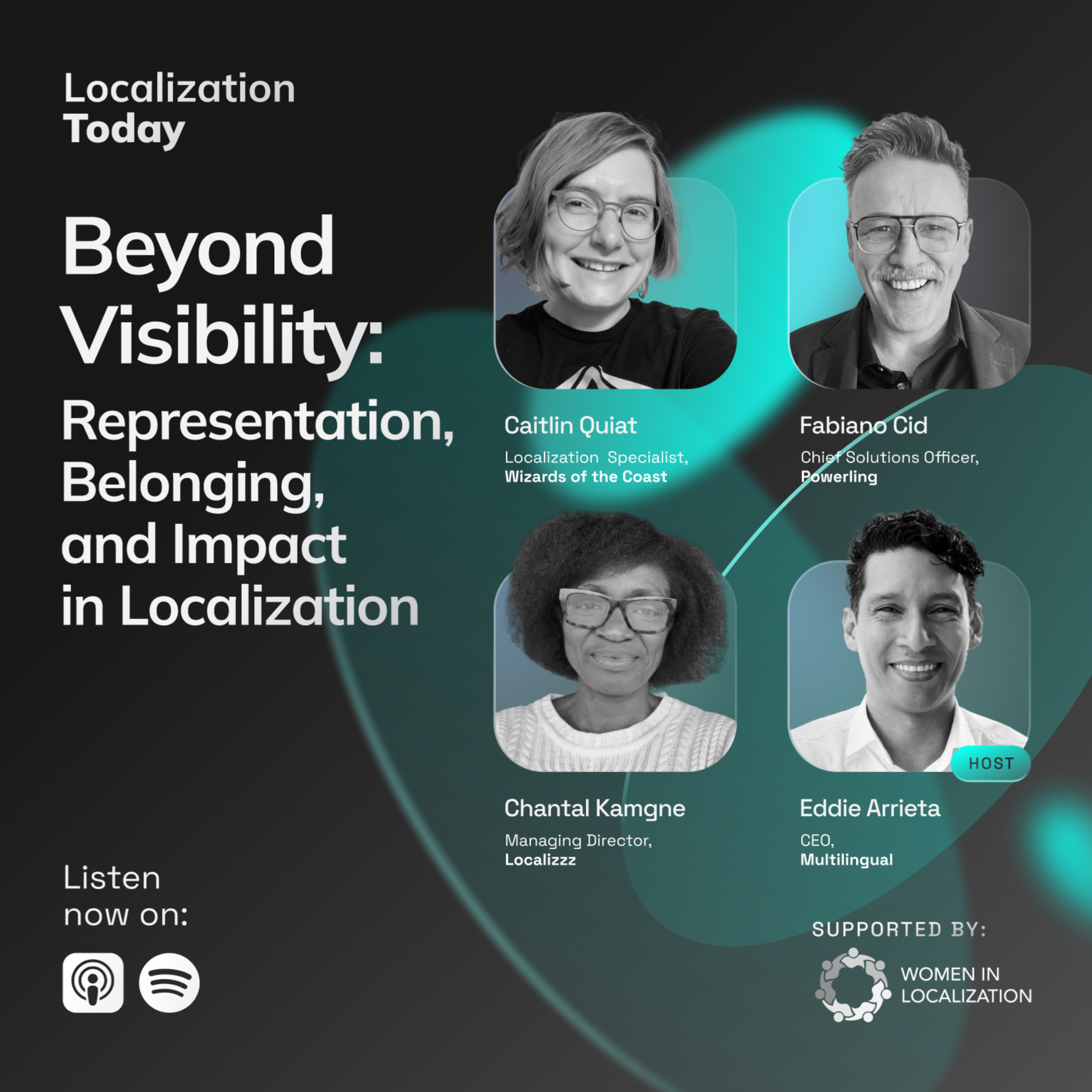
Thank you so much for joining us today. Today I'm joined by three people bringing different experiences and perspectives to this conversation. So let's get us started. First we have Chantal Kamneh. And you'll have to correct me if I'm not pronouncing it correct. I didn't do my homework. Managing Director at Localis and Director of Research at Engage Africa NLP Chantel's work focuses on multilingual content, language technology and culturally aware data set development, particularly in underserved language communities.
I'll continue introducing everyone. Next we have Caitlin Kiat, Localization Specialist at Wizards of the Coast. Caitlin's work and advocacy explore intercultural communication, gender inclusive language and the human side of localization.
And finally, we have Fabiano Seed, Chief Solutions Officer at Powerling, former Chair of gala, industry advocate and one of the creators of the underrepresented Interest groups initiative within Women in Localization. Welcome, Fabio. Welcome. Caitlyn, wait. Welcome, Chantal. Thank you for joining Us.
[00:03:37] Speaker B: Hi, Eddie.
[00:03:39] Speaker C: Hi.
[00:03:39] Speaker D: Thanks so much for having us.
[00:03:41] Speaker A: You did not tell me.
We needed our. Our special shirts.
I could have. I could have done it.
I could have done it.
[00:03:57] Speaker D: For a colorful group.
[00:03:58] Speaker B: Us.
[00:03:59] Speaker A: We're all the special ones. Now heal. I feel like a cool welcome. Thank you so much for doing this.
[00:04:07] Speaker B: Thank you, Eddie, for having us.
[00:04:09] Speaker A: That is wonderful. First question number one. Are you excited about this panel for everyone?
[00:04:17] Speaker D: Oh, my God, yes.
[00:04:18] Speaker A: Yes.
[00:04:19] Speaker C: I'm so excited that I lost my voice.
[00:04:24] Speaker A: We will put some great subtitles for Fabiano's voice, and we apologize.
We apologize on his behalf, of course.
For us, what's most important about this panel is to give as much context as possible. And the Women in localization team has done an amazing job to set the stage, to set the audience, and to also set the different sections that we will have in a conversation like today. And, of course, we believe that what was most important was to first of all, begin the conversation with the personal stories, the people behind the conversation, so that this is not theoretical only and we can actually get in contact with the experiences. Caitlin, when do you first feel that you truly belong or perhaps did not belong within this industry? Welcome, Caitlin, again.
[00:05:23] Speaker D: Thank you.
Yeah, you know, funnily enough, the time that I felt that I truly belonged and didn't belong actually happened at the same place.
I went to grad school at the Middlebury Institute of international studies. So, Ms.
And that was really my first foray into localization and so my first real encounter with the industry.
All of the professors there are working professionals, so do sort of, you know, represent the industry in that way.
And I'll start when I feel like. Felt like I didn't belong. So we can end on a happy note. But I had a professor who, despite telling him my pronouns, telling him repeatedly, I'm not a woman, I'm not a girl, I'm not a lady. Please don't call me that.
He continued to misgender me, and it really. It got to the point where I couldn't really take his classes anymore because while I was very interested in what he was teaching, I just.
It was a level of emotional turmoil that I didn't really want to go through.
On the other hand, though, through my time at miss I met so many people, colleagues, professors alike, who were amazing allies and very supportive of me and my gender identity.
I wanted to especially shout out Max Troyer. I was his ta, not only because I really enjoyed his classes, but because. Because he was one of my strongest allies at mist.
[00:06:52] Speaker A: Thank you, Caitlin, for Sharing your story. And Fabiano, have you ever experienced prejudice or lost opportunities because of who you are? And again, welcome. We love your background and your shirt.
[00:07:07] Speaker C: Thank you. This is my kitchen.
So I think this is one of the reasons why I stop at this.
This group, the Wigs, or started thinking about it.
I think question is no. Even though I am a gay man, I am white, I'm cis, I've been an entrepreneur virtually all my life, which allowed me to. And I was accepted by my parents. I lived. I had a good social condition.
So think privilege. This is what I had despite being a member of the LGBTQ community.
I had a lot of privilege.
But I think this is exactly why. And there's a combination of factors that led me to start these discussions. I think the experience that Caitlin has and Chantal has are completely different. I mean, we're going to go into that, but the quick question is, no, I wouldn't say that I've been. I've suffered any kind of prejudice apart from when I grew old. I think North America has become a place or not in salt.
And this is why I moved to Europe recently. I think there is this obsession with youth that doesn't realize how powerful life experiences can be.
And I would say that I. I've had gay people telling me, you shouldn't be here. You don't belong in here. This is a gay club. Because I'm too old. I'm 55, very proud.
And I think the only time when I started suffering prejudice was because of my age, not because I was gay, not because anything else, but mostly because of my age. So, yes and no.
[00:08:57] Speaker A: Once again, thank you for sharing, for sharing your experiences. Chantal, what make, makes, or has made you genuinely feel welcome in a professional setting? Again, welcome, and thanks for joining us today.
[00:09:10] Speaker B: Thank you. Thank you, Eddie. First, I'm going to define what I understand by belonging. For me, belonging and being welcomed professionally means that not only I feel personally welcome in a room, but also that the topics that are related to my identities and to the communities that I want to serve, that I care about are. Are treated as variable, that they are seen as worthy of investment, both by our clients and industry.
But we all know that diversity is already hard to achieve. And even then, it does not always mean real inclusion. So often in our industry, in discussion spaces, my English, French professional side has benefited from conversations, but my other identities, bipoc, African, low resource language practitioner and other identities contributed to diversity, but without benefiting much from the discussions because of how things are usually set up. So a great moment of feeling genuinely welcome for me was when Fabiano.
Sorry, Fabiano, for thanking you in public.
I am almost getting emotional. Fabiano invited me to help design an initiative that would empower underrepresented communities and with access and impact in the industry.
[00:10:39] Speaker A: That is a wonderful story, Chantal. And of course, I want to make sure that everyone who's watching also takes a moment to think about. If you've ever felt pressure to hide part of yourself professionally, feel free to share your thoughts, feel free to share your experiences, your success experiences, as well as those failures that you've had. And I'll take the opportunity now to say hi to those in Foster City, California, Argentina, Caracas, Venezuela, Luxembourg, Singapore, Ottawa, Canada.
So we have plenty of people watching from all around the world. So we're really grateful. Please share once again, your city, your country, and also please share your own experiences. Caitlin, you mentioned that your experience kind of went from sour to happier.
And of course you can identify in a professional space what feels emotionally safe or welcoming to you. Can you outline what your position is on it?
[00:11:53] Speaker D: Yeah, I think there are a lot of ways to achieve this, both big and small.
Speaking from a non binary perspective, I think I knew I was in a safe environment at work when I saw the number of folks using their pronouns and their email signature, for example.
And when you first enter the office right at the security desk, there's a little container of pronoun pins. They have all sorts. You can pick out what you want to use.
There are also little ways in which my co workers and manager alike have demonstrated that they genuinely care about honoring my identity.
So for example, using both sets of my pronouns or asking me questions to make sure they don't accidentally misgender me or not really making a big deal out of it if they accidentally do.
And I think a really big step in the right direction is just being self aware, trying to like self educate, self interrogate. What are stereotypes or biases you might hold? How do they inform the way you think?
And maybe how you can better support the diverse folks around you.
[00:13:10] Speaker A: Thank you, Caitlin. And Chantal, perhaps you can help us understand this even further.
There seems to be an understanding that this environment then translates into representation, leadership spaces, conference speakers, public visibility and localization.
So what do you see right now?
What things do you think need to happen for it to look different?
[00:13:41] Speaker B: Well, our industry tends to give a voice and visibility to people who already have access to professional networks and leadership opportunities and to center discussions around dominant markets.
So when you are underrepresented you are also often underserved and sometimes you are not served at all because content is often 100% selected for the majority and anything else than what matters for the majority is considered as niche and it is not included. So this silences minorities and it makes them invisible. In leadership spaces and at events where advocacy is made, decisions are taken that can influence professional development, resource allocation or market expansion. So I think more transparency and intentionality in selecting topics like creating categories would help.
[00:14:40] Speaker A: Thank you, Chantal, Kaitlyn. And of course, what would ask, and this is what we internally also ask a multilingual Is this good?
Why should we care?
What role does psychological safety play in professional growth? Because if it doesn't matter, then why are we even going to look into it and make changes in the way we operate?
[00:15:06] Speaker D: Sure, yeah.
Truthfully, I think a huge reason that I'm able to thrive in the position that I am today is due to the support of my colleagues and my manager.
I feel safe to be my authentic self at work and that means that I also feel safe to suggest work process improvements or go to my manager actively and say, hey, maybe we should reexamine some of these antiquated documentation stuff like that.
I think if I wasn't really able to be fully present, feel fully safe in my career, I would certainly be a much less successful localizer and certainly a more tired one. For all the masking that I would have to do.
I think it plays a huge role in allowing folks to actually blossom in their own professional careers feeling psychologically safe.
[00:16:05] Speaker A: Thank you. That's wonderful to hear. And Chantal, in terms of accessibility, I understand of course there is a lot of regulations that are involved, there's a lot of compliance. But what's behind it? Truly, can you scope the conversation for us
[00:16:24] Speaker B: in terms of compliance? There are things to think about a lot, like whether assistance and events are accessible to professionals with disabilities, the format and design of things. But there are, I think there are crucial considerations beyond that. Who feels seen, who is supported, who feels safe, who gets access to knowledge, who gets to knowledge that's relevant to them, who gets to contribute to knowledge. So for professionals with underrepresented identities, access means not only being present in the who, but it also means that they are able to benefit from knowledge and research and to present their expertise from the perspective of their life experience.
I can illustrate that we can step out of the industry one second and do what we like to do, criticize society outside the industry and lecture decision makers on language access. So my example is going to show that even a global majority like French speaking people get sidelined in an environment when they are a minority. And this means that being sidelined does not reflect the value of a community.
So among other identities. I'm a French speaking Ontarian in Canada and I'm part of the Diversity Inclusion Anti operation advisory committee. And I once was advocating for the city's crisis communication and documentation public agency signage to be available in at minimum both official languages. And I got the reply that there was not enough demand in French, which is the minority language, to justify the investment.
But I was literally there, I was there, I was representing the French speaking community in this case and I was presenting the demand and I'm literally part of the advisory committee.
So we can laugh at the situation, but the truth is that we do the same in the industry.
We resist anything that does not immediately benefit the perceived majority and we hope that professionals from minority would want to invest time, membership, registration and travel to come and present more demand.
So for me, accessibility beyond compliance, it means that we design space with people in mind before they have to ask, before they have to justify, before they have to adapt or prove that there is sort of demand.
[00:19:03] Speaker A: Thank you Chantal and thank you everyone who is still commenting on our different live streams on YouTube and LinkedIn.
I can let you know we also have people from Bangladesh, Poland, Lotrup in Sweden, Barcelona and of course we had asked originally as well if you could tell us what you do in the language industry.
We have. Greetings from Argentina. I'm happy to say that I've had the opportunity to support our team on gender inclusive language projects primarily involving Spanish.
Asmuth is. I'm a freelancer, Rohingya medical interpreter working for many years.
We also had a certified medical interpreter at.
Thank you so much everyone for sharing your experiences with all of us. And remember at the end we're going to have a Q and A session. So put your questions as well and if you're going to direct them to anyone in particular, this is your opportunity. I have to say it's hard to catch Fabiano, so come on, you need to do it now, today. And Fabiano, I have you here.
Please help us solve it all.
What would a truly human centered language industry would look like? Can you tell us what the utopia looks like?
You have a blank check here.
[00:20:34] Speaker C: Well, I think we're starting to do it. I think the work has started happening a while ago. I think women localization is one of the pioneers in transforming this industry more human centric.
I recently ran a webinar with Alice Antun.
And this is.
I've been quoting her. And a lot of people have been saying this at these times when we know what AI is doing amazing things, but also taking away lots of people's jobs. I think as industry folks, we need to regain our role and AI in the loop. Human in the center. And when we say human in the center, we need to open up to all humans. It's not the white cis, straight human in the northern hemisphere. We need to look at the black folks, the trans black women, who was at the bottom of the spectrum of society. We need to look at the non binary folks. We need to look at the aging folks, women and people who menstruate and who are undergoing menopause. This is a conversation that I had with Sophie Solomon, who's, by the way, sat on the sofa. It was an amazing conversation.
So I think this is a human centered industry that we're aiming for.
An industry that looks at the people who build industry, whether with as much visibility as we all had or with less visibility, but who are taken care of, but who are also given a voice, I think. And Chantal, thank you for this. You always make me emotional to think about it, but I saw you being, you know, raising your voice and being, you know, occupying spaces. And I think this is paramount for us to understand the value of listening to these people.
We had the opportunity. It was Locke Road, by the way. Congratulations. Multilingual. Being part of the group. You've just acquired Lock Road. And it was a beautiful event and we had so much representation of people who were not represented otherwise. We had Nova Patch. I think I saw Nova in the chat room, Gary Fisher distributing the pronoun pins. And we're going to talk about the wigs soon. But we had Alex Iraq, who's also part of the group non binary as well, talking about inclusive language on stage at Lock Road. This is unthinkable. We had LGBTQ Allies dinner. We had so much, so many activities happening around the theme because we also made an effort to bring the wigs to the front and to the surface. And I'm so happy that we're doing this because I think this industry is democratic in nature, but needs to start looking outside of its bubble. We need to start looking down south. We need to look at minority languages because this is the future of AI as well. The AI, 70% with English, Eurocentric or US centric white.
This is not what will take us further. It's the diversity, it's the inclusion, it's representation of everyone, not only in this industry, but everywhere.
[00:24:07] Speaker A: Fabiano. So why don't you tell us a bit more, Dan, about why we are here today. Tell us about the work the team is doing and about the new initiatives in women in localization. And let's talk about what we want to achieve from here on.
[00:24:22] Speaker C: Thank you. Thank you, Adi. Yes. And thank you for giving us this platform to talk about.
I get emotional, I get excited. So apologies if I sound. I get militant if I can't.
I think, yeah, because this is. This is so important. And when I see, you know, our meetings, we've been meeting. So let me go back two or three years ago. I think it was during the pandemic. We had an LGBTQ panel. I was part of it. I think it was one of the first in the industry.
Caitlin was in the audience. Caitlin reached out and said, I would love to do something around this because I said, we need to do more.
I was crazy busy. There was a lot going on, but I always kept that message in my inbox. I have a special place in my inbox.
Years later, I started living, I think, because I started suffering prejudice. Going back to your first question, Eddie, I started realizing if I'm. If I'm feeling prejudiced because of my age. I started looking beyond. My husband is a millennium.
He's in the room, by the way.
His friends are non binary and trans and everyone in the fluidity, gender fluidity spectrum. And I started realizing how important it is to pay attention and how much talent there is outside of our own groups. And I started reaching out and I. But I have this platform. And, you know, following the advice of Greta Thunberg, if you have a platform, you're not doing anything about it. History will judge you. And since I'm very scared of judgment, I thought, I need to do something about this. So I reached out to Carrie Fisher, who is also on the wigs. We presented the idea to the board. Anna, thank you for coming. Thank you.
Anna was the president, is the president of Women Localization. They accepted the idea on the board and we started working. For the past six months, we've been working weekly meeting and having very enlightening, very inspirational and very emotional meetings lately. Like, we cry every meeting because we get excited about it.
So we decided that the launch. This is the first week we're launching. It's the pilots LGBTQ that launched in January 1st. We had a series of activities of initiatives around this idea. And thank you again, multilingual. We have a brilliant, a gorgeous article written by our Very own Caitlin here. And Alex, you must read it on multilingual. Thank you for opening that space for us, Caitlin. I hope you can have time to talk about it. So let me be a little more concise. We had. I presented with Alex, as I said, Arnova, Nari Nova was there at Lock Road. We had the distribution of our first pronoun, pronoun, bad guidance for conference organizers. The launch was June 1st, Pride Month. So we did all these activities. This is the. I think one of the last activities that we have for the month.
And wigs, as the name says, is underrepresented interest groups. We're starting with LGBTQ next. Chantal will be leading the BIPOC for black, indigenous and people of color, people from the community. And then we want to expand to talk to Sophie Solomon, to talk about menopause during menopause group. We want to do about people with disability, whether visible disability or invisible disabilities. We're talking about body. So we thought we want to reach out to people whose bodies, colors, minds and genders and geographies and cultures and languages are not represented, not well represented today. We want to give them a voice. We want to create a safe space, space for them to exchange, to have discussions and to send to create recommendations for the industry. The first recommendation was the pronoun badge guidance. We had pronouns. I, I should have mine here. I'm gonna pick it up while someone is answering. So we had pronoun localization, pronoun badges for people who were crazy about it. Everyone loved it. Everyone was wearing them. You could choose your pronoun he, she, or they. But there is more coming up and we will keep you updated.
We have a LinkedIn group. We're getting the gathering. The candidates and the activities will continue just right after summer. Sorry, I talked too much. Go ahead.
[00:29:15] Speaker A: Thank you. Of course. I want to get your impressions, Caitlin and Chantal, on what is happening, how you are receiving it, and what do you see? It's becoming evident as potential benefits that are going to come out of this initiative.
[00:29:31] Speaker B: I think this is about the kind of communities that we want younger professionals to inherit.
We should want them to inherit communities where they do not have to fight so hard to belong.
I would also like them to feel that their knowledge is valuable and strategic, that it is not marginal, it is not extra, it is not niche, because any sort of underrepresentation is not.
It does not reflect on the. It does not reflect the lack of value it reflects under investment.
[00:30:05] Speaker D: Yeah, I completely agree.
I feel very hopeful, very excited that we are actively creating this space, this intentional community.
It is a level of belonging that I feel like I've looked for in my own career.
The first few non binary localizers I met, I went, wow, there are other people like me out there and they're probably going through similar challenges that I am.
Similarly, when I met my first non binary people leader at Wizards, who is now my mentor, it was really exciting because I could see a path forward that I hadn't seen before. There's a level of I can potentially be a people leader, I can be a producer or a director.
So I'm hoping that this initiative can inspire these feelings in other folks and can also drive change within our industry that is meaningful and positive.
[00:31:18] Speaker A: Thank you.
And I want to use the opportunity to say hi to all of those who are saying hi. From Chihuahua, Mexico, Nora Diaz, Russia, Elsia. Hello Anna Schlegel. Go Fabi. Sammy.
Love that everyone has such a fun shirt except for me.
They excluded me from the Anyways. Carla from Rio de Janeiro, Brazil, formerly with NMT on Systran, now co developing AI based tools to translate and transcribe locally on PC. Ping me if you want to test a sample. Is that, is that. Did I just do an ad?
Did I.
I think I just did. San Diego, California from Egypt, Malak. Hello.
Yes, yes. Thank you everyone for, for saying the Conrado from Mexico City as well. Hello everyone. Thank you for. For staying here. We with us and of course we are expecting. Remember, put your questions in there. We are expecting a potential movement also from the communities, from the audience. If I like to get involved, if I like to know more, if I like to explore, read, put the PDF my Kindle, what steps are there for us to make right now? And we're really glad I'm multilingual. We know there are different types of stages, different types of channels. We're using them as much as we can. What can individuals do at their company, especially those in leadership positions as well? Caitlin and Chantal Fabiano, we've talked about how much responsibility is there, not turning kind of like your shoulder on the conversations, but rather at least opening them would open our arms. I don't know what thoughts you might have, Caitlin, we might begin with you sure?
[00:33:24] Speaker D: Yeah.
I honestly think that there's a tendency for folks to see underrepresented minority leaders as sort of figureheads for an entire group of people. It's the old like, oh, you're insert minority here. Tell me what you think about this. And while individual voices can be really powerful and Impactful.
It can also create a lot of pressure to talk on behalf of a whole community of folks who are all individuals themselves and they have their own thoughts and opinions.
And this is why it's not only important to have many minority voices in leadership positions, so there's a diversity of thoughts and voices there as well. But community powered action such as we're hoping to create in the WIG group, it can allow for voices that are traditionally not present or who are spoken over to come together, create tangible change and hopefully see themselves reflected in others.
If you are a leader who isn't a part of a minority group, maybe take some time to look inward and maybe look outward, do some reading for yourself, talk to the folks who are diverse around you, really listen and hopefully that will also inspire growth and change within you as well.
[00:34:59] Speaker B: Yeah, I think for me it means that we create safe spaces.
That's spaces where people can speak honestly without being punished, dismissed, tokenized, not having to constantly translate their experience into terms that make others comfortable.
People cannot grow if they are always managing self censoring, managing the pressure to prove that they belong so that we don't feel like inviting underrepresented professionals. We feel invited to be visible, but not given influence, decision making power or long term support.
[00:35:47] Speaker A: Renato.
Renato had mentioned when we acquired and I'd say as a group acquired lockworld, the impact that, you know, or the compound effect that we could have in terms of giving, you know, footing and visibility to different conversations. I think there are many opportunities that are going to be opening up within the next, you know, few months and I hope that, you know, the events that are coming up can provide us that opportunity. I was so happy to see your sofa at LogWorld. Fabiano and I already saw, you know, we already physically seeing how, you know, we are creating different channels, different stages to continue all the conversations that we might have. I want to open up for some questions and I'll let you comment. This one's Fabiano as well. Carrie Livermore.
She's mentioning Livermore Fish.
If you're interested in learning more or just starting a conversation, feel free to email
[email protected] Fabiano, what happens when someone sends an email to you?
[00:37:03] Speaker C: So the weeks that women localization all of us from the pilot will receive the email.
At the moment we are collecting interest parties information.
We need a break. So we're taking. I think I've been saying this and I contaminated everyone else.
So we're taking a break also to assess the initiatives to do something because this is really important, this is really critical and it can be and it can backfire if we don't do it in a solid and safe way. We have a lot to learn and this is because we're creating safe spaces for people who are not necessarily for whose needs we are not necessarily fully aware. We're creating, trying to create a space for trans people who are the target of aggression and either online or physical. So we need to make sure that all of these people, people with disabilities, how do we create a safe space for them while they are fully enjoying the experience of being part of the wave?
So we're doing it slowly, even though I'm a little anxious, we're doing it slowly. So we're giving ourselves time to prepare, to aggregate the ideas, receive feedback, but do write to us to wigsmenlocalization.com we are receiving the information from the candidates and we're vetting every candidate. When I say candidate, people who show interest, they are vetted again to maintain the safety, the confidentiality and everything around the whole experience of the wigs. So write to us. We will provide you with as much information as we have. We have a full charter at the moment. We have some operational procedures in place, our manuals, but we need input from people who from all these varied communities so that we can move forward. But the plan is this.
We're taking kind of a break.
We're not meeting as often as we were. The activities will be held up until the end of the summer when we start the two officially the two wigs, BIPOC and lgbtq. Preparing again to next year. We will have more communities involved and we will have everything ready to go.
[00:39:29] Speaker A: Thank you, Fabiano, for sharing. And before I ask my final question and I let you go, enjoy your colorful and happy shirt.
Let you enjoy that.
We want to read a few different comments. Carrie Livermore as well. She says, for the record, you are my heroes for Fabi, Chantal and Caitlin, so grateful and humble to be part of this initiative. We also have people from Ireland, from Cambridge, uk.
Unconscious bias is everywhere someone comments. Once you are aware of it, you can consider it and how you respond to and handle various situations.
I'm really happy to have you all here, all those that are joining us live on LinkedIn and YouTube. And before we go, what gives you hope? We could do Rock, Paper, scissors to go first. We could do alphabetical. We could do. We could take you. You decide.
[00:40:32] Speaker D: I can go first. Totally.
Also, I just want to be sure to be Explicit. The LGBTQ wig group, which is also spelled uig.
So it's. If you want the email, don't not. It's not w. I g. Just.
Just to make sure everyone does underrepresented interest groups.
The LGBTQ group is not. Even though we are under the umbrella of women in localization is not just for women.
I am a non binary person and I am a part of this pilot initiative. Everyone under the LGBTQ umbrella is welcome.
So please feel free to join in.
What gives me hope though?
Gosh, it's.
I think, I think right now for a lot of queer and trans and non binary Americans. Specifically speaking from my own experience as well, I think it's especially hard to exist in this political moment.
There's a lot of fear around changing legislation and honestly, rightfully so. There's some laws that have been created in various places to create really hostile, if not impossible living conditions for our community.
One of the examples that I always think of is what's been going on in Kansas.
And so there's this level of pressure. But on the other hand, I've seen so much community response and aid, people showing up for other folks to get them out of hostile situations and set them up in safe places, generosity of time and effort and money.
I think there's also a level of continuing presence that is also very comforting.
So looking around and seeing my fellow queer and trans and non binary friends thriving, it reminds me that even in challenging times that there's a potential for happiness and there's a reality of happiness as well.
We are here. We have always been here and we will continue to be here. And we are not alone.
[00:42:45] Speaker C: And we're not going back to the closet.
[00:42:48] Speaker D: No, it's too cramped in there.
Too many fabulous shirts. Can't go back in the closet.
[00:42:57] Speaker C: Go ahead, Chantal.
[00:42:59] Speaker B: What gives me hope for the industry and society in general?
It's the younger generation. They are smart, they are open, they are critical, they are less willing to accept inclusion as normal.
They are asking all the difficult questions about gender power, societal norms, race, disability, age, bias, orientation and identity in general. But I think that hope does not release us from the responsibility to prepare the ground for them.
It does not release us from the responsibility to challenge harmful norms and make sure that we leave the industry that they inherited, an industry that is more inclusive than when we entered.
[00:43:47] Speaker C: There's gives me a lot of hope, I think seeing how the world is going move, trying to move backwards and we're resisting and we are putting our strengths together, as Caitlin said. But More importantly, I think how we are managing to prove the importance of these activities, not only on a humanitarian level, but also from an economic point of view. We matter. We pay taxes, we spend money and we are successful and we are damn talented.
So once we start realizing, I think this is what's important, once people and companies and governments start realizing how much loss has been made with pushing people to the side and keeping it secluded to a certain group, the idea of diversity has to come back from. It's again, of course, the humanitarian aspect will also always be important, but that we live in a capitalist world, unfortunately, where money still is, you know, the currency of exchange. So we need to prove how important we are not only. Only, you know, we're not giving visibility to these people or because. Oh, put them, put them. No, they're not poor. They're amazing. They're fantastic. They're fabulous people. Look at these people in here. And this is why we're giving them advice and a space and the stage.
[00:45:19] Speaker A: Thank you, Fabiano. And I'm really sure that our audience is feeling inspired and, you know, a lot of action and impact will come out of our conversations, which is the intent that we can have here. We have some questions. Remember, if you haven't asked your questions, this is the moment to do so. You might not have this opportunity as Fabiano is going to enjoy his summer. There's no more. He's going to be tanning, it's going to be sunbathing, and this is it. This is the moment to ask those wonderful questions.
How can I build a more inclusive MTG deck?
[00:46:00] Speaker D: That's a great question.
The one thing that I can super highlight immediately, we have a secret lair drop or we.
This might be a little bit hard to wrangle together. You might have to do some, some shopping around. But we did have a pride drop.
There are fabulous, fabulous cards in that. There are also lots of gender diverse planeswalkers. If you're really into the kind of the lore around Magic the Gathering.
[00:46:33] Speaker C: This is.
[00:46:34] Speaker D: Sorry, MTG is Magic the Gathering.
I should clarify.
And there's also a real diversity of like, races of folks, shapes of folks, so.
And we also feature all sorts of animals, specific spirits, wild illustrations, corpses, I don't know. So it depends on what you mean by inclusive. But if you're talking in terms of lgbtq, definitely check out the pride drop that we did a few years back and some of our cool, our cool gender inclusive, awesome trans and non binary planeswalkers.
[00:47:20] Speaker C: By the way, this question comes from Novapadi. Who just presented at Lock Road, a beautiful session called Queer Localization.
So reach out to Nova. And here's our. Here's my pronoun pin with a he.
Sorry.
[00:47:37] Speaker B: No. Thank you.
[00:47:38] Speaker A: Thank you.
I don't have to do anything. I love it. Fabrici says it's so important for us allies to learn all this insight.
Thank you all so much for sharing such personal thoughts.
Sam says thank you all for sharing these important insights.
And there's a question from Shirley Cody. Code. I don't know how to pronounce it. I took a course on unconscious bias once. That was truly eye opening. I still use examples from that to call out bias. Would you consider offering something like that publicly?
[00:48:18] Speaker C: Should I answer?
[00:48:19] Speaker A: Yeah.
[00:48:22] Speaker C: We're not experts in unconscious bias. I think unconscious bias or the interest in conscious bias, when I learned about it, I started being more aware of everything. I think someone. Matt, just talked about it. I'm sorry if I'm mispronouncing your name, but I recommend looking for unconscious bias to learn about how we react to certain things, ideas, people, situations. We're not experts in that.
I think there are people who are more capable of doing it. The wigs are a space for gathering, for discussion, and for recommendation.
Could be a recommendation. One of the recommendations could be go do your unconscious bias course.
But I don't know if we ever will ever promote or offer such courses. But that's a good idea.
[00:49:17] Speaker A: All right. Anna Schlegel also asked earlier, what is one thing we can do during meetings to support you?
[00:49:27] Speaker C: I think pronouns is an easy way. Put your pronouns on everywhere. But I sometimes forget. I must be honest.
It's an effort. It's an exercise. Put it on your social media profiles, on your zoom profiles. I think we put ours here, everywhere. It shows that you care, especially for people for whom, because you just take for granted. Yeah, I've always been a he's there. Yes. There's so many more pronouns and they value.
So I think it's. It's a. It's a tiny action that makes a huge difference for people who do not have the same experience that you do.
[00:50:10] Speaker A: Thank you very much, Fabian. I don't know if Chantal or Caitlyn want to add anything before we go, Any final thoughts, Anything you think we should say?
Final call.
[00:50:26] Speaker B: I think we.
Am I muted again? Okay. No, I'm not.
I think the industry should stop avoiding or should start having conversations about power.
Who controls budgets?
Technology.
Inclusive technology for people with disabilities, like, for example, visual disabilities, language priorities.
Not only care about dominant markets talk about on the surface, on the resource markets as well.
Also. Also bias and that shows up in assumptions about credibility, geography, accent and all of those things. We need to talk about that and I think that will help the industry.
[00:51:13] Speaker C: Yeah.
[00:51:14] Speaker D: My concluding thoughts are simply just to say thank you so much for allowing us to have this conversation and thank you to everyone who has tuned in.
Really appreciate being given a platform like this to talk about our existence and the localization industry and how we can create change.
[00:51:38] Speaker A: Fabiano, Sid, thank you very much then. Thank you.
[00:51:41] Speaker C: Thank you.
[00:51:43] Speaker A: Thank you, Fabiano. Thank you, Chantal. Thank you Caitlin. You share your thoughts with us and I think it has been a tremendous panel. We had many live attendees and we want to thank them for participating in our conversation beyond visibility, representation, belonging and impact in localization. We hope you continue sharing this webinar and we'll be sharing snippets of this amazing speakers that we've had today.
Thank you for those experiences, perspectives and insights. And thank you everyone who join us from around the world in every continent. Language is ultimately about connection, understanding and humanity. If our industry wants to lead conversations about communication across cultures and communities, then we also have to be willing to to examine how we treat people within our own spaces. Community does not happen automatically simply because people work in the same industry. It is something we build intentionally through dignity, accessibility, care, accountability, and the willingness to make room for one another. Hopefully today's conversation is not an ending, but part of a much longer reflection about what kind of individual industry we want to become and are becoming.
Thank you for joining us and if you enjoyed this discussion, make sure you follow localization today on Spotify, Apple Podcasts, YouTube and multilingual dot com. Take care everyone and we will see you next time.
Goodbye.