Episode Transcript
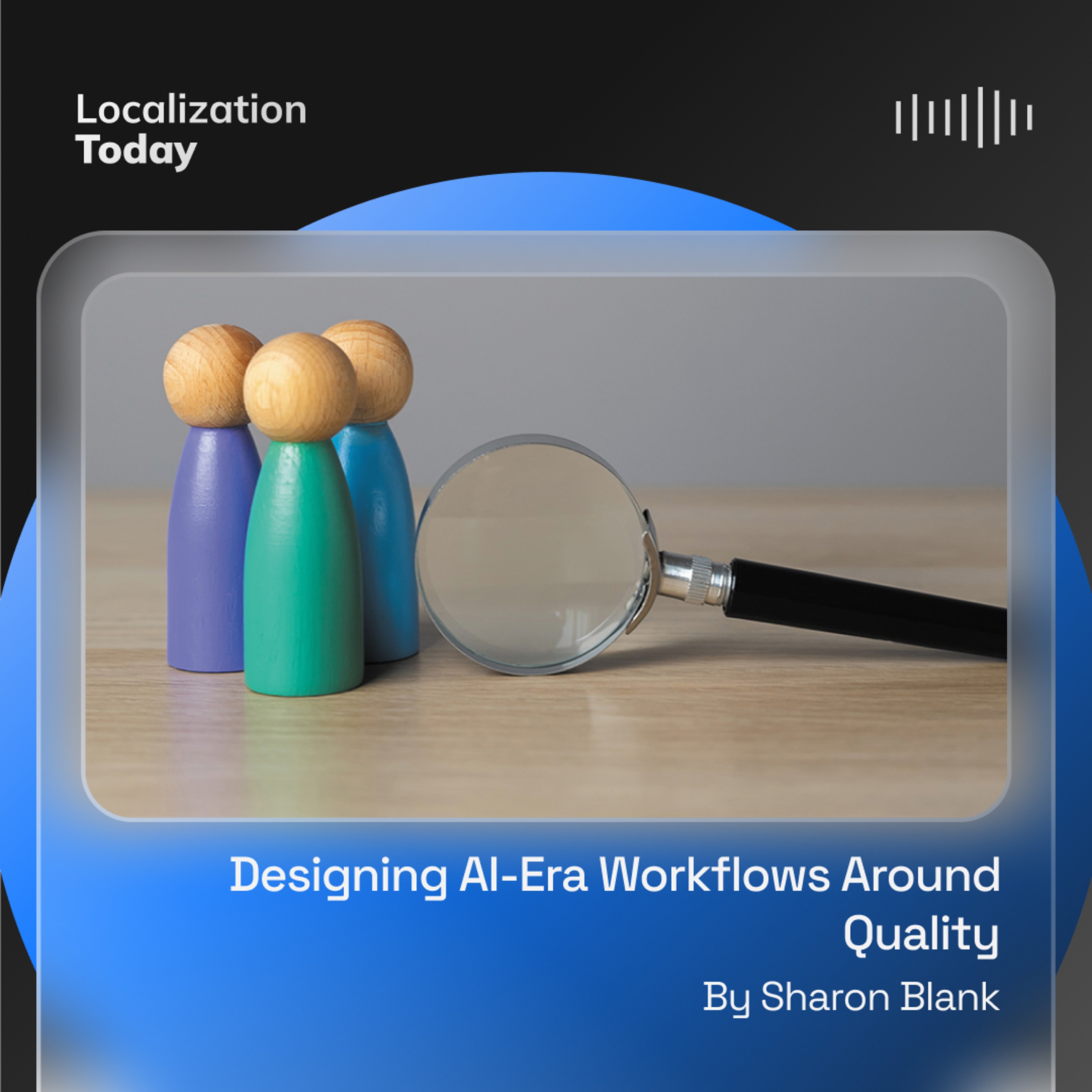
[00:00:00] Designing AI Era workflows around Quality By Sharon Blank the transition to AI leveraged workflows since the launch of ChatGPT in late 2022 has represented a major shift in how language companies do business, re envisioning the traditional translation editing, proofreading process and focusing on responsible and intentional AI use. Customers want AI's efficiency gains, while language companies remain committed to brand reputation, data integrity, and patient safety.
[00:00:31] Additional considerations include internal AI usage policies and viewing AI as a corporate identity issue. Rather than a subtle tweak to our translation processes, it's important to talk about these new models. An open dialogue strengthens not just individual companies, but the language sector as a whole.
[00:00:49] The workflow was more linear when I took my first role in the translation business more than a decade ago. The workflow was largely tep. That model served the language industry for a long time with various boosts from technology in different eras. Translation memory programs and statistical machine translation boomed in the 1990s. Multi term for Windows launched in 1992, followed by Translator's Workbench, the precursor to Tratos in 1994, and AltaVista's Babelfish in 1997. Pre AI, the translation process was built on deterministic human translation.
[00:01:27] After a translation was validated and confirmed in our termbases, translators used the same word or phrase in the same way every time. Concordance searches displayed every previous translation of a given term in our databases. TEP was a very linear workflow with a highly predictable outcome.
[00:01:45] Translation companies were focused on throughput, knowing that experienced translators could produce 2,000 to 3,000 finished words per day. The workflow no longer moves in a straight line. After the release of ChatGPT's beta version in late 2022, we saw that large language models LLMs were no Babel fish. This was a new reality. We soon saw that LLMs are incredibly fast produce probabilistic results.
[00:02:12] Instead of looking up a translation like a human translator with a glossary or concordance, LLMs simply predict the next word in a series produce texts that sound very fluent even when they contain serious translation errors perform very well on language combinations English less than greater than Spanish with a lot of high quality training material and much less well on language combinations. English less than greater than Tagalog where that's not the case or inconsistent. They might use three different Spanish words for the English word pain in one document. We knew that clients would demand the speed and skill advantages that AI offered and that we had to maintain human validation as a critical part of the process Not a formality, particularly for those of us working in the clinical research and life sciences sectors. We're always balancing medical grade accuracy with tight timelines. The AI shift forced language companies to focus on this balance, one that we've been honing for a long time.
[00:03:05] Human expertise is a validation system, not a backup plan. On certain days. I think a lot of us get nostalgic for tep, but something interesting is happening at the same time. Human experts are becoming more important, not less, especially in sectors like clinical trials. Heavily regulated, high stakes translation output has to be accurate. Everything, especially if its probabilistic AI output must be validated, appropriate to the audience. Is the information directed at clinicians, patients, the general public, or someone else fit for purpose? Is this a regulatory submission? A questionnaire for a clinician to review with a patient? A patient reported outcome document for a patient to fill out on their own? As this shift occurs, we're seeing a whole new set of considerations.
[00:03:54] Subject matter experts need explicit decision making authority and they have to be empowered to use it. If something doesn't seem right, either because it's inaccurate or it conflicts with a past practice or an existing translation, human experts have to challenge it. Teams have to be trained differently for AI oversight. Compare this to proofreading a document that someone typed versus a document that they dictated. Typing produces mistakes taught his instead of to this. Whereas dictation software never makes spelling errors. It just inserts the wrong word if it doesn't understand you or the context. Weather versus weather, for example.
[00:04:31] Likewise, AI makes different errors than human translators do. And there's a difference between proofreading a human translated document lightly post editing an AI translated document, and doing a thorough validation of a document created using both human and AI input. Humans, not IT tools, are responsible for risk mitigation.
[00:04:51] If the US Food and Drug Administration or the European Medicines Agency has an issue with a translated submission, an AI tool doesn't take the fall. The translation company does. How this affects operations and compliance for language companies and their clients. Liability, confidentiality and defensibility traceability are always at the forefront of what we're doing with AI embedded workflows. We need to rethink all three of these factors. First, we needed to consider model selection and transparency. With fitness for purpose as the key principle, it's important to be honest with clients about AI's capabilities and limitations.
[00:05:32] If a client just needs the gist of a document that uses controlled vocabulary, raw AI output may do the job.
[00:05:38] On the opposite end of the spectrum are clients dealing with incredibly high stakes for the fiscal year 2025. The cost of a new drug application or biologics license application submitted to The FDA is $4.3 million if the application requires clinical data and $2.1 million if it doesn't. And these are review fees. They aren't refunded if the application is rejected.
[00:06:05] With that much on the line, clients need robust, defensible and auditable translation processes that will stand up to intense scrutiny. Raw AI output ticks none of those boxes, especially for companies providing certified translations. AI doesn't sign this certification. A human does. Version control and traceability are significant issues.
[00:06:25] Another change from the TEP days no more stack of files in track changes mode. The workflow is also less predictable. Pre AI, the technology flow was up to us, but it was consistent.
[00:06:38] Most files were handled with translation memory software, computer assisted translation tools, whether on a server version or a freelancer's desktop. As AI becomes part of many companies everyday workflows, clients contact a language company in various stages of the translation process, some with traditional source files, others that have invested heavily in their own LLMs and need linguistic validation.
[00:07:04] Responsible AI integration as a Competitive Advantage boast ChatGPT We've seen a lot of shakeups in the language business. In Multilingual's own December 2024 issue, Nimzi Insights mergers and acquisitions analyst Jonathan Otis noted that the language sector's M&A landscape rebounded this year, with nearly every language service provider that generates over $50 million annually completing at least one acquisition.
[00:07:34] Otis went on to note AI as a key force reshaping the economics of the language business in deals both large Jonkers Aklaro and smaller mid sized companies purchasing small ones, with the mid sized company perhaps then being acquired by a market leader. We see our industry being molded by these new forces. As with any new technology implementation, language companies need to strike a balance. We don't want to rush to adopt a new tool, but neither do we want to be left behind with customers either frustrated or looking for a new provider. The future belongs to language companies focused on strategic implementation rather than reactively bolting AI onto the traditional TEP workflow. In practice, this looks like balancing the efficiency gains that customers are demanding with maintaining a quality driven brand reputation. Production times can be significantly reduced when a translator is reviewing and post editing versus translating from scratch.
[00:08:30] But AI output demands a high level of human oversight, which takes time and a different kind of attention. Integrating client education in the workflow send us the files has to be replaced with a consultative conversation where AI fits in where human control points are indispensable and how to create a finished product that we can certify and stand behind. Some clients use in house LLMs but don't know much about the translation process as the experts language companies have to explain that a nearly instant first draft translation doesn't mean it's ready to submit to the fda. Building AI Augmented Workflows Rather than shoehorning humans into an AI driven process, AI speed and scale gains can't be ignored, but we also can't gloss over the risks. Regulatory submissions rely on citations, clinical studies, regulatory guidance, and past approvals.
[00:09:22] Examples from other sectors higher education show that this is an area where AI often stumbles. I was intrigued by a recent Inside Higher Ed article focusing on journal submissions riddled with AI created fake citations. As we adapt to these new workflows, we are learning where AI shines and where it falls short. It's on us to convey this honestly to our clients. We're more than three years into the AI transition and each phase of the process has forced us to rethink the way we do business.
[00:09:51] At this point, we're no longer asking whether AI will be embedded in our workflows. It's already there. We're now looking at how to move more thoughtfully in this faster paced environment. How to responsibly balance quality and efficiency.
[00:10:05] We're guided by the truth that in the AI era, humans must lead the way. Validating, assessing and safeguarding this important work. This article was written by Sharon Blank, CEO of Language Scientific, originally published in Multilingual Magazine, Issue 257 November 2026.