Episode Transcript
[00:00:03] Speaker A: Hello.
[00:00:04] Speaker B: Welcome to Localization Today, where we explore how language, technology and community converge to unlock ideas for everyone everywhere. I'm Eddie Arrieta, CEO at Multilingual Media.
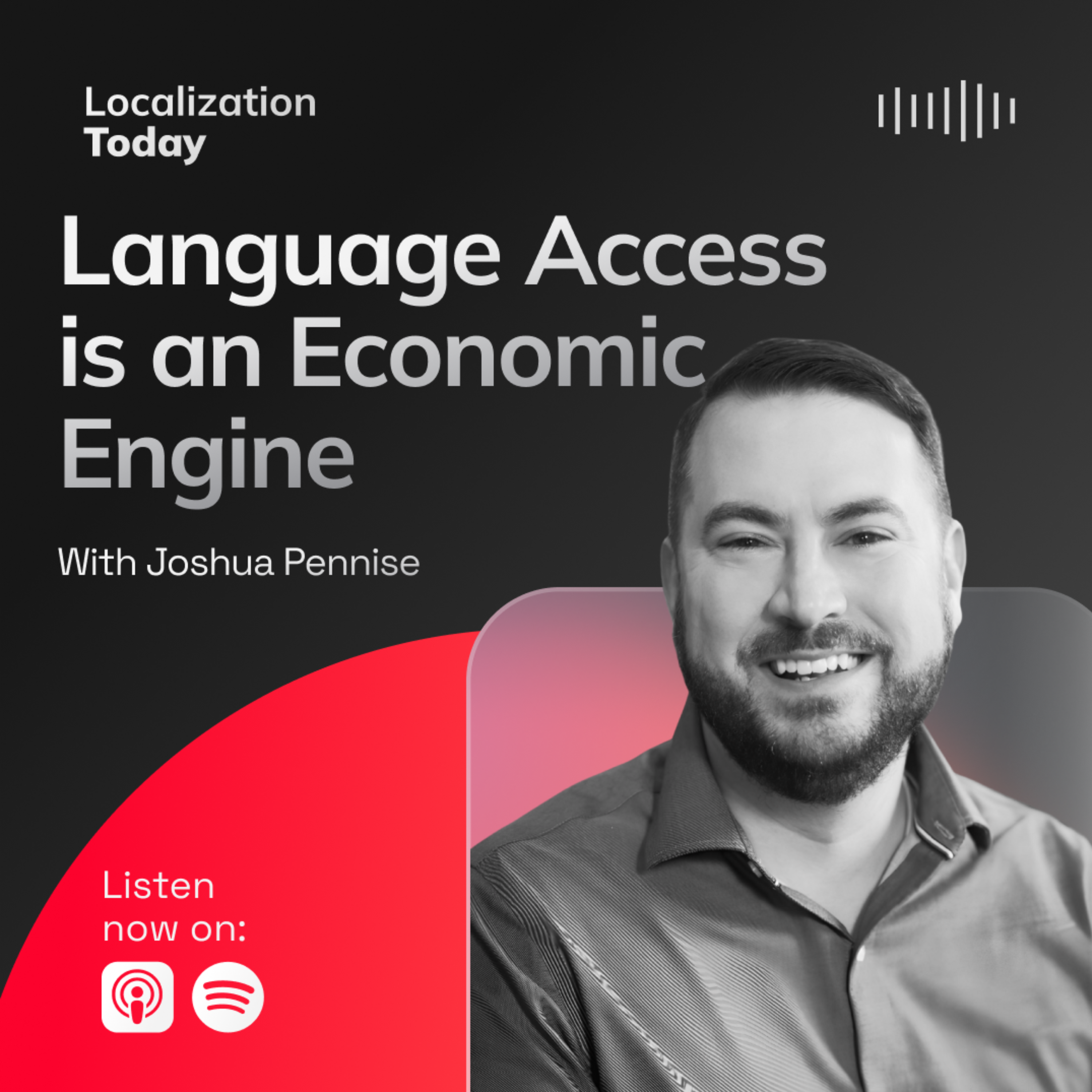
Today's episode takes a closer look at the state and trajectory of the association of Language Companies, or alc, a vital organization representing the business side of language access and localization in the US and beyond. We're joined by Joshua Pennise, ALC's newly elected president. Josh is an executive board leader and Certified American Sign language interpreter with 25 years of experience at the intersection of language services and accessibility.
He served on multiple academic, governmental and professional boards, including the Registry of Interpreters for the deaf, and holds MBAs from Columbia University and London Business School, as well as a Master's in Applied Linguistics from Old Dominion University. Josh, welcome to Multilingual Magazine, to Multilingual Media, to Localization Today. Thank you for joining us.
[00:01:22] Speaker A: Pleasure to be here, Josh.
[00:01:25] Speaker B: We talk a fair amount already and we are continuing this conversation now live. For those that listen to us, Josh, for those that might not know your trajectory, who you are as a professional, how would you describe yourself and what you do?
[00:01:41] Speaker A: Yeah, so I got started in this industry, like you said in your intro, actually, 26 years ago when I was very, very young.
I met deaf people when I was, I think, 13 and was able to learn American Sign Language through just friendship and engagement with the community. And eventually that led to a career as a sign language interpreter.
That trajectory really accelerated for me when I think I was 18 years old and we were trying to revive the local professional association in my town, which had gone defunct some time back and a room full of interpreters voted to do that. And then when the question came to who was going to be president, everyone took a proverbial step back and I wasn't smart enough yet to know that I should do that too. And so at 18, I became the head of my professional association in my town. And that started what would be over, well, actually from them until now, continuous service on boards or national level committees of some sort or another from that time until now.
And it started my trajectory as a leader and eventually led to me being appointed an executive in two different companies in this space and continuing that work until today.
And so for folks that are maybe individual contributors and want to get engaged in the industry in a different way, in a leadership way, my advice is always just say yes.
Figure out how you're going to do it after, but step in, lean in, as it were, and figure a way forward.
I think for me, what's kept me in this industry and kept me engaged is I've become addicted to work that gives real impact to people on the ground in the end. And knowing that throughout the day, my meetings and my emails that I'm doing eventually, somewhere down the line, have a positive impact on somebody who's sitting in a hospital and needs to understand what their cancer diagnosis is, for example. And so I love being in this industry because of that, really direct impacts that we get to make on people. I'll also just add, you know, the sign language side of this industry has been operating on its own for a long time. And I think now we're seeing some convergence with the broader language industry.
When I joined the ALC, I think eight years ago, I was, I think, the second sign language company.
And today we have 20.
And so we're really growing that side of the industry within the alc, which is amazing to see. And I think part of the reason for that is that kind of the underlying mechanisms that have led to the development of, in interpreting of spoken language interpreting and sign language interpreting have been very different.
The level of engagement with the consumer has been very different. So these ecosystems have built out separately in a different way. But then when we get into the room with a patient or with someone in court, the end work, that last final mile looks very similar, but how we get there has been quite different. And so it's really great now to see that kind of synergy and for folks to be able to learn from each other and take what's best from both of those ecosystems and build something even better.
[00:05:21] Speaker B: Josh, thank you. Thank you for that because that really helps frame how we move forward with the conversation. As I came into the industry about three years ago, ALC is one of those legendary events that you hear about and then you have legendary locations. And there are some upcoming events that also seem very, very attractive, very historical places, which. Which is a very interesting take.
But, you know, for those also that might not be familiar with the association of Language Companies, and I particularly personally would love to hear more detail about it, as I've not attended any of the events, I haven't been to the meetings, I haven't been involved.
What is the association of Language Companies? What role does it play in the broader industry from your perspective?
[00:06:14] Speaker A: Yeah, so our association is a industry trade association representing companies who are providing any type of language service, all the niches of our industry, and particularly addressing the US marketplace. So we're focused on companies selling into the United States. Our members are international, but a Common tie generally is addressing the US Market.
Our ethos is really one of coopetition.
And so it's a group of competitors.
But we know that making each other better, making the industry better, means that we all individually get better. And most importantly, the really important work that we do that I already mentioned is kind of what I'm addicted to. That really important work that we do gets better. And the end consumer or the end customer who's trying to globalize their product are better for it.
And so it's an important mission that we have in trying to build the industry, defend the industry at this moment in particular against external threats, and make us all better off. So we do that in a few different ways. I think the one that's probably most prominent to many folks is our advocacy efforts.
We track and respond to issues from the federal government, from state and local governments. A good example of that is, and we can talk later about it if you want, our engagement in the state of Wisconsin, where they were considering a bill and still are considering a bill to replace human interpreters in courtrooms with AI interpreting today.
So we've engaged on that issue. We've mobilized other organizations. One unique thing about the ALC is that we touch the concerns of many different organizations operating within this industry. So the interpreter labor group, the translator group, the court interpreter group, localization groups, we're concerned about all of the issues they're concerned about because our companies do all of these things. So we in some ways are the glue that organizes advocacy around broad based issues within the industry.
So we do a lot around advocacy, we do a lot around collaboration amongst our members. We provide forums for executives and owners to exchange ideas, to brainstorm on solutions together, even to do things pretty tactical like connect each other with who has a KICHE interpreter in Wichita, Kansas, or who has a good fractional CFO they can recommend. So a lot of it is like really tactical business type stuff and also strategic, right? So we balance the two together.
We have webinars, we have a WhatsApp group that's super hot, that people are talking on all day long roundtables, all these sorts of things to kind of get people talking. Because really our biggest, our biggest value I think for our members are each other, right? It's not the programming on high, but it's what we can bring each other. And then last, you know, we do produce some of that knowledge and data. Our industry survey is pretty widely used, 166 pages this past year of trends in the industry, from pricing to costs to profitability, trends to labor trends, strategic insights, all sorts of things that companies that we survey share, we engage with, helping to cultivate new labor talent for our industry with our ALC Bridge program.
And last thing I'll mention is just our wonderful Executives and Residents program where we have top executives like Scott Klein, former CEO of LanguageLine, was an executive in residence for us. And our members could literally book an hour with Scott to talk about whatever they wanted to.
So just really engaging programs that help, again, lift up our company members.
So, yeah, I think, you know, if I boil it all down, it's really that we're focused on making this industry stronger so that our members can amplify this really strong positive impact they make to the end user and the customer.
[00:10:38] Speaker B: Josh, so many questions come to me to get in there, but before we get into what you see the industry right now, I'd like to pause and talk a little bit about the responsibility that you mentioned in terms of advocacy and defending the companies.
And I'm wondering how within the conversations you have, the trainings you do, the events you do, how do you strike a balance between advocacy and the defending the rights of the industry and also innovation and the places where you need to push and where you need to transform? Because sometimes what we see in different conversations is that these are inversely proportional.
And it doesn't seem that that's necessarily the case, that perhaps it could be an effort to uplift both. I am curious to see how that balance is perceived within, as I said, the events or executive one on ones. What are you seeing there?
[00:11:41] Speaker A: Yeah, so I think it's really important for everyone in this session industry to remember to stay in love with the problem and not the solution. Right. And that's a common problem that, a challenge that founders often have, right? Where they, they create a really cool tool and stay in love with that really cool tool and not the thing that it's supposed to do for people in the end. And in the end, we're about to, you know, two broad things, right? Making sure that people have access to the fullness of their life when it comes to interpreting in moments that matter and taking innovations new ideas and helping to globalize those to new markets.
And those two things are important problems that we get to solve that impact individuals and lift GDP and spur economic development for people all around the world. So I think we're dealing with really big things. So I'll say that as the backdrop. And I think kind of you're alluding to a lot of the technological change that we're facing right now, and a lot of the shifts with AI, and certainly that's disruptive.
I think in any time of disruption like this, the most important thing is not isolating ourselves off into our own corners, being the last to know what's happening, but being together.
Right. And being able to share. So how we strike that balance is, I'll say two different things. One is that about 20% of our operating budget is spent on advocacy, which is a lot for an organization. Our side, we have our own dedicated lobbyist who works on our issues for us, and we're working on, in particular with AI, the responsible usage of it, helping to craft guidelines.
We're involved with SAFE AI.
In fact, our lobbyist is the chair of that effort, and we're involved in coset, which is the Coalition for Sign Language Equity and Technology.
So we're there in the room representing what we think is important, which is that the end user is made better for this technology and not worse. So I think that's number one most important principle that we're looking to, to engage in. An example of that, like I mentioned, was in Wisconsin just recently, where they proposed a law that would replace interpreters with AI interpreting in court proceedings. Right. Which we don't believe the technology is there yet to make a full transition.
Right. So two of our member companies flew in and testified.
So we organized around that, and we're still tracking that, working on that till the end of that bill. But then on the other side, I'll just say that we also are inviting AI first companies into the alc. We have more than one member company now who is an AI interpreting company. We want them as part of our association. They're welcome.
Because this is where the magic is going to happen by us engaging both sides of this transformation together and learning from each other and building something that's positive and impactful to people in the end. And so that's how we're trying to balance it. We're making sure to keep the end consumer in mind and what's good for application today, what helps address the problem that they're facing and also engaging with these companies that are on the cutting edge.
[00:15:16] Speaker B: And of course, Josh, with that perspective, if I'm a company. Thank you. Thinking about joining alc, then my question would be to you as a president elect, what your perspective is on then the language industry.
And I can tell you that in the conversations we've had, there is this feeling from some, you know, some are panic a bit more than others, some move slightly faster in Terms of claiming that they use certain technologies, others are successful at launching their own small language models, large language models, including different types of optimization AI technologies that allowed for some middle to middle activities to be somewhat automated.
Of course there is a bit of the conversation on what's called right now workslop. And for those that don't know what workslop is, it's an equivalent of AI slop. And if you haven't heard of that, slop is really the low quality, superficial content that can be created by artificial intelligence, which ends up generating long tail work for the final reviewers. So what that really means is that at the end of the day is the same effort for a translator to translate by himself than to review at the end. Maybe, maybe. And I'll just put that out there for some that's more enjoyable. Me, I would prefer to be a reviewer at the end and be like, oh my God, this is terrible, let me just fix it. Rather than like doing from scratch. That would require less cognitive load for me and that mean me, Eddie Areata would probably feel better because I would have a larger output. But I believe there are probably many nuances to all of these that I'm mentioning. Josh, sorry for that huge segue there.
One, what is your take? Where is the industry right now? Where are we going? What do you see?
[00:17:12] Speaker A: Well, in terms of technology, obviously we are in a big moment of transition and everyone feels the need to invest in AI and figure out the best way to integrate. I think most of our companies are looking at process optimization, operational efficiency as a really important way to do that and we're offering programming in order to help people do that. So we recently had a collaboration with Magic Beans agency in the UK providing a 10 week long AI bootcamp for translation companies.
And we've had a number of different offerings either in webinar or in our summit just recently in New Orleans to try to help people to adapt. You know, where this ends up is anyone's guess.
At what point do the. Well, we're already seeing, I think that the exponential improvements in translation quality are no longer following that same trajectory with each new model release. Right now we're getting more incremental gains and sometimes the gain doesn't seem there at all with one model to the next. And so it'll be interesting to see, you know, does at what point these models make it to full parity. Right.
I think you and I talked earlier about, you know, also the context around language, the semiotic and the multimodal aspects of language, and how Rich and deep it is. And, you know, as being a kind of a reformed linguist myself, I've always found it miraculous that we can have a conversation at all, given the complexity of language and everything that goes around it.
And so we'll see how that works out with moving to full AI models or not at any time in the future. But certainly for now, the human in the loop is valuable and necessary for many, many, many contexts. And so our companies, whether or not they're a technology company, have a really vital role to play.
I'll add in, too. I mean, you talked just more broadly about at the start about the shift in the industry and the fears in the industry. And I think here in the United States, it's not just around AI, but it's also around the shift in the Zeitgeist, the negative framing coming from the administration here around multilingualism, multiculturalism, and any other language being spoken in the United States besides English.
And that is impacting, I think, both our companies who work directly with the federal government in a really negative way, but also just this change in feeling, this empowerment, maybe to some others in the private sector, that maybe they don't need to be too concerned with the kind of services and values that are, that our services bring to them.
And so I think we've seen like this, this shift kind of is boomerang because sometime during the Biden, the last administration, it became really positive for us to frame our services as inclusion. Right. And like, oh, if you, if you add more languages to your offerings, then look how inclusive you are. And isn't that just from a value perspective?
And now we've shifted to where inclusion is almost a banned word and seen as a negative. And I think for us, it's pretty obvious that inclusion means a bigger market, it means more talent, it means all of these things. But that may not be apparent to the broader world, at least in the United States, I should say the broader country of the United States. I know the rest of the world looks quite different.
So I think we have to think about how to reframe our services right away from the inclusion bucket in the United States and more into direct business impact. And I think our companies are doing a good job at that. We really have an argument that we are supporting a meritocracy. That's what the current goal is, is right? That it's, this is about meritocracy. And, well, when 80% of the world doesn't speak English fluently, how do you find the best ideas, the best innovations, the best Talent. Right. It's through having a multilingual approach. This kind of lifts the veil and allows you to see talent that, you know, that four fifths of the world has that we may not have here. And it also, like I said before, expands the market. So we're an economic multiplier, right, of products and ideas, taking them to the rest of the world. So I think it's important, you know, in this time that we're seeing that we defend in these kind of advocacy ways we talked about, but we. We also defend conceptually the value of the services that we bring, because unfortunately, it's no longer just self evident in the United States.
It's something that we need to make clear to our customers.
[00:22:30] Speaker B: And that's a very interesting take because it seems that there was an underlying conversation at the very beginning of the adoption of a.
On where the value was at. There continues to be a case right there.
We saw in a panel when we were in the globalization summit by Adobe in Noida, India, how Renato was suddenly asking to some people in the panel, we were talking about human in the loop. And he said, yeah, I've heard about human in the loop, but where exactly in the loop?
Where exactly in the loop? Right? Like, are they in the contextualization of nation conversations and are they in the contextualization of terminology and like proper annotation? Like, very nuanced. Like as an example with the one that we just. That we just mentioned inclusion, why is it so heavy in the. In the United States? Why? It's not as heavy in Latin America, but it's still inclusion in Latin America. The translation in Spanish. Right. Inclusion, which is the same, basically, it's got a similar weight, but not so much as the one that it has in the States. It seems like in Latin America, we agree that's a good thing. We don't. We don't somewhat give it. Give it this other.
We don't tilt it that way. But it's understood also that this is how a language works. There is no way to force these or another way. You know, we attempt to do that as human beings try to like, steer words or sentences into certain directions to then realize we're not able to. To control any of that. But from what you're mentioning, Josh, it gives us a hint of where, in terms of policy and advocacy, you are focusing that defending.
Could you summarize for us right now kind of like the current focus on policy advocacy and what are the important conversations where you are involved right now as an association?
[00:24:25] Speaker A: Yeah, sure. So I think I pretty well covered the emerging Technology AI section and what we're doing there to monitor implementation of AI in a responsible way. So that that's one important thing. For many, many years we've been focused on worker classification in the United States. It's a big issue of concern for our members. We continue to be engaged on that. There are new, for example, law being proposed in New Jersey that we're actively working on. And this really is about allowing interpreters and translators and end users to organize themselves as an independent contractor versus necessarily having to be an employee of 10 or 15 different companies that they engage with. It's an important issue to our companies because of the impacts on their business models, costs, all these sorts of things, and again, freedom of the individual worker to be able to choose the type of way that they engage with our companies.
So that continues to be an issue of concern for us.
But we've also shifted during this present administration to an educational function, to the end user, to the end consumer, because there's a lot of talk here, things like English only. That's now the policy of the federal government that we should be English first and English only in federal operations. But there's still law in this country that says otherwise. Right? It's still the law of the United States that access be given in many, many, many circumstances. And so we've shifted gears in a way, instead of trying to necessarily convince the administration of these things, but to equip our end consumers to know their rights. And so if you go on our website alcus.org in our language access tab, you can see materials that we've developed in this past year that are a bi fold card in 20 different languages that someone can pull out of their pocket and explain their request and right to have an interpreter, for example, as well as some educational materials, 20 languages, including video and American Sign Language, explaining what those rights are so that people are better informed and are able to ask. So we've also, in addition to engaging that end user, we've engaged the service providers themselves, the interpreters and translators.
We've had our first forum that invited everyone to give updates on the legal situations that we're facing and how interpreters and translators can help be on the front lines supporting the rights of the end users to have these services. And so, yeah, so I'd say, you know, we're looking at this on a multifaceted approach given the unique way that we need to look at engaging with our federal government at this time.
[00:27:32] Speaker B: And thank you, Josh. Of course this gives us a huge understanding of what we see as the, let's say, the front end of alc, which are your events, your programs. What can you tell you? What can you tell us about those? And of course, we have the annual conference next year, as well as the on conference, which I have to tell you is the one that I really, really, really, really want to attend. If there is one event I want to attend next year, is this on conference. So it's out there. But please, what can you tell us about your events and what's coming up?
[00:28:05] Speaker A: Well, Eddie, you're in luck. We still have tickets available for the unconference. So.
So I'll. When we finish this call, I'll take your money.
So our unconference, save the date.
San Juan, Puerto Rico, February 11th to 13th.
This is one of our favorite events of the year for our members because it is different from most other events you'll encounter. There are no talks, there are no panels. You won't hear from me other than maybe to welcome you over a cocktail. We're in a warm location, we're largely outdoors. And it's not a free for all. It is programmed.
You are randomized into different table discussions essentially every hour over two and a half days.
And those tables have specific guiding questions and a topic. And you are with new people every time.
Right? So you'll be sitting there next to an owner of a $500 million company and possibly a new emerging business who's just breaking half a million at the same table, talking about similar problems that we're facing.
So it could be things from how are you compensating your sales team to what are you doing on cybersecurity, et cetera. So it's really leveraging that. I think the most important asset that we have, again, which is each other in this association, the vast wisdom and experience that people bring to the table.
So it's mostly C suite and owners. It's a smaller event, usually around 70, 80 folks. So pretty intimate and really, really fun. And optionally, usually by the last day, the last couple of sessions, many of the groups end up in the pool for their discussion. So I think no better way to talk about business than floating in the pool in beautiful San Juan, Puerto Rico. So take a look at our website on that.
On the advocacy front, in March every year, we do a lobbying day, so we'll be doing that again. That's virtually everyone's welcome to join. You don't even have to be an ALC member to join that. But we set you up with your local congressperson or senator. If you are not in the United States, you're still welcome to join. They like hearing from people who are doing business in the United States and how to encourage that.
So we set you up with one of their staffers usually and train you on talking points and we bombard the US Congress for a day.
The nice benefit to that is a lot of our members end up being the go to person for that legislative office. So we've even had one of our members who got a call randomly from a senator himself while she was in the grocery store saying hey, I need some advice on the spill that's on my desk. What do you think? And so having those kind of connections with your representatives is really a cool benefit to doing some of this advocacy work.
So yeah, those are the two next things on our docket. But I can talk about. Do you want me to talk about the summit as well?
[00:31:28] Speaker B: Yes, I think give us a general sense and of course where we can find information of course on the website.
But tell us about the summit and what's in your mind.
[00:31:38] Speaker A: Okay. Alcus.org that's our website. So take a look for all of this information. The summit is our marquee annual conference event. Happens in September of every year. We just had it in New Orleans which ended amazingly in a second line parade. If you've never done that, add that to your bucket list.
We marched through the streets of New Orleans to our banquet being led by a jazz band, harlequins, all sorts of of fun stuff and really ended our conference on, on a high. And yeah, it's a hard act to follow. I'm kind of not happy with the last president for, for ending her term that way. Kind of ratchets up what I need to do next year. We're in, we're in San Diego. So I'm trying to arrange, I don't know, maybe, maybe Shakira landing on an aircraft carrier and doing a concert for us, but have not yet lined that up. If you want to sponsor that, please let me know.
We could definitely use the help.
But our event this year, San Diego, September 23rd to 25th, panels, talks, exhibitors from platforms and other providers to our industry will be releasing the results of our 2025 industry survey there. So you'll get the first data on the industry there's and it'll be an excellent event. The quality is always super good.
Talks from top industry mind. Feel free Eddie to submit a talk for September. Our applications are open for programming so again take a look.
Alcus.org and we'll, and I will say yes, please. Let me just add too that I talked a lot about the programming part, but that's about half of this. We're really intentional about designing big blocks of networking time in between because honestly the benefits is 50, 50 between the programming and the time to connect with each other and the business deals that are made in the hallways of our summit. And so it's typically a talk or a panel and then a half hour of networking, another talk, another half hour of networking. So we really plug in a lot of time for people to actually get business done while they're at our summit.
[00:34:01] Speaker B: That's great, Josh. And like you said, ALC alcusa.org alcus.org alcus.org is where we've got to get all the information and sign up for these events. Just before we go, any, any final comments, message to our audience and your audience, of course.
[00:34:22] Speaker A: Yeah, well, I, I would just. And by saying that again, I know that the industry is experiencing such a transformation.
We've been through big transformations before and the companies that make it and come out on the other side stronger are the ones who have access to the most and best quality information the fastest. Those are who can pivot, those who can take advantage of the change. This is an opportunity to shine and to grow and to take our businesses to the next level. But to do that, you, you need to understand the environment. And I think there's no better way to do that than being amongst peers that are at the cutting edge.
So now is probably the best time you ever could conceive of to join the ALC and to be a part of the conversations that we're having. So alcus.org check it out. If you join now, you get November and December for free along with your 2026 membership. So check us out.
[00:35:22] Speaker B: Josh, thank you very much for this conversation today. And for those that have been following the conversation, we have a surprise. You are going to see now an amazing video of what we have talked about today. It's the summary, but ALC is their take on what language access is. And I have to say what surprised me the most is the connection with economic growth, the economic value of accessibility. So I think you should check it out just right now.
[00:35:58] Speaker C: After two years and millions of dollars in development, Alpha Seattle's hottest startup rolled out its long awaited app last month, smashing records for downloads and new users. But not everything went as planned. Limited English proficient users quickly complained they couldn't navigate the app. Pointing to missing translations and zero support on other languages. This morning, Alpha presented a revised version of the app.
[00:36:27] Speaker A: We lost registered users and we were invisible to millions of potential customers. We listened, we localized, and now we're winning. Language access isn't a future anymore.
[00:36:41] Speaker B: It's a growth strategy.
[00:36:45] Speaker C: You already know that language access is the law. But you shouldn't just invest in language access because you have to. You should invest in it because you want to. Because from a business standpoint, language access just makes sense.
One in five US Residents speaks a language other than English at home. If these are not your patients, your clients, or your customers, they could be There is a huge difference between professional interpreting and just providing a bilingual employee. Professional is a business advantage. Here are five reasons why.
First, it expands your reach. More than 69 million people in the US speak a language other than English. Another 12 million are deaf or hard of hearing. When you offer professional language access, you outperform competitors and retain twice as many customers. Second, it improves customer experience.
Accurate interpretation leads to faster service, better conversions, and higher satisfaction. Third, it builds loyalty. Serving people in their preferred language sends a powerful message that we see you and we value you.
Fourth, it boosts productivity. Professional interpreters help conversations stay clear.
They cut interaction time in half on average. When your staff can rely on interpreters, they stay focused on what they do best. And fifth, it reduces legal risk. When you meet regulatory requirements, you protect your brand and your bottom line. Language access isn't a nice to have. It's a smart investment. It lowers costs, strengthens relationships and grows your business.
Language access, interpreting, translation and beyond delivers more than words. It delivers results.
[00:38:38] Speaker B: All right, and with that, we say goodbye. Thank you for listening to Localization Today. Special thanks to Josh Pennis for joining us and sharing his vision for the association of Language Companies.
Josh, thank you so much.
[00:38:52] Speaker A: Thank you, Eddie.
[00:38:55] Speaker B: And of course, for reflecting on how leadership, community and advocacy will shape the future of language services. To Learn more about ALC's programs, events and membership opportunities, visit alcus.org Once again, alcus.org that's O R G Catch new episodes of Localization today on Spotify, Apple Podcasts, and YouTube. Subscribe rate and share so others can find the show. I'm Eddie Arrieta with Multilingual Media. Thanks for joining and we'll see you next time. Goodbye.