Episode Transcript
[00:00:16] Speaker A: Oh, oh, hello.
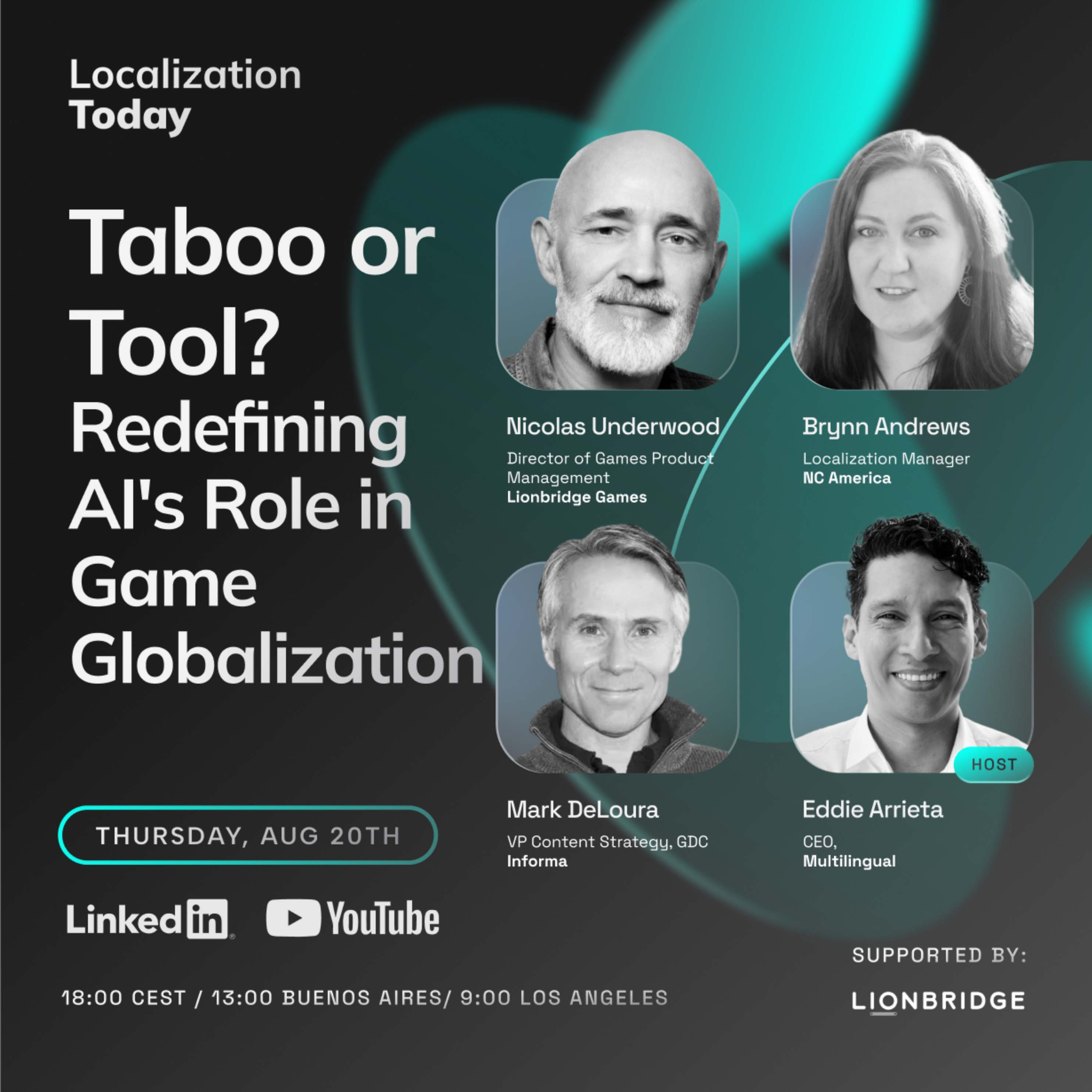
I was not game before a gaming webinar. I'm kidding. It's all jokes. I'm really terrible at aura farming, which is the new term that all the youngsters are using in this past week. But everyone, hello and welcome to Localization Today live. As you had seen and for those who have registered today, we have a great conversation taboo or two redefining AI's role in game localization. So welcome. This is presented to you by Multilingual Media and with the amazing support of Lion Bridge Games. And we are very grateful. I'm Eddie Arrieta, CEO here at Multilingual Media and before we get started, thank you everyone who is joining us live on LinkedIn, YouTube. If you're watching this later on on Spotify Apple Podcast, thank you for doing so. Please comment, please share so that others can see this amazing content. Please let us know where you are tuning in, from which part of the world you are joining this wonderful conversation on game localization.
Today we're tackling a subject that has become almost impossible to discuss in the gaming industry without generating strong opinions. The use of artificial intelligence.
Studios are under increasing pressure to release games faster, reach more markets, and launch globally and simultaneously. At the same time, developers, localization professionals and players are asking important questions about what AI means for creativity, quality, authenticity, jobs and ultimately player trust. That is what we are talking about. Please let us know if you are hearing us correctly. Whatever you are tuning in from, like I said, if our audio looks good, if our video looks good, just let us know.
And that's the tension. Like I just said, that's the tension. It really is at the heart of today's conversation. We are not here to argue that AI is either inherently good or inherently bad. Poor game localization. Instead, we want to ask a more useful where does AI actually belong in game localization?
Where can it genuinely improve workflows? Where does it fall short? What happens when you use generic AI for something as context heavy and creative as a game and where most human expertise remain firmly at the center.
We have three fantastic panelists joining us today who bring very different perspectives from across the gaming ecosystem. First, Mark DeLaura. Mark is a longtime games industry leader whose career has spun engineering, game development, education, technology, public policy and industry advocacy.
He's held leadership positions at companies like Nintendo and Sony PlayStation, Ubisoft and THQ, and spent two years in the Obama White House. Mark is a recipient of the Game Developers Choice Ambassador Award. We also have Nick Underwood, Director of Games Product Management at Lionbridge Games Nick leads a product strategy focused on technologies that improve game localization while preserving the expertise of professional linguists.
He's also been instrumental in developing Lion Bridge Samurai and an AI powered localization platform built specifically for game production workflows. Finally, last but not least, Bryn Andrews, Localization Manager at NC America. Bryn brings extensive experience across game localization, machine learning, technical strategy and process improvement, including work at NC America, Amazon and Coursera. She brings the perspective of someone dealing directly with with the practical realities of building and scaling localization workflows. Thank you all for being here today on this amazing panel.
[00:04:27] Speaker B: Nice to be here.
[00:04:29] Speaker A: Welcome, welcome and I hope you appreciate my introductory no. Or a joke with my that's what I'm sure when I show it to my children they are going to be like minus aura points, anti aura. But this gets me to Mara to our first question and let me also direct that question to our audience. We've just asked you if you're watching this to let us know where you are tuning in from. We have people from Athens, Greece, Sarajevo. Great, LA, wonderful. Thank you all. If you're watching this, please let us know where you're tuning in from. And just to start today, what is and we're going to see what the answer is and I'll start with my answer. But what is your favorite game? Let's say video game, but we could leave it a game if you want. Right now my favorite game is FC26. Now they are of course recruiting me for FC27.
Let's see if they get me before I get my discounts. My children love Minecraft. I also love Minecraft but those are my two for now.
How about you Mark?
[00:05:47] Speaker B: Yeah, I have to say Minecraft is just my constant go back to but I spent way too long earlier this year playing Blueprint and now I'm in it with Arc Raiders with my brother now and again which is super fun.
[00:06:02] Speaker A: Great. Nick, how about you, any favorite games there?
[00:06:05] Speaker C: So currently I'm totally addicted to Europa Universalis 5. Hope my boss isn't watching and knows how much time I spend doing that.
But honestly my favorite game of all time has to be Mountain Blade. Just because at the time I was probably supposed to be looking after the kids and most of the playing experience was with one of the kids on my knee and then no, they're now both avid Mountain Blade fans so.
So that's going to be my all time favorite.
[00:06:33] Speaker A: Oh wonderful. Bryn. Yes.
[00:06:35] Speaker D: Yeah, I would say I have two at the moment. One of them is Aion 2 which is our next big launch, and I feel like it's critical for me to say that. But also I'm playing it almost every day and really enjoying it.
But when I'm at home and trying to de stress, I'm usually playing Rust on a heavily modded server to avoid the Wild west piece of the unmodded servers. But that's, that's been my favorite game for quite some time.
[00:07:00] Speaker A: All right, so our wonderful audience just get the chance to share with us and we'll share later on in the conversation what your favorite games are. Who knows? Probably our great panelists have worked on those games before and we'd like to see what's going on there. And let's talk about the elephant in the room.
AI has become one of the most devices top divisive topics in gaming.
Why do you think this has generated such a strong reactions from developers, localization professionals, and of course players? And do you think some of those concerns have been misunderstood? How about we start with you, Bryn, and then we go with Nick and Mark?
[00:07:44] Speaker D: Yeah, I mean, this is a big one. I think, you know, all of the stakeholders have different reasons for feeling different ways. The developers see it as a great opportunity.
Players are concerned that, you know, it means that there will be less focus on getting them a really good product.
And of course, localization professionals are worried that their livelihoods will be impacted.
But I think something we need to keep in mind is that AI is a tool.
It's not a replacement for people. It's something to help with the mental load. It's something to help speed things up.
And I think as long as we're keeping that consideration in mind, keeping the impact on the players in mind, it can be a really valuable tool for improving our workflows.
[00:08:27] Speaker A: Thank you, Nick. Why do you think this is happening or has happened in the past few years, would say now?
[00:08:33] Speaker C: I think it's interesting from the kind of generic general player, not necessarily somebody who's linked to the industry in their mind, there's an association between something being AI and it being bad quality. And I think they may have experienced that in the past, but I think today there's more an equivalence of its bad quality, therefore it's AI, than the fact that it's AI. And I think it's bad quality.
And I think, you know, the quality has to improve that. The AI has to be able to contribute to delivering the player experience. And I think there's many ways in which it can actually improve the player experience.
And when players start to experience that as they're playing. I think there's going to be a very big difference in the way that people respond to the use of AI in games.
[00:09:26] Speaker A: Thank you, Mark. It's all yours.
[00:09:29] Speaker B: Thanks. Yeah, I think for me, I feel like the game industry is an industry made up of people who have spent long, long years perfecting their craft, whether their craft is art or animation or audio or programming. And to see technology come along that some fear could replace what it is that they do.
There's a natural fear about that, that maybe you'll lose your job, maybe you'll have smaller teams.
It feels very natural to me. It reminds me a bit of what happened when game engines first hit the scene, which has been 20 years ago now, and people said, ah, game engines, nobody's going to want to use those. It makes every game look exactly the same. Who would do.
And then I think it was Grand Theft Auto 3 came out and looked nothing like any renderware game that had come out previous to that. People were like, wait, hang on, this could be really handy. We don't have to write all of the tech. So I think we're in this phase now with AI as well. We're like, okay, we know this is useful for something. We're a little bit fearful of the ramifications on our industry and we're trying to find the right way to use it. That just feels good for us and helps make our games better.
[00:10:42] Speaker A: Yes, definitely. Many have started to use artificial intelligence. Nick, of course, you've been instrumental building Samurai for Lion Bridge. The reality is that many developers have experimented with generic AI tools. Walked away disappointed.
What are the biggest limitations from your perspective, Nick, on those approaches? Why does game localization require AI that's actually designed around game specific context rather than some general purpose language models?
[00:11:16] Speaker C: Yeah, I mean, I mean, just think of the challenge. Yeah. If you look at video games, some are set in the middle Ages, some are set in a historical period, some are set in the future.
Some, you know, the tone of any particular game might be wacky or it might be a little bit more serious.
And then on top of that we throw in a whole bunch of technical constraints with tags and gender variations and formatting, and we create a very complex set of translation challenges.
In the same way that we wouldn't bring in a general translator or we wouldn't think it's best to bring in a general translator for your new RF rpg, that process of training, that process of onboarding the translation solution, whether that's a human or whether that's an AI is a part of that.
All of that ecosystem has to be properly onboarded and understand, you know, what is this IP about? You know, what is a game, how do you play it?
What is the language style that we want?
And I think you need to do that for each of the different content types. So the language problems that you'll come up against when you're translating dialogue, okay, we want fluency, we want, maybe this is deliberately ungrammatical, this is deeply contextualized because you won't understand the last line of the scene unless you understand the first line of the scene.
That's a very different set of language challenges from translating UI where many strings are kind of largely independent and you're dealing with problems like the amount of space on the screen.
So for all of those different content types, and I'd even say for each individual target language, because the problems you come up against in an Asian language that uses honorifics and a European language with its own approach and quirks, they're going to be very different. So all of those things, what is a game about? What is a particular challenge of this content type? What are the particular challenges of this language?
I think you need to codify that and make sure that the RM is aware, just as a human translator would be aware of what a good translation for this particular, for this particular game in this particular content type should look like.
And there are different approaches to do that. I think early approaches I saw was very much about building a kind of black box.
Maybe you train a model, maybe you'd do some fine tuning, but you had this black box somewhere between the incoming content and the human translators who'd essentially become post editors. And it looks like the old machine translation workflow.
I think the level of customization that you need in video games is that you often need customization down to the point where this translator is looking at this piece of content in this target language. And we want to bring all those things with the AI together so that last minute customizations can happen while an English is still working, generating the AI output.
I think that gets you to a very interesting place.
And I think it is something that will come up against again in these conversations around what is the role of the human in a world where AI is a part of that translation process.
[00:15:03] Speaker A: And that is a question that we are all asking ourselves for not only this industry, but many, many other industries for those that are just tuning in. Remember, we're talking here about tool or taboo or taboo OR tool redefining AI's role in game localization. You have any opinions on this, please put them on the comments. If you know someone who should be joining this conversation, share it on your LinkedIn, YouTube, Instagram, whichever profile you prefer. And don't forget, let us know where you're tuning in from and what your favorite game video game is. And thank you, Nick, for your position. Bryn, of course, as Nick is mentioning, there is a lot of diversity, a lot of moving pieces, a lot of different elements, a lot of context. That's what we love about games. When you see this texture, and I know Mark appreciates the texture comment there, but this is what we have to be paying attention to. Every game has its own world, characters, terminology, player expectations. From a localization manager's perspective, which parts of game localization are best suited for for AI and which ones perhaps are not so much.
[00:16:16] Speaker D: So, yeah, I mean, as. As we're talking about how diverse things can be in games, this is going to vary by every studio's needs.
It's going to differ by game.
In my experience, my North Star tends to be immersion. So, you know, when we get feedback from players, what I see the most is that they really want to feel like the game was designed for them, not like we were, not like it's a cash grab just to publish in their language and hope that they'll pay for something.
We really want to make sure that the localized versions feel like they've had as much care put into them as the original version.
And so with that in mind, we find that AI, or I find that AI is most effective to sort of, like I think I said before, reduce the mental load of the linguists so that they can really focus on the creativity, the creative text, making sure the final version is really in the correct world. Everything feels natural.
If we get down to the nitty gritty, for example, something like skill descriptions, those are really error prone to translate. There's thousands of strings. They frequently have very minor differences between strings. And so when a human is working on those, it gets exhausting.
My translators have reported that they don't enjoy it.
And so we've found that AI is actually great for those really sort of more tedious or formulaic tasks, significantly better than neural MT used to perform.
But then when we get to things like dialogue, I see a lot more value in more of the human contribution to it because we're really creating characters. And I think there's an argument to be made that some AI could absolutely learn those characters and continue to perpetuate those characters in output. What I'm seeing in practice is, you know, humans are really still needed in that piece. The. The final creative sort of icing on the cake needs to come from people.
And so absolutely that as sort of a base to reduce the effort, reduce the time.
AI is great for most parts of video games, but I'm definitely seeing that when it comes to the more creative stuff like dialogue, like lore, those sorts of things, you really need more of a human touch in those areas and
[00:18:38] Speaker A: that icing in the cake. I really love that comment, Mark. That probably relates a lot to what games are actually successful in the world, what makes something successful or not. And someone might think the localization is simply translating dialogue, but we know better than that.
What are some of the creative technical, operational challenges that AI must understand before it can genuinely actually support game localization? I love for Nick and Bryn to give me their take on this question as well.
[00:19:10] Speaker B: Yeah, I love listening to both of your answers to those questions. It made me think a lot about my own positions.
I feel like one of the things that's amazing about games is that it's the magic that happens when you have a whole bunch of different kinds of people with different expertises coming together to create something together.
And there's always so much creative tension that comes from that. And in the best situation, what comes out the other side is better than the sum of all of those people's experiences. I think with AI entering the picture, you can accelerate a lot of processes. And we're all kind of experimenting to see what makes sense for us, what works well, what doesn't work well. But what's really vital in all of these processes is the human element. I can right now, pretty easily one shot, one of the frontier LLMs and get a game. But it doesn't feel like a game I want to play necessarily.
It takes the curatorial element of a human to make something which feels good to a human, at least in the majority of cases. I think maybe as things evolve, we'll find ways to improve all of that. But really, as a human, what I want is to learn about the experiences of other humans. So there are a lot of challenges built into all of that on the edit side, on the programming side, on the creative side.
We're all just wrestling with together now. So I appreciate the open conversation, of course.
[00:20:40] Speaker A: And Nick, you are at the center of this.
How are you solving it?
[00:20:47] Speaker C: I totally agree with the opinions here that the role of humans is essential.
And something as creative as a dialogue is a place where you will, for the foreseeable Future want a human in the loop to make the tweaks.
But one of the things that we've been experimenting with is just the idea. If you're a translator and you want to do a genuine transcreation, you want to really take this experience that is happening in the original language and make sure that that's kind of the response that the person in the target language is going to have. You're actually getting away from the idea that you're translating text.
You're trying to take elements from the context of what's happening, what the line is trying to achieve in any given scenario.
And then how would that work in the target language, given the way, for example, in dialogue, the character has been defined in this target language.
And you can do better than a generic AI translation if you actually take the LLM through that process, give it the additional material it needs to be able to abstract from what the source is and give it lots of other material in order to make its choices than just the source.
[00:22:10] Speaker A: And of course, for you, Bryn, it's a little different because you cannot romanticize either the human role or the AI role. You gotta take some decisions. So for you, this balancing act becomes very instrumental into the success of the games and ultimately the bottom line of the projects that you have, right?
[00:22:33] Speaker C: Yeah.
[00:22:33] Speaker D: I mean, ultimately, when we're assessing how to move forward with a process or how to properly localize some portion of a game or a whole game, it's really, you know, Nick kind of nailed it on the head. Those are considerations we have as well.
But at the same time, we also need to consider, you know, for. For us, it's really the end product is what matters. And so when we are looking at rolling out AI in our processes, we really just want to see how it works. So by going through it, we want to see what the end process is. If I look at it and it matches my expectations for dialogue, then it seems like it's probably an effective process. But, you know, it can be. It can be the most advanced process in the world. But if what comes out of it isn't what, you know, our players are expecting, or if it doesn't match the world we've created, then it's really not, you know, that valuable to us.
So it's really just a matter of trying things out.
And I think as AI improves, maybe we'll see better results.
But yeah, largely we're focused on the end product and what comes through the process that we've created.
[00:23:43] Speaker A: Yeah. So interesting to see what the measures of success look like and what the evolution of that continues to be over time.
Nick, you've. With Lionbridge Samurai, you've emphasized in keeping humans at the center of the workflows. Many studios rely on translation, editing and proofreading tep as the foundation of their localization quality. From both the technology and studio perspective, how can AI strengthen the process without replacing the expertise that we're talking about, the expertise that makes experience what it needs to be for the games to be successful?
[00:24:24] Speaker C: I mean. I mean, first let's look at what the humans bring. And they bring this profound IP knowledge, deep understanding of video games, excellent language tools, and an understanding of how to go from one language to the other.
And the first step of AI is to make sure that the AI itself understands what's required in that translation process. And if that's done, that's the first place where the AI and the human is collaborating, then the AI can bring efficiencies.
It can bring a level of consistency because it's always working from the same set of instructions. If consistency is what you want, of course, sometimes you don't.
It can bring a level of rigor around rules that sometimes translations translators find a little bit hard to respect.
And it can bring an additional awareness about what the content is doing.
So, for example, you can ask the LLM to try and make explicit everything that is kind of implicit within a dialogue, bring that to the translator's attention, use that as a part of the AI translation process. But now it's there for the translator to be able to see it.
And of course, we can use the AI after the translators beam through the process to find additional problems in QA steps.
So I think, yeah, it's about efficiency, it's about consistency, it's about a rigor that may not be as easy for a human to maintain, but at the end of the day, it's about the AI being responsive to the creative input of the human that's running the process.
[00:26:26] Speaker A: And definitely, like we said earlier, the volumes have changed, the speeds have changed, and we have newer problems. Mark, in your experience, there are new problems today that did not exist decades ago in the gaming world. I hope you can tell us a little bit about those. Those issues that didn't exist a few decades ago, especially around governance, around trust, the decisions that need to be made to get products online.
[00:26:54] Speaker B: Yeah, I'm laughing. I love this conversation about keeping humans in the loop. And I'm remembering vividly some early localization processes that I was in where we would put all of the text for the game in a spreadsheet, English column on column A. We would send it off to somebody and say, hey, can you convert this to French, Italian, German and Spanish? For me, E figs back when that was all we needed to convert to. And we get it back and you look at it and like, I guess these are right.
I'm sure I can trust them. I'm sure they're fine.
Without a human in the loop, we wouldn't know what was said in the German translation that was sent back to us. So regardless of the technologies and the techniques that are using the processes that you're using, you need that sanity check. You should always sanity check any result, especially localization. You need to be able to work with your vendor and trust your vendor. Understand that the LLMs, if it's an AI process, the LLMs that you're using have governance rules that you agree with. Whether that's, that the LLMs are run locally and everything is secure, whether you're working with a frontier LLM, in which case that text that you're working with may be shared with the vendor of the LLM. Like these, these AI governance rules are vital. When you're sending mission critical information from the game that you're building, you know, off to somebody, you know, this is like, you know, your blood, sweat and tears, your love that you've poured into your title and you're just like, please do okay by me. Do an awesome job.
You need to check when it comes back.
What I love though, just like broadly from this conversation, is the idea of being able to leverage AI to improve localization and to streamline and make it more cost effective. Is this idea that there, like, as the game industry grows, there are so many games being made around the world and being made by small teams, maybe a single person or a very small group of people who have a singular voice. And I want to know those stories, I want to hear those tales and I want to see them through games. And maybe they were written in Arabic, you know, like, I don't speak Arabic. How do I make it cost effective for that team to be able to then share that game with other cultures so that we learn about them. So this, this is an exciting conversation for me because I think what we're talking about makes this so much more accessible to everybody.
[00:29:17] Speaker C: Yeah.
[00:29:18] Speaker A: And I see the challenge right in front of me. You know, some of us are purists. I watch anime and then I'm like, oh, I know there is, there is dubbing for English and dubbing for Spanish, but I'm going to watch it in Japanese. Good subtitles. Because I want to feel the Japanese and you know, I probably won't feel it unless I Japanese and then some others are like, you know what, I'm just gonna just experience it in my own language. I was reading, I recently, recently about six months ago, visited Saudi Arabia for one of the language events and they gave us a book called Tales of Saudi and it's short stories translated into English from Arabic. And sure, I'm getting the stories, but, you know, I can't avoid having the feeling that you know something, that what happens when I read in Spanish, you know, someone like Garcia Marquez, something in there is.
We're losing something there. Unless the translator is someone who has that experience and context. And definitely, you know, with gaming we have a great opportunity to achieve something like that through technology because it is happening already with anime. I see it, I see the dubbing and it's amazing in Spanish and in English and I know it's generated by technology and that is incredible. Our audience, I want to take once again a chance. Someone share their favorite game. Someone from Argentina, Loose Moose, big world and Warcraft fan here. Great, thank you. We have people from Argentina, we have people from Indonesia and like we said, La, Sarajevo, Greece. If you are watching this, if you're in gaming, what role do you have in gaming?
Are you a localization manager? Do you work at a studio? Are you a translator? Are you a developer? What do you do in gaming? At the end of this conversation, we are going to have a Q and A. Please make sure that you share with us your questions, whatever questions you have, if you are directing it to someone in our amazing panel, please do so. And we are here to answer those questions.
Please hurry up because time goes by real quick. Bryn, from your perspective, of course, there are technology decisions that we said earlier, where to use humans, when to use technology.
There is also operational decisions that you have to make there. What governance, review processes, quality controls.
[00:31:47] Speaker B: Sure.
[00:31:47] Speaker A: Studios established before AI generated content becomes part of, of their localization pipeline. If you can share what you do, that'd be really great for those that are starting out.
[00:31:57] Speaker D: Yeah, I mean, I think, I think the first big piece is to understand what you're looking for.
It's sort of critical to think of, okay, what does our end product need to look like? What do we need to do to get there?
And you know, making sure that you have all, you know, a good term base to begin with. If you have a tm, make sure that that's in Good shape.
Because if AI is starting with bad inputs, it's going to have bad output.
And so making sure that you have your ducks in a row internally is probably the first piece of ensuring that it's going to go well.
But then after that you want to make sure, if you're doing AI translation, you want to make sure that you have a reviewer somewhere in that process, making sure that they are trained on the content, not just, you know, a native speaker of the language, but, you know, making sure I've found that my translators have to have played, played the game for them to do an excellent job with the post editing or with the final review or that sort of thing.
And if you're rolling out workflows that are more AI driven, so if you're rolling it out and there's more, you know, maybe you have AI translation and AI post editing, you do still want to make sure that there is a human review at some point. You want to make sure that there are at least check ins and that sort of thing throughout that process to make sure that it's not sort of going off the rails. Make sure you're still from day one when you launch to day 30 to day 60, continuing to see consistent results that you need.
But again, it's a human, you need a person to check that everything is going the way you plan for it to go.
[00:33:35] Speaker A: Thank you, Brian, for sharing your perspective. Of course, Nick.
Shipping is at the end the goal. We want to have games out there, those that don't speak specific languages. We want to experience those games. They come from, wherever they come, we want to see them. And studios increasingly are aiming to release games simultaneously across multiple markets.
Tell us a little bit about your experience with your clients. How is that working? How can AI help accelerate multilingual launches whilst they still respecting what we're talking about here, Cultural nuance, technical constraints and the unique identity of each game.
[00:34:13] Speaker C: Yeah, so look, I think everybody wants translation localization faster.
Everybody wants to reach and delight as broad an audience as possible.
And I think AI can play a supporting role there because at the same translation quality, same delivered translation quality, with all the caveats of the human role there, you can do it faster and you can do it at a lower price. So that means two things for our customers. Yeah. So one, it means they can get their content back quicker, gives them an opportunity to reduce the localization window, get their content to market faster.
And it also means that their budget goes further, which means that they can address new languages that they hadn't reached before. Because they now have an ROI on those languages given the reduced cost.
So that's the areas where we see the biggest impacts of AI in terms of what our customers can achieve.
It's also been quite useful in a couple of salvage cases where the original process hasn't gone quite right and there was a need to make a rapid remediation.
So we've had some customers reach out for us in that area too. So yeah, if it's about speed, if it's about lower costs, at the same quality, AI can play a role.
[00:35:43] Speaker A: Thank you. Mark, are you seeing speed change significantly in how simultaneous releases are happening today?
[00:35:54] Speaker B: Yeah, thanks for asking. I was sitting here mulling in my head about how we used to do localization versus what I've heard from studio execs now more recently.
I always thought of it back in the day as a post process. You're like, I'm mostly done with my game now. We're going to localize everything and we're going to put the other languages in. And what's exciting about the fact that it's now more available, lower cost and you can leverage things like LLMs is you can do it during the entire development flow of your game. So even in the early stages where maybe you're trying to get more feedback on how fun your game is or whether the story makes lands, you're halfway through development, you're a quarter of the way through development now you can use localization earlier in the stage of your game because you can get it more quickly and you can integrate it into your development flow. So you're testing as you're going along, you're testing to see whether the stories land, you're testing to see whether the gameplay works in other cultures during development. Whereas before, you know, maybe you had to wait till most of the game was baked before you actually did the localization. So speed is super vital and like increasingly changing the way that we do things. So I love to see this.
[00:37:06] Speaker A: Oh, thank you, brain. The speed for you, the speed. Has AI helped you with the speed?
[00:37:13] Speaker D: Oh yeah. Oh yeah. The whole simultaneous launch thing is definitely a trend.
I have found that it's sped things up considerably. And something that really occurs to me, especially as we're talking about how things used to be done. I mean, MTPE has been around for most of my career. I've been in localization for 15 years and I would say probably three years in, we started using it regularly.
So it's been quite some time since I really considered TEP as the base workflow. There's always been for me, some sort of MT piece in there. And what I'm seeing is AI is significantly better for gaming than Neural MT was. And I think that's, you know, that's not news necessarily to anyone, but because of that, I'm actually seeing a lot of things that were like, I wish MT did this, I wish MT could do that. And AI is really kind of doing it for us. We're able to get more sort of more natural language out of the tools and that means we spend less time, you know, cleaning it up and that means that we ship it faster and that means we ship it more places, we access more players.
So absolutely, in terms of shipping speed and shipping quality, we are seeing improvements from AI.
[00:38:35] Speaker A: That is fantastic. Of course, this is a great conversation for us. Remember, we are almost close to an end of our conversation, so if you have some questions for us for our Q and A, this is the time for you to add them.
Practical advice for studios out there from you, Mark, Nick and Bryn. If a studio is just beginning to introduce AI into its localization pipeline, what's one mistake you would encourage them to avoid and one best practice you recommend from them?
From the very beginning, Mark and then Nick and Brain.
[00:39:09] Speaker B: Yeah. I saw Seyad ask a question in the comment thread about hallucinations and keeping things consistent. And what that reminded me of is the best practices that I apply to doing coding and doing vibe coding and building apps are the same best practices you should use in localization. Like never trust a single Source.
Especially with LLMs, you may get something back that you're not expecting.
So one way that you can get around there, of course you should have a human in the loop. But another way you can do it Is use multiple LLMs and cross check them against each other, find ways to do multiple conversions, feed one into the other, have them grade each other, set up a rubric so that you have some kind of ground truth.
All those techniques help, and having them set up early in the process of your game's development will benefit you down the road, you know, Miles,
[00:40:08] Speaker A: Thank you. If we can get some of your perspective, Nick, this would be great here.
[00:40:14] Speaker C: Be prepared to put the effort in.
LLMs are great, but they're not magic.
They need to have the thing that you're asking them to do, the translation that you're asking them to do, very clearly explain to them, and any elements that you miss out, they're likely to make a mistake on. So if you're working with a provider of AI translation Services like us, we still go through a fairly rigorous process of making sure we understand from the customer exactly what it is that they want.
Because if that isn't correctly codified, the customer is not going to get what they want. And if you're doing it yourselves, I think exactly the same rules apply.
If you call a character robust versus strong, you're going to get a different translation. So words really matter.
And probably quick rule that we've always found it's better to have the fewer words but the most accurate words you can have in everything you're doing.
[00:41:20] Speaker A: Thank you, Bryn. Bryn, what can you suggest to our wonderful audience?
[00:41:25] Speaker D: Yeah, my piece of advice would be just don't just rely on publicly available information.
It can be really tempting to look at bleu scores, comet scores, that sort of thing, or look at anecdotal articles about really high performing AI in a given area.
Test it for your use case. Make sure that you're using your actual data when you are piloting a given tool or a given technology.
That's the only way to really ensure it's going to work well for you. Because something that works well for one game may not work well for another. Something that works well for one company or industry may not work well for games.
So I think it's really critical not to just rely on the publicly available information that's there to help you narrow down your options.
Certainly. But I would make sure that you're definitely testing with your actual data before committing to a workflow.
[00:42:20] Speaker A: That is really great advice. Thank you all. And I'm going to be selfish in this Q and A and have my question be the first one in the Q and A if possible. I'd like to get your perspectives. I'm thinking about the future.
For me, it's sometimes really hard to think about where do we see things going? Where are things going to go? I have my own hopes and there are some technical expectations. So perhaps you can give me if possible, what are your goals?
Hopes, perhaps expectations in relation to gaming and technology, of course, AI. But what are your expectations, hopes, objectives?
Nick, I want to put you on the spot here with this one too.
[00:43:07] Speaker C: Yeah, so I mean, apart from plugging the LLM into the, the translator's brain and having a direct communication going on there, I think we're looking at a technology that's going to evolve. I think I ask questions every day about the utility of the traditional CAT tool with the idea that efficiency comes from the leverage of the TM with AI. It doesn't come from the from the leverage of the tm. Consistency comes from leveraging the tm but not the efficiency. So.
So, you know, is there a platform of tomorrow in which, you know, the translator is going to be seamlessly interacting with the AI to generate the translation that he wants with, you know, AI agents in the background continuously checking what he's doing and then popping up with agentic advice about, you know, maybe you want to consider this. This doesn't look quite consistent with what you did over there.
And an interface that is rigorously AI based rather than the one that's essentially still built around the idea that we're going to pull content from glossaries and translation memories and then restitch that content together and that will do the job. I'm not sure it will for the future.
[00:44:29] Speaker A: Thank you. What are your hopes, Mark?
Your hopes objective.
[00:44:39] Speaker D: Who was that for? You went a little fuzzy.
[00:44:42] Speaker A: Sorry. That's my little Canela. That's my dog barking back there.
[00:44:50] Speaker B: Go ahead, Bryn.
[00:44:52] Speaker D: Actually, I would say my hopes are a little bit more outside of the localization space. So within the localization space, obviously we're always building for the future. We want to future proof our processes and build for whatever's next.
And the path of least resistance, whatever is going to give us the best quality in the most efficient way is really what we're looking for.
But in gaming in general, I would like to see a pivot toward creating games that players really, really, really want. Like, that's what I'm hoping for in this industry with a lot of creativity.
I think when we think of, well, localized games, we can think of things like Witcher, where the localization manager actually traveled to work on making sure the localized versions would be excellent.
I'd really like to see more of that both in the gaming industry and the localization industry, where we're creating really excellent products for all of the players in all of the locales. Maybe a pipe dream, but that's what I'd like to see.
[00:45:59] Speaker A: Thank you.
[00:46:03] Speaker B: I love that.
I think that we're in this long arc of work to democratize the development of games. And I think about it a lot in terms of other media forms.
150 years ago, people got access to the ability to make pictures with the device and so they didn't have to paint everything.
75 years ago you got access to video cameras and you could take movies of things. And now with our phones, you can take movies everywhere all the time.
With the advent of AI technologies, now you can do the same with games. You can quickly one Shot a game, you can make something and it may not be the most amazing piece of art.
Neither would your quickly taken picture be an amazing piece of art or your movie necessarily. But it could be exactly what you need to share with your friends to talk about your experiences.
I get really excited about where we are with AI now. But whether it's a six year old making a game to show with their friends or 500 person team spread throughout the globe making a high quality AAA title, what's so about all game development these days is that they come from an interconnected group of people who share a common vision.
And having reliable partners to work with on that is like the most fundamental thing. And so the conversation that we're having about working with a partner who can deliver high quality localized material at good cost rapidly and figuring out the right way to work with them.
I feel like we didn't have this five, 10 years ago. So I get really excited about that.
[00:47:57] Speaker A: That's wonderful. And I can already tell that's going to be a very popular snippet on our social media. We couldn't do that before. Now we can be in different parts of the world, have a webinar like this one, and then reach out to amazing audiences all over.
We have a great question coming from inspiration from you, Mark. You mentioned it earlier from Syed. He says, as AI becomes more common in game localization, what do you think is still the hardest problem to solve? Hallucinations, keeping things consistent across the game, cultural adaptation, or even evaluating whether the localization is actually good. Anyone? Any volunteers?
[00:48:44] Speaker C: Believe me, being funny is still so hard.
I mean, I'll be honest, hallucinations, I don't see it. I think if you are working in a really constrained environment, it's extremely hard to leave the the LLM with any room to hallucinate. So I really don't think that's an issue for us.
But anything that is fundamentally human, something like humor, is still hard. Now it can make a bad attempt. Something like me and my dad jokes.
But that isn't what our customers want. When they want humor, they want the players laughing.
And that still requires a human there setting up the joke, making it land.
And the AI does that badly.
[00:49:41] Speaker A: That is a really good point. I don't know if you.
Please, please, Margo. I was going to mention, I don't know if you saw this trending movie from China. The lowest quality movie looks so bad and it broke all the blockbuster records in China. Just because it was so bad people wanted to go watch it. Which puts Everything that we hold precious in line. But Mark, sorry for interrupting you.
[00:50:08] Speaker B: No, no, no.
I love that story because of course it did. Because it's about the content, it's not about the technology. Right.
That's where we're at now with games too, which makes me super excited. Some of the best games have a jankiest technology underneath them. And it's not about that, it's about the experience you're having.
Yeah, I was just noting that Bryn had disappeared. Sorry. That was why I was jumping in. But like, for me, the thing that I think about Eddie, as a, As a. Also as a student of Japanese language, I've seen a number of times where I've been trying to talk to an LLM in Japanese. And even with my mediocre ability to understand Japanese, I've seen it use words that were being used in a context that didn't quite make sense to me as to what I was saying. So there were gaps either in the LOL understanding or gap. Well, certainly gaps in my own knowledge. But there have been definitely times where I was like, okay, that is wrong.
So this is why I think with AI, everything's getting better all the time. But definitely the sanity checking back and forth between different versions can help you minimize the risk that you're seeing. And cultural adaptation is just such a challenge.
[00:51:27] Speaker D: Yeah, I apologize for disappearing. My emotion activated light went out.
I actually, I actually find this a really interesting question because my biggest concern when we started working with AI translations was hallucination, because I saw a lot of it. I had seen a lot of it previously. And the reality of working with it on a daily basis, what I find it actually struggles more with is creating something that sounds both epic and means something.
So, you know, if you're working. I'm often working with a Korean source language. Right. And the phrasing, the cultural references, all of that is very different. And what I find we get from AI, if we were to just run it through an LLM, what we get out either sounds really epic or it means something.
A lot of times it's a really epic sounding word salad and it needs a lot of, you know, in many cases we'll, we'll redo it from scratch. So I think that that's the bigger risk is just, you know, as cool as it sounds, does it actually mean anything?
That's more the challenge that we're facing when we're working with the AI output.
[00:52:36] Speaker A: Thank you. And the. The name of the movie, just for your curiosity, Niu Lai, which means the cow. Is coming.
And it's in the category of Dan Pian, which is a super bad film.
[00:52:55] Speaker C: Bad.
[00:52:55] Speaker A: In Tuami, they made over $2 million at the box office, which is. I mean, for something so low quality, that is incredible.
We have a question, and this question is for unique. From the studios you've worked with, and perhaps if anyone else wants to chip in as well. But from the studios you've worked with, where have you seen the strongest ROI from AI in localization?
Is it reduced cost, faster time to market, Improve player engagement in local markets?
[00:53:31] Speaker C: Yeah. I mean, different customers looking for different things, but the strongest driver is cost.
Customers see an opportunity to reduce their cost at the same quality and get it faster.
That's definitely something that interests a lot of customers across the globe and kind of started in the east in Asia, being some of the first customers to set those priorities and adopt AI as a part of their translation process.
But now I think there's not a studio that isn't considering at least AI in some way or another.
[00:54:19] Speaker A: All right, and we are going to do one of the questions for our LinkedIn users.
We're really close to the end of our conversation.
You all mentioned, and I'm not sure if you all mentioned efficiency being important for you. I think it's important for all human beings. We're going to be productive. We don't want to be wasting our times.
How does efficiency look like for you in practice? Is this how many words a translator turns around in one hour? A different measurement or concept? What is your idea of efficiency?
[00:54:57] Speaker D: I mean, it can be the words that are turned around in an hour. If we're going just on metrics, it would be what is our throughput and what are our turnaround times and that sort of thing. I think just focusing on that does miss the point a little bit, because just because a translator has translated a certain amount of text in a certain amount of time doesn't mean we got the result that we wanted. And so efficiency is not just the turnaround time, you know, not just cost, for example, or not just the metrics, but it's really how easily and quickly can we get the result that we need at the quality that we're expecting?
So it's sort of those metrics plus additional considerations.
[00:55:44] Speaker C: Yeah, I just thought another thing which is really hard to measure, but certainly a more than anecdotal observation, which is translators are so much more motivated working with good AI output than they ever were with machine translation that it's interesting to see when you look at the Changes translators used to make for mt. Essentially they were fixing problems. So you'd have a string, they fixed a problem, they fixed the problem and the string would go.
We see very little of that in the editing that we have from AI. Often the translator is going, I don't like this, I'm going to rewrite it.
And there's a level of engagement and a willing and a desire to make sure that the translation is not only correct but is good.
And I think that's a very hard thing to measure even in terms of quality because it's some of the more subjective elements of the quality frameworks.
But certainly in terms of delivering player experience per hour of throughput, I think that does improve the efficiency.
[00:56:57] Speaker A: Thank you, Mark. I don't know if you have any takes on efficiency and what your take is on it.
[00:57:01] Speaker B: Yeah, as a lapsed engineer, efficiency is everything.
But my take on it is more that it's. It's not about the efficiency itself, it's about what efficiency yields you in terms of the ability to iterate. And iterate is. Iteration is really the everything. You know, if I can make a thing and I can actually test it in a bunch of different languages and realize what works and what doesn't, if it was created efficiently now I can iterate and I can improve it. If it was not efficient, maybe now I'm out of time and I have to ship the thing that's not perfect. So this is why efficiency is important to me. But it does have to be quantitatively efficient and qualitatively efficient, which is as BR noticed, it's like a very delicate balance.
[00:57:44] Speaker A: It's, it's really. Thank you so much for sharing your perspectives. And of course we are in such times that we always believe that we are so cutting edge, that we are at the highest speed possible. And you know, looked at video from the.
I was like exactly how we sound like that's exactly what we look like.
All these efficiencies that we have, they look like they are so amazing and so incredible are probably not what they are going to look like in 100 years.
I'm really grateful that we have these conversations allow us to consolidate knowledge and to share with others is amazing experience. So thank you Nick, Mark Brain, for sharing your thoughts today, your expertise, your insights. Before we go, do you have any final thoughts, any proverbs, any facts that you want to share before we go?
[00:58:48] Speaker B: For me, just play more games.
[00:58:51] Speaker A: Thank you.
[00:58:53] Speaker C: It so I mean thanks for having us. Yeah. But great to see the audience and the questions it's been a great experience. Thank you.
[00:59:03] Speaker D: Yeah. Thank you.