Episode Transcript
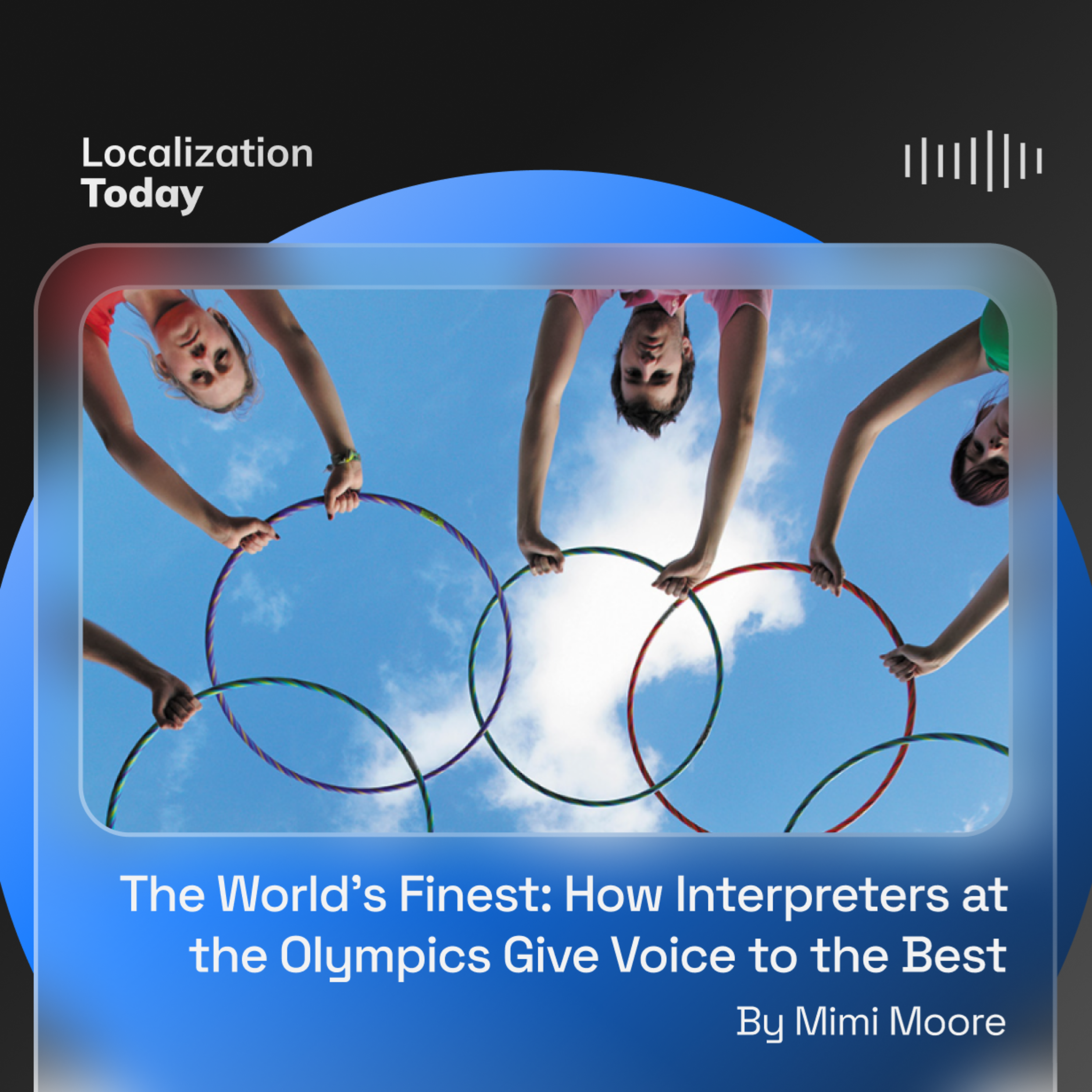
[00:00:00] The World's how interpreters at the Olympics give voice to the best I'm Mimi Moore.
[00:00:07] Every four years, the world's best athletes gather to compete at the peak of human performance.
[00:00:12] They come from over 90 nations, speaking dozens of languages, and for a few weeks they share not just venues and podiums, but press conferences, briefing rooms and media zones, where a question from a Japanese journalist for an Italian athlete needs to reach broadcasters in Seoul, Frankfurt, and so Paulo simultaneously. The Olympic Games are, among other things, one of the largest multilingual communication operations on Earth, and much of it is invisible to the people watching. This past February, every press conference at The Milano Cortina 2026 Winter Games was facilitated by a remote interpretation center in Milan staffed by linguists interpreting across eight languages in real time. Leandro Collatti, language services senior manager for the fontazione Milano Curtina 2026, managed the operational side of the RIC, while Aleksandr Ponomarev, the game's chief interpreter, led the team of interpreters. The Winter Games and Language the Winter Olympics have come a long way since their unofficial debut in 1924 in Kamenix, France, which drew 16 countries and roughly 250 athletes.
[00:01:22] Later recognized by the International Olympic Committee as the first Winter Games, Kamenex launched a tradition that has grown into one of the world's most watched sporting events. The Olympics run on language. The IOC charter actually mandates multilingualism, designating French and English as the two official languages of the Games, with the host country's language as a third official language. For Milano Cortina 2026, that meant Italian joined French and English as primary languages, with simultaneous interpretation, also in German, Russian, Korean, Japanese, and Chinese. It's a complex, coordinated language services operation that most spectators never see, but without which the Games simply could not function. From the newsroom to the Games, Leandro Cilotti Leandro Cilotti spent 14 years as a sports journalist in Argentina for Radio Provincia de e Buenos Aires. The transition from live football commentary to Olympic language management was easier than you might think. Both require the ability to process chaos and synthesize a narrative in seconds.
[00:02:27] In hindsight, it was the perfect training ground. As a journalist, I was always trying to understand things, colladi explains. To prepare an interview, you have a methodology.
[00:02:38] Now I use that same methodology for what I do every day. Journalists adapt quickly, and that's a good skill to have. He got his start at the Rio 2016 Olympic and Paralympic Games, where he worked on the International Dignitary program.
[00:02:53] He coordinated logistics for heads of state and sports ministers from across the Americas, which required cultural fluency, diplomatic sensitivity, and a lot of multitasking.
[00:03:04] Those same skills came into play as he moved to the Buenos Aires 2018 Youth Olympic Games Tokyo 2020 and the FIFA World Cup Qatar 2022. In 2024, he joined the Fontazione Milano Cortina 2026 as a venue operations manager and was promoted to language services Senior Manager in 2025. Building a language Infrastructure for the Games Language services at the Olympics operates across two distinct interlocking departments. The interpretation team, led by a chief interpreter, handles the hiring, scheduling and assignment of interpreters to cover the press conferences of potential medal winners. The Venue Operations Team, which Koladi oversees, is responsible for the infrastructure that makes interpretation possible, testing audio equipment, coordinating press conference rooms, and managing the supplier of the remote interpretation platform. For Milano Cortina 2026, supporting eight official languages in multiple venues across northern Italy required both a skilled team of interpreters and a robust technological backbone. That backbone was the RIC in Milan, staffed by 32 on site interpreters and supported by an additional 24 working fully online.
[00:04:16] Every competition venue was connected to this central hub, so interpreters no longer had to travel between venues for medal events. First introduced at the Tokyo 2020 Games, the RIC has fundamentally changed how interpretation is delivered at the Olympics. In the past, you would send seven or eight interpreters to each venue to cover all the languages of the potential medalists, collati explains. Many of the interpreters would not be needed.
[00:04:42] There was a lot of wasted time, and while they were traveling they were not available.
[00:04:46] The remote center changes that completely. 10 games, 1 vocation Alexander Ponomarev When Alexander Ponomarev arrived in 1994 at the Middlebury Institute of International Studies MIES in Monterey, California, he was already multilingual. Thanks to a childhood lived across languages and cultures. Mies gave him professional training and a community that would define his career. He has worked as a consulting and chief interpreter ever since for organizations such as the World Economic Forum in Davos, the Court of Arbitration for Sport, and FIFA. The Olympics, though, have shaped his professional identity most deeply. His first games were Beijing 2008. By Rio 2016, he had become chief interpreter, the person responsible for building and managing the interpretation team, responding to last minute requests, and facilitating press conference Q and A sessions for medalists in eight languages. Milano Cortina 2026 was his 10th Games, and he shows no signs of slowing down. The Art of Building a Team For Ponomarev, the most important work happens long before the Games begin Building the team of interpreters is the foundation on which everything else rests, and his instinct is to work with interpreters with Olympic experience.
[00:06:03] These people are usually the core team, he explains.
[00:06:06] From their experience, they know how the Olympics function and have deep knowledge of sports disciplines and terminology.
[00:06:13] Some are athletes themselves. In Paris and Rio, there was an interpreter who had previously been an Olympic competitor. They share a love of sport, and that is essential. It's important because the linguistic demands of the Olympics are inseparable from their athletic content.
[00:06:29] If an interpreter is covering a press conference with a snowboarder or a surfer, they will encounter the specialized lingo of that sport.
[00:06:36] Hanimarov says. Research and preparation are key to being able to interpret this kind of lingo quickly and accurately. Culotti describes the same dynamic Interpreters work like detectives before each assignment, learning about athletes, backgrounds, recent results, and whether two competitors are rivals or training partners.
[00:06:54] This research makes all the difference, he says, because they are not surprised by what the athlete is saying, they can keep the rhythm and work smoothly. A day that runs from 7am to 2am during the games, Potomarov's day typically begins around 7am and may not end until 2 in the morning. He moves between his office and the RIC in the booth when he is interpreting and at his desk when responding to questions, reviewing the daily assignment sheet from the press conference booking office and managing inevitable last minute requests. In Beijing, Ponnamarev managed 250 interpreters by Milano Cortina Technology, and the RIC model had whittled that team down to just 56.
[00:07:37] While the efficiency gains are substantial, coordination remains intense. Interpreters work in shifts to cover time zones. An Italian labor legislation regulated the number of hours an interpreter could work in a day.
[00:07:49] When shift limits were reached, Potomarev had a backup team standing by the relay. How eight languages flow through one A critical aspect of Olympic interpretation is the relay system. With eight official languages, direct pairing between every language combination would be logistically unworkable. Instead, English serves as the pivot language. Every interpretation flows through English. First, the system is preset for English collatti, so from any language you go to English. The other interpreters listen to the English and then interpret into their language. In a press conference, this means a French journalist asking an Italian athlete a question produces a chain French to English, then English to Italian for the athlete, then English to all other languages simultaneously. For the press briefing room, speed and accuracy in that first link are critical because any error or mistranslation in the English spreads through all the other languages instantly.
[00:08:48] The team that keeps coming back.
[00:08:50] Over the years, the interpreters who keep returning to the Games have become like a family. But friendships draw people back as much as the events themselves. The interpretation team has become really close, ponomarev says. Apart from delivering an amazing quality of service, it is really just a group of friends there to support each other and celebrate, enjoying the atmosphere. When they show up for work, their eyes are shining with excitement. They ask to be assigned to events they love. They swap nose on athletes for a group Ponomarev describes as sports fanatics. The Games offer something no other assignment can match. When you close the Games without a hitch, he says, and the Olympic Broadcasting Service tells you things are working brilliantly. But we've done our job facilitating communication between the athletes and the media. It's very fulfilling. There's no feeling like it. This article was written by Mimi Mar. She is owner of Netherlands based Wolfsenhaus, Writing, a content marketing agency for LSPs, language technology companies and B2B technology companies.
[00:09:53] She has 25 years of experience in the localization industry and is program manager, Content and Social Media for Women in Localization Originally published in Multilingual Magazine issue 254August 2026.