Episode Transcript
[00:00:00] Women's Writing by Tim Brooks I've been in the habit of saying that the Chinese minority script New Shu, the word means women's writing, is or was the only script to have been invented and used solely by women. But as usual, life is more interesting and I have been giving out false information.
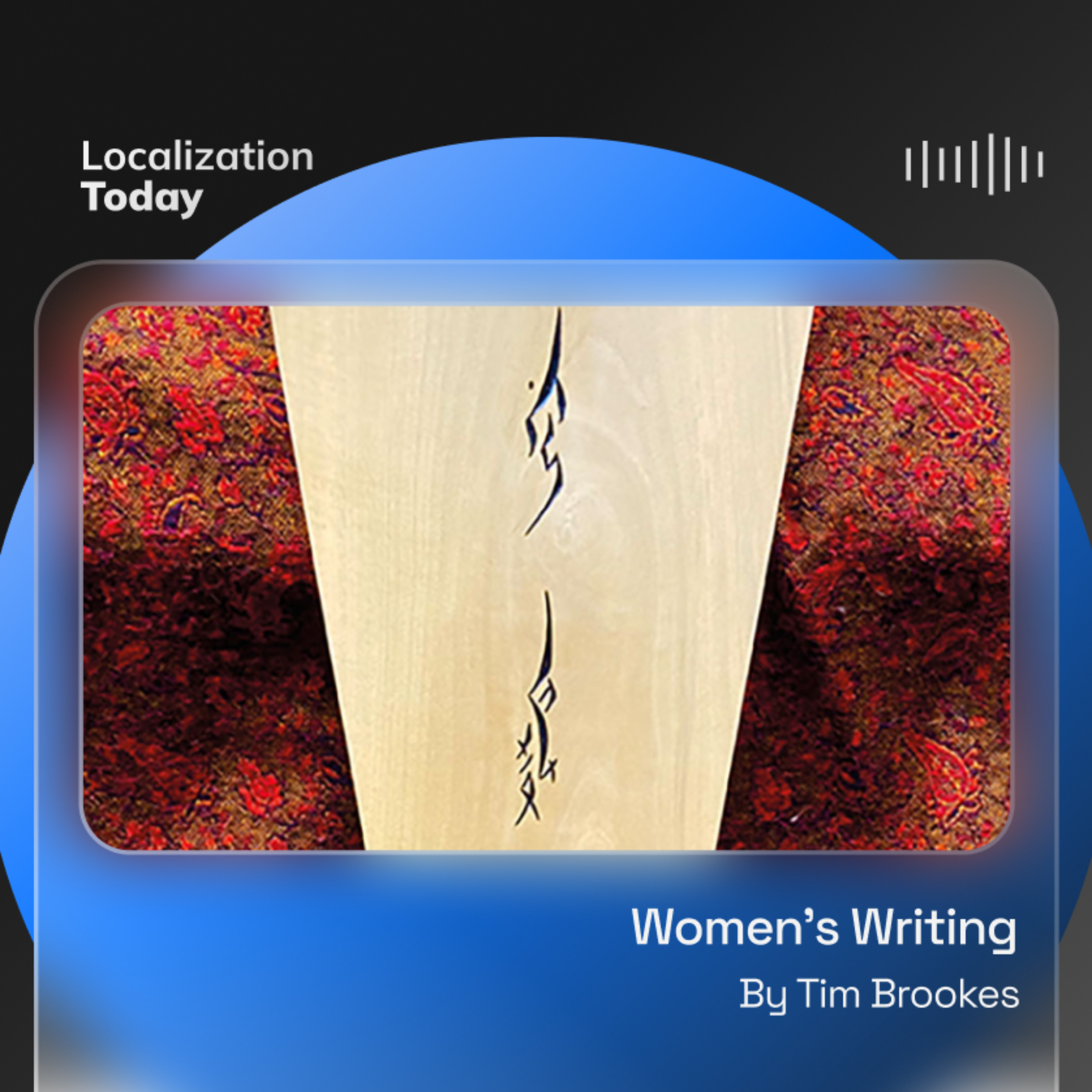
[00:00:21] There have in fact been in one sense or another, at least five women's scripts New Shu from China Reaching its peak during the latter part of the Qing Dynasty, New Shu characters adapted from standard Chinese were used exclusively among women in rural Jiangyang county in Hunan province of southern China. Unlike standard Chinese script, mushu writers valued characters written with very fine, almost thread like lines. Because the women users could not afford the standard writing brush or ink and instead used slivers of bamboo dipped in water mixed with soot, they referred to the leggy result as mosquito writing. This make do approach, combined with the repressive environment women endured and the personal, private details it expressed, underlies almost every aspect of New Shoe. One glimpse into this culture is offered by Crouging Tiger, Hidden Dragon composer Tan Dun's multimedia performance work New Shu the Secret Songs of Women.
[00:01:25] Inspired by Jong Yong's folk songs, mainly the minority Yao ethnic music and sinicized Yao women's bridal laments, he spent several years in a remote village in his native province of hunan, recorded over 200 hours of audio and video, and created a work for orchestra, recorded voices, and projected still and video images. The music is by turns dramatic, plaintive, reflective, melancholy, and grief stricken, but it is the video images of the women singing in New Shu and the circumstances of their singing that demonstrated social context, meaning, and poignancy. The songs capture a world of concealed emotion, mothers losing daughters, daughters losing mothers, sisters losing each other. It reflects a social web so torn, so desperate, it needed a secret language to bear such emotional weight. After the communist revolution of 1949, New Shu slowly fell out of use as women were granted equal access to state sponsored public education.
[00:02:30] Moreover, New Shoe was condemned as a witch's script during the Cultural Revolution, and many texts and artifacts were burned.
[00:02:38] Yang Wenyi, the last native writer and speaker of New shu, died in 2004. Scholars in both China and the west are working to revive the script, and in 2002 new Shu was added to the Chinese National Register of Documentary Heritage. A New Shoe Museum was built on Puway island, jiangyong County, in May 2007, and at least two typographers, both female, are working to create New Shoe fonts, while a few calligraphers are starting to use the script, in some cases teaching it only to female students. Hiragana from Japan Hiragana was disregarded by the educated and elites, who preferred the perceived sophistication of the kanji system imported from China.
[00:03:24] Historically in Japan, the regular script form of the characters was used by men and called otokode, men's writing, while the cursive script form of the konji was used by women barred from male educational disciplines. Court women used hiragana for personal communications and literature. From this comes the alternative name of onnaid, or women's writing.
[00:03:49] For example, the Tale of Genji and other early novels by female authors used hiragana extensively or exclusively from Korea. The Koreans had a similar belief that Chinese characters were superior, superior in this case to the Hangul script created in the 1440s. Until well into the 20th century, Korea's elite preferred to write using Chinese characters, and according to some accounts they referred to the Korean Alphabet scornfully as amkul, meaning women's script, though of course in reality both men and women used it Verbertaish or mashkit, primarily from Eastern Europe. While the three preceding scripts represent a class distinction as much as a gender one, the same cannot be said of verbertas or mashkit, a semi cursive script typeface for the Yiddish Alphabet. Here the distinction is a complex mix of gender, education, language and religious practice.
[00:04:47] Hebrew square script was used for classical texts in Hebrew and Aramaic, but thanks to gender based education, women could at best read only Yiddish.
[00:04:57] From the 16th until the 19th century. Then, Verbetaish mashkit was primarily used in texts for and by Jewish women, ranging from folktales to women's supplications and prayers to didactic works. Tedobrely from Georgia In Georgia, posted Thomas Weir, a Caucasologist, there used to be a form of script derived from Mercedruli called or didbrili zeli maternal hand used almost exclusively by women from the southwestern Georgian regions of Guria and Iraea. In this case, even though the script was truly a women's script, the motivation was cultural, religious and linguistic. Another secret script in response to conquest and suppression during the Ottoman rule, explains the website of the Keraton Akvladiani Museum of Ajara. The population of Ajara was obliged to serve in the Ottoman military service and to wear a compulsory Muslim cheddar.
[00:05:55] The chada covered the woman's face and body.
[00:05:58] A secret Georgian script named didobrili was used among old Ajuran women in this script. According to the article, the digital corpus of Kobulatian ajerien.
[00:06:12] The script was modified from Merced rule to feature angled letters, vowels, not separating words, not using punctuation marks. That sounds simple, but it suggests two important points.
[00:06:24] First, a secret script shouldn't be too difficult or far removed from familiar written forms, and second, that to Ottomans, the Mercadruli script was already unfamiliar. As for the name of the script, didobrelyli means specific to an old woman, and heli means handwriting. Thus, didobrely heli means old woman writing.
[00:06:46] Why specifically old, I wonder? This article was written by Tim Brooks. He is the founder of the Endangered Alphabets Project, which aims to create a list of the world's writing systems, identifying every script currently in use and assessing its degree of health or vulnerability.
[00:07:04] Originally published in Multilingual Magazine, Issue 253, August 2026.