Episode Transcript
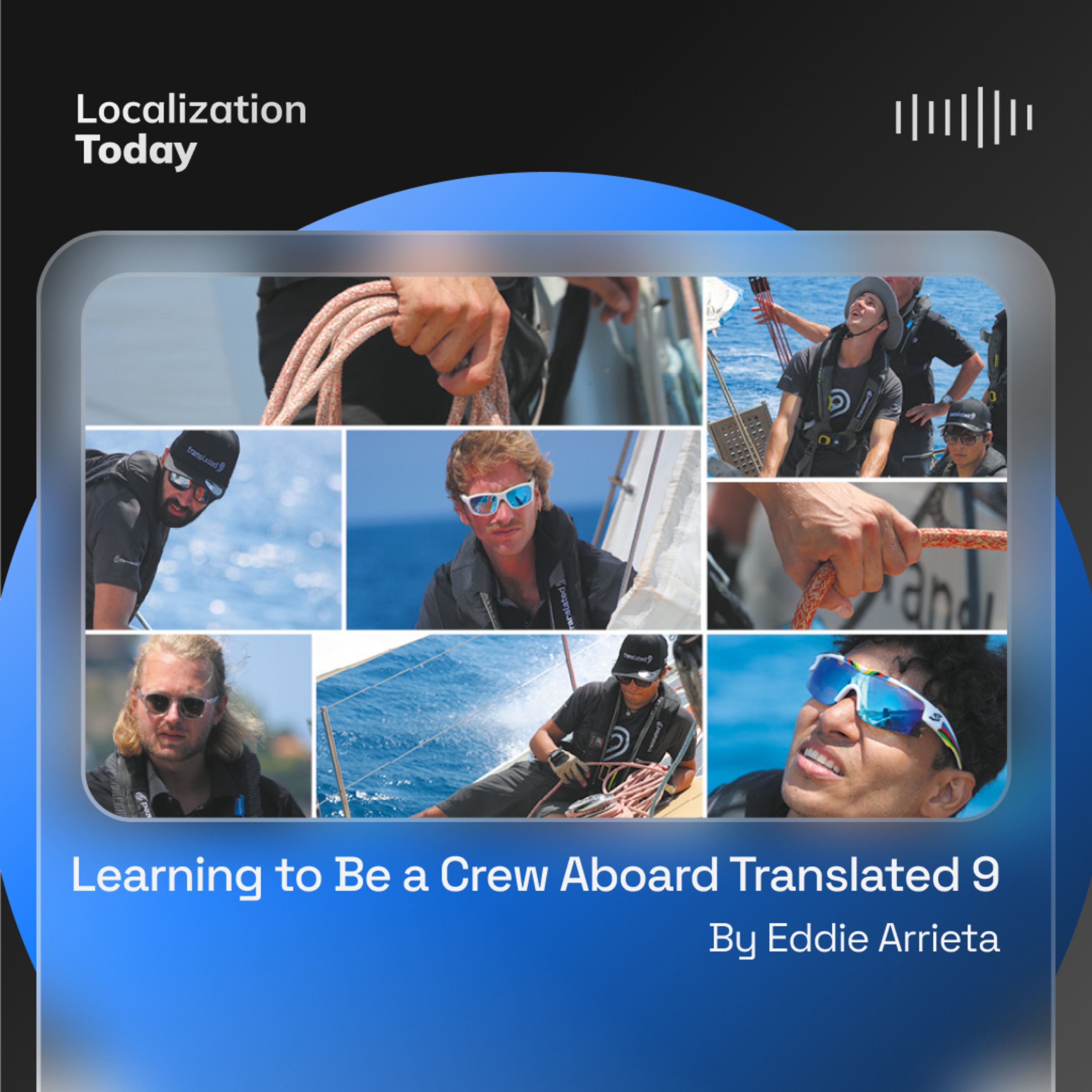
[00:00:00] Learning to be a crew aboard Translated 9 by Eddie Arrita Strumenti was one of the words I heard most often during the Ocean Globe Race. Translated nine tryouts and selection sessions in Porto Santo Stefano. The Italian word means instruments, and it was usually shouted by the person at the helm whenever somebody stood directly in front of the boat's displays, blocking information needed to steer. The command was practical, but it also became something of a running joke. Someone would drift into the wrong place, the helmsman would call Strumenti and the person would quickly move aside. There were many words like this throughout the week, words that were completely ordinary to the sailors and completely new to some of us, the applicants.
[00:00:45] They belonged to a system in which every rope, movement, position and command affected something elsewhere on the boat. Learning the vocabulary was only the beginning. The real test was learning how to respond. I have to confess that I did not know how difficult it was going to be. Welcome to the world of Sailing what is the Ocean Globe Race? For those encountering it for the first time, the Ocean Globe Race is a crude race around the world inspired by the early editions of the Whitbread Round the World Race. First held in 1973.
[00:01:19] It is deliberately different from modern ocean racing. Rather than relying on purpose built boats and constant streams of digital information, crews sail production yachts associated with an earlier era and navigate largely as sailors did half a century ago. The crews circumnavigate the globe without GPS or electronic chart plotters, using paper charts, a sextant and observations of the sun and stars to establish their position.
[00:01:45] The restrictions do not remove technology completely, particularly where safety and race communications are concerned, but they place unusual demands on the navigators and on the crew's judgment. The 2027 race follows the inaugural Ocean Globe race in 2023. Its appeal lies partly in the deliberate anachronism. Old boats restricted technology, long periods at sea, and crews whose success depends not only on speed but but on judgment, endurance, communication, trust and the ability to continue working together when the nearest help may be days away. Going back translated nine is a Swan 65, designed by Sparkman Stevens, launched in 1974 and previously named DC AccuTrack. By the time the 2027 Ocean Globe Race begins, the boat will be more than half a century old. It will compete in the Flyer class, which connects the modern race to the yachts and spirit of the early Whitbread era. Translated first entered the Ocean Globe race in 2023.
[00:02:50] The campaign drew 1,500 applications and ultimately involved 27 crew members 23 of whom had never sailed across an ocean. Translated nine completed the around the world race. The team won two legs and led two more until structural damage forced a stop in the Falkland Islands.
[00:03:09] Emergency repairs in extreme conditions, with the support of the local community, allowed the boat to return to racing. For this Translated nine received the Spirit of OGR Award. Translated says we believe in humans who take on challenges a bit bigger than they think possible.
[00:03:27] I took those words personally and applied for the 2027 selection process.
[00:03:32] The challenge was huge for me.
[00:03:34] Still, part of me said yes. Believing in people and never giving up are part of The Spirit bringing translated nine back in 2027.
[00:03:43] By August 2026, more than 700 people had applied. The intended crew would combine professional sailors with people from outside professional sailing, and selection would extend far beyond the ability to handle a rope. Applicants would be assessed on their motivation, resilience, humility, coachability, practical skills, and ability to contribute to the crew beyond individual performance.
[00:04:09] Translated describes the project through three we believe in humans, believe in yourself, never give up. In Porto Santo Stefano, those phrases were not abstract slogans. They were being tested. Saying yes. My own participation came almost out of nowhere.
[00:04:28] I had been speaking with Silvio Ghulizia, head of content at Translated, because I wanted multilingual to follow the story from the beginning rather than reporting only after the race, as we had done for the 2023 campaign.
[00:04:42] Why don't you do the tryouts? He asked. I thought, is he crazy? Maybe he is crazy. Maybe I am a little crazy. My niece says no, I told him, but my mind says yes. Three weeks later, I was traveling through Madrid and Rome on my way to Porto Santo Stefano. Patrizia Boglioni, creative director at Translated, advised me to focus on the selection and forget about work. That was almost impossible.
[00:05:10] Even while traveling, I was already noticing the elements of a story. A magical stop in Rome, the drive through Tuscany, and a town beside the sea that was nothing short of spectacular.
[00:05:22] Porto Santo Stefano had its harbor, Vespas, hotels, summer crowds, sun and stone.
[00:05:29] Then there was Translated nine. I first saw the boat from a support speedboat while the final group of the afternoon completed its session. From a distance, I began to understand the scale of the challenge. A boat weighing around 30 tons, moved by the wind and coordinated by people working its sails and lines.
[00:05:48] The boat leaned dramatically to one side and yet continued in the direction intended by the crew. Just as impressive was the crew's ability to direct people who might never have sailed a boat of this size and make their combined effort move it forward Looking at the boat from a distance was like looking at a dream. Something that was going to happen, but that I was not yet sure I would truly be part of. Six of us watched from the support boat, safe behind our cameras.
[00:06:15] The following morning, I would be aboard. I would pull the ropes, run from one position to another and feel the sun on my eyes, head and back. I felt like a dolphin on the speedboat, watching a large whale move through the ocean, as if it wanted us to see it. For some reason, I felt that the boat was calling me. I felt the sea was calling me. TRY OUT and SELECTION I did not sleep well that night.
[00:06:41] I kept going over the excitement of what was ahead and what I would need to do in the morning. I walked to the meeting point on Valla del Molo. We were welcomed aboard and given a T shirt and a hat. At first I did not understand the significance of the shirt. Soon I would feel that if I wanted to wear it, I needed to earn that right. We left our belongings in the cockpit and gathered for an initial conversation led by Captain Jonathan Hammond. He spoke about why translated was returning to the race the company's belief that people can accomplish extraordinary things. When they combine effort, trust and a common purpose, a group can become more than the sum of its parts. Then the training crew, which included Simon Kirwan, Jonathan Hammond, Baptiste Gillette, Devillers, Esgin Mistecoglou, Nicole Banfi and Fabrizio Macaroni, introduced us to what we needed to know before beginning. The first question made me go cold. Is everything clear? Baptist asked. I had to be honest. It is not clear.
[00:07:44] I do not know what you are talking about. I have no idea what sailing is. It was the right call. The instructors repeatedly told us that if we did not know how to do something, we needed to ask for help. Pretending to understand would not help the boat or the people around us. I had prepared for the tryouts by thinking about balance, stronger legs, a stronger back, the ability to stay steady on a moving boat. Within minutes, the ropes corrected me. What mattered first were my hands. Pull, pull, pull, I heard, followed by faster, faster, faster. I joined the others, hauling on the lines, trying to keep pace with people who understood the work far better than I did. My hands began to blister almost immediately.
[00:08:30] The strain was not only physical. It was the effort of moving quickly while still trying to understand what each rope did and why. Everyone had to act at once. Some applicants moved immediately.
[00:08:41] Others hesitated. Some, like me, could focus only on the task directly in front of them. It was difficult to understand that pulling one line changed something at the front of the boat, that moving aside opened a working space for somebody else, or that clearing a station was essential if the group needed to tack quickly. The sessions included raising sails, building speed, tacking and jibing. I exercise and play sports regularly, but the cardiovascular effort and strength required aboard the boat gave me a new appreciation for sailors. When it was over, the simplest thing felt extraordinary. Drinking water.
[00:09:19] The work had made the sea feel less like a tourist experience and more like a place that demanded attention, humility, and cooperation.
[00:09:28] Listening to the others stories afterward, I began to understand why people became attached to boats and to the sea. Not because it was easy, but because it asked more of them than they expected.
[00:09:39] During my own session and in other sessions, I observed from the support boat, I saw what happened when a maneuver went wrong. During a jibe, a sail would sometimes become stuck.
[00:09:50] An instructor would rush forward to free it, while many applicants froze, uncertain what to do. In other groups, people immediately move to help. When someone needs help, you all go to help, one instructor told them. This is a boat for everyone. We don't stay staring at what is happening. That instruction explained what the selection was really measuring. The responsibility for a problem did not belong only to the person standing closest to it.
[00:10:17] On this boat, a crew moved toward the problem together.
[00:10:21] Most of the 78 people who participated in the August tryouts would not advance, but the lesson would remain useful even for those who never stepped aboard. Translated nine again.
[00:10:32] When something goes wrong, do not simply watch.
[00:10:35] Find a way to help. After the boat, when our session ended, we finally had a moment to relax and eat a panino. Some of us examined our wounds. My hands had been injured by the repeated effort of working the lines, and only then did I begin to absorb what the training had demanded. Other groups still needed to complete their sessions, so we waited until the afternoon before gathering for dinner.
[00:10:59] Later, we drove to pa, a nearby translated villa where applicants from the different groups would eat, spend the night, and get to know one another.
[00:11:08] The evening was almost entirely informal. People played cards.
[00:11:12] Some played guitar or piano. Others prepared food or brought drinks.
[00:11:17] Under a clear sky, a few of us stepped outside to look at the stars. After spending the day responding to shouted instructions and working under pressure, everyone recovered. In a different way. The stars created an unplanned connection with the race. We were admiring them casually from the safety of land, the ocean, globe. Race crews would eventually use them to find their way across the world, making room. Back in Colombia, I was a hero, at least within my closest circle. I had something to be proud of. But after seeing the abilities of some participants, I really doubted I'd be selected. And I was right. My reason for coming to Porto Santo Stefano had begun with a story I wanted to follow. Spending a day aboard gave that story a physical reality.
[00:12:02] The weight of a line, the urgency of a command, the effort required to understand what someone else needed while struggling with my own task. Multilingual will continue following the people who advance through the remaining selections and preparation for the 2027 Ocean Globe Race. There will be results to report and a final crew to meet. There will also be smaller moments that explain how that crew takes shape, someone admitting they do not understand, someone noticing a problem, someone stepping forward to help. Strumenti was one of the first commands I learned. At its simplest, it asked someone to move so the person at the helm could see.
[00:12:42] Amid the noise and effort of the day, that small adjustment mattered. I did not need to understand the whole boat to begin contributing. I could listen, look around, and make room for someone else to do their job.
[00:12:55] This article was written by Eddie Oreda, originally published in Multilingual Magazine, Issue 257, November 2026.